Financial Technology Adoption and Performance of Micro, Small and Medium Enterprises (MSMEs) In Nairobi County, Kenya
DOI:
https://doi.org/10.65150/EP-jefrr/V2E9/2026-06Keywords:
Financial Technology (Fintech), MSME Performance, Mobile Payment Platforms, Digital Lending Platforms, Digital Financial Management ToolsAbstract
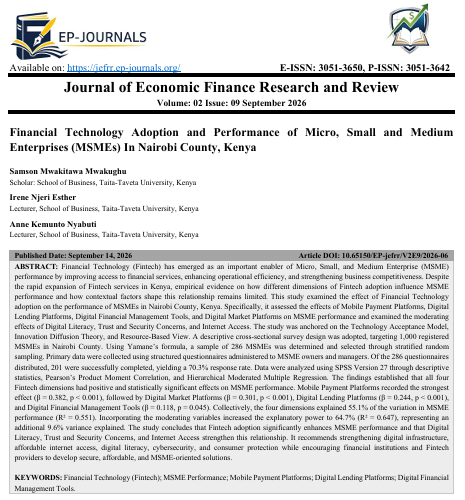
Financial Technology (Fintech) has emerged as an important enabler of Micro, Small, and Medium Enterprise (MSME) performance by improving access to financial services, enhancing operational efficiency, and strengthening business competitiveness. Despite the rapid expansion of Fintech services in Kenya, empirical evidence on how different dimensions of Fintech adoption influence MSME performance and how contextual factors shape this relationship remains limited. This study examined the effect of Financial Technology adoption on the performance of MSMEs in Nairobi County, Kenya. Specifically, it assessed the effects of Mobile Payment Platforms, Digital Lending Platforms, Digital Financial Management Tools, and Digital Market Platforms on MSME performance and examined the moderating effects of Digital Literacy, Trust and Security Concerns, and Internet Access. The study was anchored on the Technology Acceptance Model, Innovation Diffusion Theory, and Resource-Based View. A descriptive cross-sectional survey design was adopted, targeting 1,000 registered MSMEs in Nairobi County. Using Yamane’s formula, a sample of 286 MSMEs was determined and selected through stratified random sampling. Primary data were collected using structured questionnaires administered to MSME owners and managers. Of the 286 questionnaires distributed, 201 were successfully completed, yielding a 70.3% response rate. Data were analyzed using SPSS Version 27 through descriptive statistics, Pearson’s Product Moment Correlation, and Hierarchical Moderated Multiple Regression. The findings established that all four Fintech dimensions had positive and statistically significant effects on MSME performance. Mobile Payment Platforms recorded the strongest effect (β = 0.382, p < 0.001), followed by Digital Market Platforms (β = 0.301, p < 0.001), Digital Lending Platforms (β = 0.244, p < 0.001), and Digital Financial Management Tools (β = 0.118, p = 0.045). Collectively, the four dimensions explained 55.1% of the variation in MSME performance (R² = 0.551). Incorporating the moderating variables increased the explanatory power to 64.7% (R² = 0.647), representing an additional 9.6% variance explained. The study concludes that Fintech adoption significantly enhances MSME performance and that Digital Literacy, Trust and Security Concerns, and Internet Access strengthen this relationship. It recommends strengthening digital infrastructure, affordable internet access, digital literacy, cybersecurity, and consumer protection while encouraging financial institutions and Fintech providers to develop secure, affordable, and MSME-oriented solutions.
References
1. Abbasi, T., & Weigand, H. (2017). The impact of digital financial services on firm’s performance: A literature review. arXiv. https://doi.org/10.48550/arXiv.1705.10294
2. Barney, J. (1991). Firm resources and sustained competitive advantage. Journal of Management, 17(1), 99–120. https://doi.org/10.1177/014920639101700108
3. Central Bank of Kenya. (2023). Bank supervision annual report 2023. Central Bank of Kenya.
4. Chang’alwa, M. V.; Kimaku, P. M. (2022). Corporate Level Strategy and Performance of Coffee Industry in Nairobi Metropolitan, Kenya. International Journal of Social Sciences Management and Entrepreneurship 6(1), 288-299.
5. Davis, F. D. (1986). A technology acceptance model for empirically testing new end-user information systems: Theory and results [Doctoral dissertation, Massachusetts Institute of Technology].
6. Davis, F. D. (1989). Perceived usefulness, perceived ease of use, and user acceptance of information technology. MIS Quarterly, 13(3), 319–340. https://doi.org/10.2307/249008
7. Demirgüç-Kunt, A., Klapper, L., Singer, D., & Ansar, S. (2022). The Global Findex Database 2021: Financial inclusion, digital payments, and resilience in the age of COVID-19. World Bank. https://doi.org/10.1596/978-1-4648-1897-4
8. Financial Sector Deepening Kenya. (2023). How is finance supporting Kenyan businesses? Results from the 2023 FinAccess MSE Tracker Survey. FSD Kenya.
9. International Finance Corporation. (2023). MSME finance. International Finance Corporation.
10. Kenya National Bureau of Statistics. (2022). Economic survey 2022. Kenya National Bureau of Statistics.
11. Lerionka, P. M., & Kimaku, P. (2023). Strategic alignment and performance of privately owned meat processing companies in Nairobi County, Kenya. International Journal of Social Science Management and Entrepreneurship, 7, 467–477.
12. Musa, S. K., & Njeru, A. W. (2023). Effect of digital financial innovation on the financial performance of small and medium enterprises in Nairobi City Centre, Kenya. International Journal of Social Science and Humanities Research, 1(1), 466–482. https://doi.org/10.61108/ijsshr.v1i1.41
13. Mwachia, J. K., Kimaku, P., & Makungu, T. (2023). Influence of organizational agility dimensions on performance of hotel industry in Kenyan Coast Counties. Social Sciences & Humanities Open, 7, 172–187.
14. Njoroge, J. W., & Murunga, J. (2025). Digital technology adoption and the performance of micro, small and medium enterprise firms in Kenya: Implications for informal sector engagement. International Journal of Management and Economics, 7(2), 50–55.
15. Rogers, E. M. (1962). Diffusion of innovations. Free Press of Glencoe.
16. Rogers, E. M. (2003). Diffusion of innovations (5th ed.). Free Press.
17. Santoso, E. E., Normawati, R. A., & Latifah, N. (2025). Enhancing SME performance through digital finance: Do digital finance accessibility and digital financial literacy matter? Economics, Business, Accounting & Society Review, 4(2), 196–209. https://doi.org/10.55980/ebasr.v4i2.241
18. Shikumo, D. H., & Mwangi, M. (2020). Determinants of lending to small and medium enterprises by commercial banks in Kenya. arXiv. https://doi.org/10.48550/arXiv.2010.12550
19. Suri, T., & Jack, W. (2016). The long-run poverty and gender impacts of mobile money. Science, 354(6317), 1288–1292. https://doi.org/10.1126/science.aah5309
20. Terry, F. O. I., Kithandi, C. K., & Onchomba, M. (2025). Fintech adoption and credit access of micro, small, medium enterprises in Nairobi City County, Kenya. East African Finance Journal, 4(4), 79–92. https://doi.org/10.59413/eafj/v4.i4.5
21. Wernerfelt, B. (1984). A resource-based view of the firm. Strategic Management Journal, 5(2), 171–180. https://doi.org/10.1002/smj.4250050207
22. World Bank. (2022). The Global Findex Database 2021: Financial inclusion, digital payments, and resilience in the age of COVID-19. World Bank.
23. World Bank. (2023). Kenya economic update. World Bank.
Downloads
Published
Issue
Section
License
Copyright (c) 2026 Samson Mwakitawa Mwakughu, Irene Njeri Esther, Anne Kemunto Nyabuti (Author)

This work is licensed under a Creative Commons Attribution 4.0 International License.