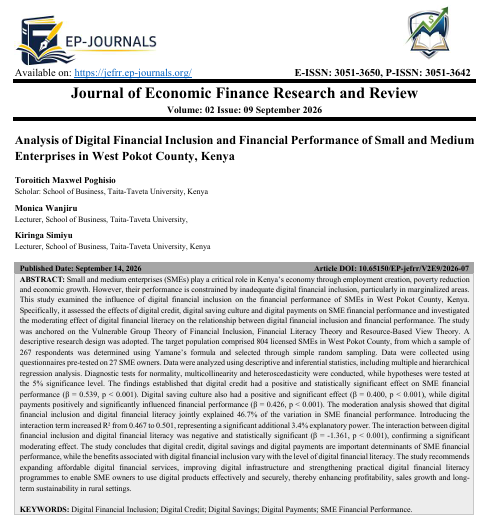
Analysis of Digital Financial Inclusion and Financial Performance of Small and Medium Enterprises in West Pokot County, Kenya
DOI:
https://doi.org/10.65150/EP-jefrr/V2E9/2026-07Keywords:
Digital Financial Inclusion, Digital Credit, Digital Savings, Digital Payments, SME Financial PerformanceAbstract
Small and medium enterprises (SMEs) play a critical role in Kenya’s economy through employment creation, poverty reduction and economic growth. However, their performance is constrained by inadequate digital financial inclusion, particularly in marginalized areas. This study examined the influence of digital financial inclusion on the financial performance of SMEs in West Pokot County, Kenya. Specifically, it assessed the effects of digital credit, digital saving culture and digital payments on SME financial performance and investigated the moderating effect of digital financial literacy on the relationship between digital financial inclusion and financial performance. The study was anchored on the Vulnerable Group Theory of Financial Inclusion, Financial Literacy Theory and Resource-Based View Theory. A descriptive research design was adopted. The target population comprised 804 licensed SMEs in West Pokot County, from which a sample of 267 respondents was determined using Yamane’s formula and selected through simple random sampling. Data were collected using questionnaires pre-tested on 27 SME owners. Data were analyzed using descriptive and inferential statistics, including multiple and hierarchical regression analysis. Diagnostic tests for normality, multicollinearity and heteroscedasticity were conducted, while hypotheses were tested at the 5% significance level. The findings established that digital credit had a positive and statistically significant effect on SME financial performance (β = 0.539, p < 0.001). Digital saving culture also had a positive and significant effect (β = 0.400, p < 0.001), while digital payments positively and significantly influenced financial performance (β = 0.426, p < 0.001). The moderation analysis showed that digital financial inclusion and digital financial literacy jointly explained 46.7% of the variation in SME financial performance. Introducing the interaction term increased R² from 0.467 to 0.501, representing a significant additional 3.4% explanatory power. The interaction between digital financial inclusion and digital financial literacy was negative and statistically significant (β = -1.361, p < 0.001), confirming a significant moderating effect. The study concludes that digital credit, digital savings and digital payments are important determinants of SME financial performance, while the benefits associated with digital financial inclusion vary with the level of digital financial literacy. The study recommends expanding affordable digital financial services, improving digital infrastructure and strengthening practical digital financial literacy programmes to enable SME owners to use digital products effectively and securely, thereby enhancing profitability, sales growth and long-term sustainability in rural settings.
References
1. Angeles, I. T. (2022). The moderating effect of digital and financial literacy on the digital financial services and financial behavior of MSMEs. Review of Economics and Finance, 20, 505–515. https://doi.org/10.55365/1923.x2022.20.57
2. Bakashaba, R., Musiita, B., & Nabachwa, S. (2024). The mediating role of access to digital finance on the relationship between financial literacy and performance of Uganda SMEs in Mbarara City. Journal of Economics and Behavioral Studies, 16(1[J]), 140–151. https://doi.org/10.22610/jebs.v16i1(J).3716
3. Barney, J. B. (1991). Firm resources and sustained competitive advantage. Journal of Management, 17(1), 99–120. https://doi.org/10.1177/014920639101700108
4. Baron, R. M., & Kenny, D. A. (1986). The moderator–mediator variable distinction in social psychological research: Conceptual, strategic, and statistical considerations. Journal of Personality and Social Psychology, 51(6), 1173–1182. https://doi.org/10.1037/0022-3514.51.6.1173
5. Chebet, A. S., & Ombaba, M. (2023). Uptake of digital loans on performance of small and micro enterprises in Uasin Gishu County, Kenya. International Journal of Social Sciences and Information Technology.
6. Chibesa, K., & Mwange, A. (2025). The role of digital financial literacy in enhancing financial inclusion among informal entrepreneurs in Zambia. East African Finance Journal, 4(1), 141–146. https://doi.org/10.59413/eafj/v4.i1.8
7. Eton, M., Mwosi, F., Amandu, I. Y., Ocan, J., & Ogwel, B. P. (2025). Exploring the effect of digital finance on financial inclusion in Uganda, a reflection from Lira City. Journal of Electronic Business & Digital Economics. https://doi.org/10.1108/JEBDE-10-2024-0037
8. Fatmawati, A., & Azis, R. F. (2024). The impact of digital payment systems on small and medium enterprise (SME) growth. Harmoni Economics: International Journal of Economics and Accounting, 1(3), 47–52.
9. Gallery, N., Newton, C., & Palm, C. (2011). Framework for assessing financial literacy and superannuation investment choice decisions. Australasian Accounting, Business and Finance Journal, 5(2), 3–22.
10. Ibosiola, J. O., & Dada, D. A. (2024). Digital financial inclusion and small and medium enterprises (SMEs) growth in Akure Metropolis, Ondo State. European Journal of Business and Innovation Research, 12(7), 60–84. https://doi.org/10.37745/ejbir.2013/vol12n76084
11. Kambi, E. N., & Onyiego, G. (2022). Effects of digital financial inclusion on financial growth of micro, small & medium enterprises in Kenya. The Strategic Journal of Business & Change Management, 9(4), 476–493. https://doi.org/10.61426/sjbcm.v9i4.2425
12. Midamba, D. C., Jjengo, A., & Ouko, K. O. (2024). Assessing the determinants of saving behaviour: Evidence from rural farming households in Central Uganda. Discover Sustainability, 5, Article 119. https://doi.org/10.1007/s43621-024-00305-3
13. Musa, S. K., & Njeru, A. W. (2023). Effect of digital financial innovation on the financial performance of small and medium enterprises in Nairobi City Centre, Kenya. International Journal of Social Science and Humanities Research, 1(1), 466–482. https://doi.org/10.61108/ijsshr.v1i1.41
14. Ozili, P. K. (2024). Vulnerable group theory of financial inclusion. Perspectives on Global Development and Technology, 22(5–6), 396–414. https://doi.org/10.1163/15691497-12341667
15. Penrose, E. T. (1959). The theory of the growth of the firm. Basil Blackwell.
16. Thalib, D. A., & Zulkarnain. (2024). Technology-organization-environment framework: The role of digital financial services implementation on MSME performance (Study at Tokyo Market Area, PIK 2). Count: Journal of Accounting, Business and Management. https://doi.org/10.61677/count.v2i1.213
17. Tulcanaza-Prieto, A. B., Cortez-Ordoñez, A., Rivera, J., & Lee, C. W. (2025). Is digital literacy a moderator variable in the relationship between financial literacy, financial inclusion, and financial well-being in the Ecuadorian context? Sustainability, 17(6), 2476. https://doi.org/10.3390/su17062476
18. Wanjiru, R. K., Kirui, D., & Kiano, E. (2024). Effect of digital banking on financial performance of micro and small enterprises in Nairobi County, Kenya. Journal of Economics, Finance and Management Studies, 7(4), 2257–2273. https://doi.org/10.47191/jefms/v7-i4-47
19. Yanti, A. D. T., & Suryani, E. (2025). The influence of digital payment on financial performance moderated by gender: An empirical study on MSMEs in Lombok Island. Journal of Economics, Finance and Management Studies, 8(3). https://doi.org/10.47191/jefms/v8-i3-03
20. Zhang, Y. (2022). The empirical research on impact of digital finance development on the performance of small and medium-sized company in manufacture industry in China. Frontiers in Business, Economics and Management, 6(3), 81–84. https://doi.org/10.54097/fbem.v6i3.3317
Downloads
Published
Issue
Section
License
Copyright (c) 2026 Toroitich Maxwel Poghisio, Monica Wanjiru, Kiringa Simiyu (Author)

This work is licensed under a Creative Commons Attribution 4.0 International License.