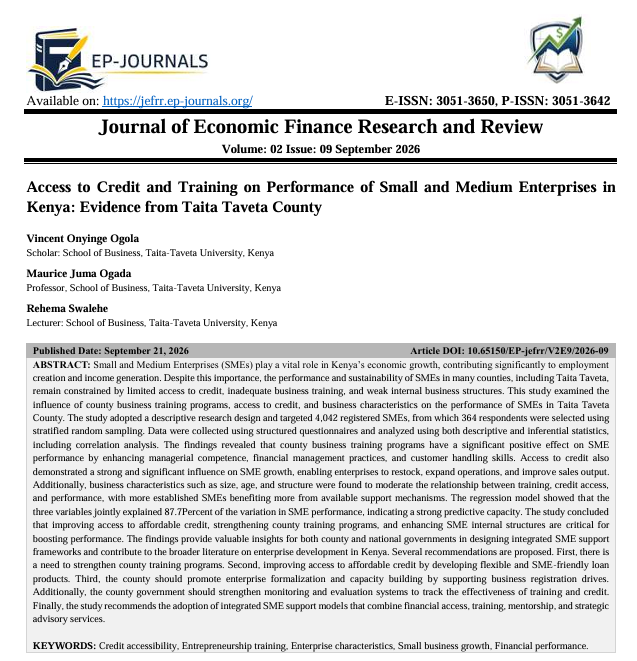
Access to Credit and Training on Performance of Small and Medium Enterprises in Kenya: Evidence from Taita Taveta County
DOI:
https://doi.org/10.65150/EP-jefrr/V2E9/2026-09Keywords:
Credit accessibility, Entrepreneurship training, Enterprise characteristics, Small business growth, Financial performanceAbstract
Small and Medium Enterprises (SMEs) play a vital role in Kenya’s economic growth, contributing significantly to employment creation and income generation. Despite this importance, the performance and sustainability of SMEs in many counties, including Taita Taveta, remain constrained by limited access to credit, inadequate business training, and weak internal business structures. This study examined the influence of county business training programs, access to credit, and business characteristics on the performance of SMEs in Taita Taveta County. The study adopted a descriptive research design and targeted 4,042 registered SMEs, from which 364 respondents were selected using stratified random sampling. Data were collected using structured questionnaires and analyzed using both descriptive and inferential statistics, including correlation analysis. The findings revealed that county business training programs have a significant positive effect on SME performance by enhancing managerial competence, financial management practices, and customer handling skills. Access to credit also demonstrated a strong and significant influence on SME growth, enabling enterprises to restock, expand operations, and improve sales output. Additionally, business characteristics such as size, age, and structure were found to moderate the relationship between training, credit access, and performance, with more established SMEs benefiting more from available support mechanisms. The regression model showed that the three variables jointly explained 87.7Percent of the variation in SME performance, indicating a strong predictive capacity. The study concluded that improving access to affordable credit, strengthening county training programs, and enhancing SME internal structures are critical for boosting performance. The findings provide valuable insights for both county and national governments in designing integrated SME support frameworks and contribute to the broader literature on enterprise development in Kenya. Several recommendations are proposed. First, there is a need to strengthen county training programs. Second, improving access to affordable credit by developing flexible and SME-friendly loan products. Third, the county should promote enterprise formalization and capacity building by supporting business registration drives. Additionally, the county government should strengthen monitoring and evaluation systems to track the effectiveness of training and credit. Finally, the study recommends the adoption of integrated SME support models that combine financial access, training, mentorship, and strategic advisory services.
References
1) Blackburn, R., Hart, M., & Wainwright, T. (2013). Small business performance: Business, strategy and owner-manager characteristics. Journal of Small Business and Enterprise Development, 20(1), 8–27. https://doi.org/10.1108/14626001311298394
2) Coase, R. H. (1937). The nature of the firm. Economica, 4(16), 386–405. https://doi.org/10.1111/j.1468-0335.1937.tb00002.x
3) Financial Sector Deepening Kenya. (2013). FinAccess business survey 2013. FSD Kenya.
4) Government of Kenya. (2005). Sessional Paper No. 2 of 2005 on development of micro and small enterprises for wealth and employment creation for poverty reduction. Government Printer.
5) Government of Kenya. (2013). Micro and Small Enterprises Act, 2012 (No. 55 of 2012). Government Printer. Kenya Law
6) Hair, J. F., Hult, G. T. M., Ringle, C. M., & Sarstedt, M. (2022). A primer on partial least squares structural equation modeling (PLS-SEM) (3rd ed.). SAGE Publications. Bibliographic record
7) Hallberg, K. (2000). A market-oriented strategy for small and medium-scale enterprises (IFC Discussion Paper No. 40). World Bank.
8) Hussein, M. (2017). Credit accessibility and growth of small and medium enterprises in Langata Constituency. International Journal of Finance, 3(2), 44–57.
9) Idris, B., Johnstone, S., & Saridakis, G. (2020). SME training and performance. International Small Business Journal, 38(4), 345–367.
10) Islam, M. A., Khan, M. A., Obaidullah, A. Z. M., & Alam, M. S. (2011). Effect of entrepreneur and firm characteristics on the business success of small and medium enterprises in Bangladesh. International Journal of Business and Management, 6(3), 289–299. https://doi.org/10.5539/ijbm.v6n3p289
11) Kauffmann, C. (2005). Financing SMEs in Africa (OECD Development Centre Policy Insights No. 7). OECD Publishing.
12) Kenya Bankers Association. (2019). MSME credit report. Kenya Bankers Association.
13) Knight, F. H. (1921). Risk, uncertainty and profit. Houghton Mifflin.
14) Lewrick, M. (2011). Entrepreneurial training and innovation. International Journal of Entrepreneurship, 15(1), 75–95.
15) Li-Jen, C., Chen-Jung, C., & Chiang, H. (2015). Experience and firm performance. Journal of Management, 41(3), 728–756.
16) Mbugua, J., & Moronge, M. (2016). County government policies and performance of small and medium enterprises in Kiambu County. International Journal of Economics and Finance, 7(4), 45–57.
17) Mothibi, J. (2015). Demographic factors and SME performance in South Africa. Journal of Enterprise Development, 3(1), 58–72.
18) Musgrave, R. A. (1959). The theory of public finance: A study in public economy. McGraw-Hill.
19) Nabintu, N. (2013). Challenges facing small and medium enterprises in Kenya. Asian Journal of Business and Management, 1(2), 20–28.
20) O’Connor, A. (2012). Entrepreneurship training and SME development. Small Business Economics, 38(3), 419–430.
21) Omolo, M. (2015). Training and development and the performance of small and medium enterprises in Kisumu County. International Journal of Business Studies, 3(2), 49–62.
22) Organisation for Economic Co-operation and Development. (2016). Financing SMEs and entrepreneurs 2016: An OECD scoreboard. OECD Publishing. https://doi.org/10.1787/fin_sme_ent-2016-en
23) Organisation for Economic Co-operation and Development. (2017). Enhancing the contributions of SMEs in a global and digitalised economy. OECD. OECD document
24) Republic of Kenya. (2007). Kenya Vision 2030: A globally competitive and prosperous Kenya. Government Printer.
25) Republic of Kenya. (2012). Kenya economic survey 2012. Kenya National Bureau of Statistics.
26) Republic of Kenya. (2016). Micro, Small and Medium Establishments (MSME) Survey: Basic report. Kenya National Bureau of Statistics.
27) Saunders, M. N. K., Lewis, P., & Thornhill, A. (2023). Research methods for business students (9th ed.). Pearson. Publisher record
28) Smith, A. (1776). An inquiry into the nature and causes of the wealth of nations. W. Strahan and T. Cadell.
29) Thuku, M. (2017). Factors affecting access to credit by small and medium enterprises: A case of Nyeri County. Kenya Journal of Business Studies, 3(1), 66–75.
30) Wernerfelt, B. (1984). A resource-based view of the firm. Strategic Management Journal, 5(2), 171–180.
https://doi.org/10.1002/smj.4250050207
31) Zannah, M., Mahat, F., Ariffin, A., & Ali, S. (2017). Influence of demographic characteristics on SME performance. International Journal of Business Studies, 8(1), 13–24.
Downloads
Published
Issue
Section
License
Copyright (c) 2026 Vincent Onyinge Ogola, Maurice Juma v, Rehema Swalehe (Author)

This work is licensed under a Creative Commons Attribution 4.0 International License.