Fair Credit Decision Assurance: An Ethical Governance Framework For AI-Based Credit Scoring in Bangladesh with Islamic Finance Duties
DOI:
https://doi.org/10.65150/EP-jefrr/V2E10/2026-02Keywords:
AI credit scoring, algorithmic fairness, explainability, financial inclusion, Islamic finance, maqasid al-Shariah, BangladeshAbstract
Purpose: Machine-learning credit scoring can extend formal credit to people with thin files, but alternative data can also turn social disadvantage into apparently neutral risk scores. This paper develops a governance framework for AI-based credit scoring in Bangladesh and adapts it to the duties of Islamic financial institutions.
Design/methodology/approach: The study is a structured integrative review combined with policy and doctrinal analysis. It synthesizes peer-reviewed research on algorithmic lending, fairness and explainability; international benchmarks (the EU AI Act, U.S. adverse action guidance, the NIST AI Risk Management Framework and the OECD AI Principles); Bangladeshi instruments on e-KYC, credit information, digital nano-loans, e-loans and data protection; and Islamic finance sources on maqasid al-Shariah, gharar and Shariah governance.
Findings: Bangladesh now permits fully digital small-value lending, yet its current instruments say little about model validation, bias testing, reason-giving or contestation. Predictive accuracy alone is an inadequate standard because a model can improve portfolio performance while concentrating false rejections on women, rural applicants or new-to-credit borrowers.
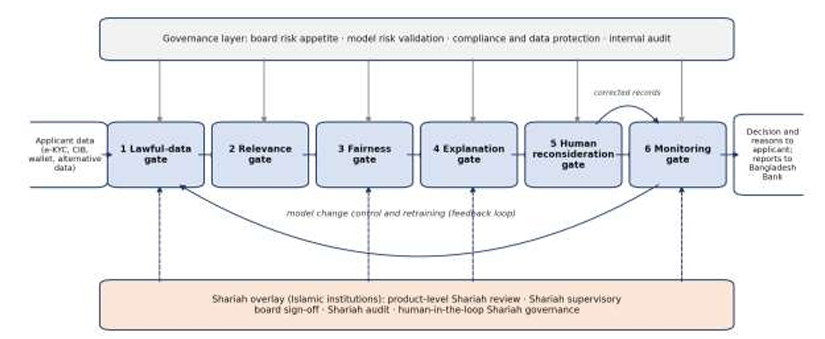
Originality/value: The paper proposes a Fair Credit Decision Assurance (FCDA) model with six gates: lawful data, feature relevance, fairness testing, explanation, human reconsideration and monitoring. A Shariah overlay adds product-level review and treats unexplained adverse decisions as a governance concern related to gharar.
Practical implications: The model gives banks, finance companies, mobile financial service providers and Bangladesh Bank a staged route to supervising algorithmic credit without halting innovation.
References
1) Accounting and Auditing Organization for Islamic Financial Institutions. (2015). Shari’ah standards for Islamic financial institutions. AAOIFI.
2) Aggarwal, N. (2021). The norms of algorithmic credit scoring. The Cambridge Law Journal, 80(1), 42–73.https://doi.org/10.1017/S0008197321000015
3) Alliance for Financial Inclusion. (2025). Alternative data for credit scoring [Special report]. AFI. https://afi-global.org/wp-content/uploads/2025/02/Alternative-Data-for-Credit-Scoring.pdf
4) Alo, J. N. (2026, July 12). From Tk500 to Tk10,000cr: The phenomenal rise of bKash & City Bank’s nano loan. The Business Standard. https://www.tbsnews.net/economy/banking/tk500-tk10000cr-phenomenal-rise-bkash-city-banks-nano-loan-1485926
5) Bangladesh Bank. (2024). Financial inclusion report Bangladesh, 2023. NFIS Administrative Unit, Bangladesh Bank. https://www.bb.org.bd/pub/annual/finreport/finreport_2023.pdf
6) Bangladesh Bank. (2026). Guidelines on electronic know-your-customer (e-KYC) (BRPD-1 Circular No. 08, 11 March 2026). Banking Regulation & Policy Department-1. https://www.bb.org.bd/mediaroom/circulars/brpd/mar112026brpd-108.pdf
7) Bangladesh Bank. (n.d.). Credit Information Bureau (CIB). Retrieved October 2, 2026, from. https://www.bb.org.bd/en/index.php/about/deptdtl/11
8) Bangladesh Financial Intelligence Unit. (2020). Guidelines on electronic know your customer (e-KYC) (BFIU Circular No. 25, 8 January 2020). Bangladesh Bank. https://www.bb.org.bd/mediaroom/circulars/aml/jan082020bfiu25.pdf
9) Bangladesh Sangbad Sangstha. (2026, May 11). BB issues comprehensive guidelines for commercial launch of “e-Loan”. BSS.https://www.bssnews.net/business/386189
10) Barocas, S., Hardt, M., & Narayanan, A. (2023). Fairness and machine learning: Limitations and opportunities. MIT Press.
11) Barocas, S., & Selbst, A. D. (2016). Big data’s disparate impact. California Law Review, 104(3), 671–732.
12) Bartlett, R., Morse, A., Stanton, R., & Wallace, N. (2022). Consumer-lending discrimination in the FinTech era. Journal of Financial Economics, 143(1), 30–56. https://doi.org/10.1016/j.jfineco.2021.05.047
13) Bazarbash, M. (2019). FinTech in financial inclusion: Machine learning applications in assessing credit risk (IMF Working Paper No. 19/109). International Monetary Fund. https://doi.org/10.5089/9781498314428.001
14) Beekun, R. I., & Badawi, J. A. (2005). Balancing ethical responsibility among multiple organizational stakeholders: The Islamic perspective. Journal of Business Ethics, 60(2), 131–145. https://doi.org/10.1007/s10551-004-8204-5
15) Berg, T., Burg, V., Gombović, A., & Puri, M. (2020). On the rise of FinTechs: Credit scoring using digital footprints. The Review of Financial Studies, 33(7), 2845–2897. https://doi.org/10.1093/rfs/hhz099
16) Billah, M. M., & Zahid, Z. (2026). Artificial intelligence in Islamic fatwa and Shariah advisory: Opportunities, limitations, and the imperative of human-in-the-loop Shariah governance. International Journal of Innovative Inventions in Social Science and Humanities, 3(1), 103–115. https://doi.org/10.58806/ijiissh.2026.v3i1n12
17) Binns, R. (2018). Fairness in machine learning: Lessons from political philosophy. Proceedings of Machine Learning Research, 81, 149–159. https://proceedings.mlr.press/v81/binns18a.html
18) Björkegren, D., & Grissen, D. (2020). Behavior revealed in mobile phone usage predicts credit repayment. The World Bank Economic Review, 34(3), 618–634. https://doi.org/10.1093/wber/lhz006
19) Bono, T., Croxson, K., & Giles, A. (2021). Algorithmic fairness in credit scoring. Oxford Review of Economic Policy, 37(3), 585–617. https://doi.org/10.1093/oxrep/grab020
20) Bücker, M., Szepannek, G., Gosiewska, A., & Biecek, P. (2022). Transparency, auditability, and explainability of machine learning models in credit scoring. Journal of the Operational Research Society, 73(1), 70–90. https://doi.org/10.1080/01605682.2021.1922098
21) Bussmann, N., Giudici, P., Marinelli, D., & Papenbrock, J. (2021). Explainable machine learning in credit risk management. Computational Economics, 57(1), 203–216. https://doi.org/10.1007/s10614-020-10042-0
22) Chouldechova, A. (2017). Fair prediction with disparate impact: A study of bias in recidivism prediction instruments. Big Data, 5(2), 153–163. https://doi.org/10.1089/big.2016.0047
23) Citron, D. K., & Pasquale, F. (2014). The scored society: Due process for automated predictions. Washington Law Review, 89(1), 1–32.
24) Consumer Financial Protection Bureau. (2022). Consumer Financial Protection Circular 2022-03: Adverse action notification requirements in connection with credit decisions based on complex algorithms. Federal Register, 87, 35864. https://www.federalregister.gov/documents/2022/06/14/2022-12729/consumer-financial-protection-circular-2022-03-adverse-action-notification-requirements-in
25) Consumer Financial Protection Bureau. (2023, September 19). CFPB issues guidance on credit denials by lenders using artificial intelligence [Consumer Financial Protection Circular 2023-03]. https://www.consumerfinance.gov/archive/newsroom/cfpb-issues-guidance-on-credit-denials-by-lenders-using-artificial-intelligence/
26) El-Gamal, M. A. (2006). Islamic finance: Law, economics, and practice. Cambridge University Press.https://doi.org/10.1017/CBO9780511753756
27) European Union. (2024). Regulation (EU) 2024/1689 of the European Parliament and of the Council of 13 June 2024 laying down harmonised rules on artificial intelligence (Artificial Intelligence Act). Official Journal of the European Union, L series. https://eur-lex.europa.eu/eli/reg/2024/1689/oj
28) Floridi, L., Cowls, J., Beltrametti, M., Chatila, R., Chazerand, P., Dignum, V., Luetge, C., Madelin, R., Pagallo, U., Rossi, F., Schafer, B., Valcke, P., & Vayena, E. (2018). AI4People—An ethical framework for a good AI society: Opportunities, risks, principles, and recommendations. Minds and Machines, 28(4), 689–707. https://doi.org/10.1007/s11023-018-9482-5
29) Fuster, A., Goldsmith-Pinkham, P., Ramadorai, T., & Walther, A. (2022). Predictably unequal? The effects of machine learning on credit markets. The Journal of Finance, 77(1), 5–47. https://doi.org/10.1111/jofi.13090
30) Gambacorta, L., Huang, Y., Qiu, H., & Wang, J. (2024). How do machine learning and non-traditional data affect credit scoring? New evidence from a Chinese fintech firm. Journal of Financial Stability, 73, Article 101284. https://doi.org/10.1016/j.jfs.2024.101284
31) Haque, Z. M. E., Zahid, Z., Alamm, M. S., Parves, M. M., Amin, M. R., & Uddin, M. M. (2026). Bridging the gap: Combating financial scams and crypto-fraud in Bangladesh through financial literacy, cybersecurity awareness, and Islamic ethical finance. COMSATS Journal of Islamic Finance, 11(1). https://lahore.comsats.edu.pk/CIF/Journal/Vol11(1)CJIF.aspx
32) Hardt, M., Price, E., & Srebro, N. (2016). Equality of opportunity in supervised learning. In Advances in Neural Information Processing Systems 29 (pp. 3315–3323). Curran Associates.
33) Hassan, M. K., Aliyu, S., Huda, M., & Rashid, M. (2019). A survey on Islamic finance and accounting standards. Borsa Istanbul Review, 19(Suppl. 1), S1–S13. https://doi.org/10.1016/j.bir.2019.07.006
34) Hurley, M., & Adebayo, J. (2016). Credit scoring in the era of big data. Yale Journal of Law and Technology, 18, 148–216.
35) Islamic Financial Services Board. (2009). Guiding principles on Shari’ah governance systems for institutions offering Islamic financial services (IFSB-10). IFSB. https://www.ifsb.org/wp-content/uploads/2023/10/IFSB-10-December-2009_En.pdf
36) Islamic Financial Services Board. (2025). Guiding principles for effective supervision of Sharīʻah governance (IFSB-31). IFSB. https://www.ifsb.org/wp-content/uploads/2025/07/IFSB-31-Guiding-Principles-for-Effective-Supervision-of-Shariah-Governance.pdf
37) Jobin, A., Ienca, M., & Vayena, E. (2019). The global landscape of AI ethics guidelines. Nature Machine Intelligence, 1(9), 389–399. https://doi.org/10.1038/s42256-019-0088-2
38) Kim, S., Lessmann, S., Andreeva, G., & Rovatsos, M. (2026). Fair models in credit: Intersectional discrimination and the amplification of inequity. Annals of Operations Research, 361(1), 465–502. https://doi.org/10.1007/s10479-026-07086-0
39) Kleinberg, J., Mullainathan, S., & Raghavan, M. (2017). Inherent trade-offs in the fair determination of risk scores. In C. H. Papadimitriou (Ed.), 8th Innovations in Theoretical Computer Science Conference (ITCS 2017) (LIPIcs Vol. 67, pp. 43:1–43:23). Schloss Dagstuhl–Leibniz-Zentrum für Informatik. https://doi.org/10.4230/LIPIcs.ITCS.2017.43
40) Kozodoi, N., Jacob, J., & Lessmann, S. (2022). Fairness in credit scoring: Assessment, implementation and profit implications. European Journal of Operational Research, 297(3), 1083–1094. https://doi.org/10.1016/j.ejor.2021.06.023
41) Kumar, I. E., Hines, K. E., & Dickerson, J. P. (2022). Equalizing credit opportunity in algorithms: Aligning algorithmic fairness research with U.S. fair lending regulation. In Proceedings of the 2022 AAAI/ACM Conference on AI, Ethics, and Society (pp. 357–368). ACM. https://doi.org/10.1145/3514094.3534154
42) Laldin, M. A., & Furqani, H. (2013). Developing Islamic finance in the framework of maqasid al-Shari’ah: Understanding the ends (maqasid) and the means (wasa’il). International Journal of Islamic and Middle Eastern Finance and Management, 6(4), 278–289. https://doi.org/10.1108/IMEFM-05-2013-0057
43) Lee, J. N., Morduch, J., Ravindran, S., Shonchoy, A., & Zaman, H. (2021). Poverty and migration in the digital age: Experimental evidence on mobile banking in Bangladesh. American Economic Journal: Applied Economics, 13(1), 38–71. https://doi.org/10.1257/app.20190067
44) Lessmann, S., Baesens, B., Seow, H.-V., & Thomas, L. C. (2015). Benchmarking state-of-the-art classification algorithms for credit scoring: An update of research. European Journal of Operational Research, 247(1), 124–136. https://doi.org/10.1016/j.ejor.2015.05.030
45) Lundberg, S. M., & Lee, S.-I. (2017). A unified approach to interpreting model predictions. In Advances in Neural Information Processing Systems 30. Curran Associates. https://proceedings.neurips.cc/paper/2017/hash/8a20a8621978632d76c43dfd28b67767-Abstract.html
46) Mittelstadt, B. D., Allo, P., Taddeo, M., Wachter, S., & Floridi, L. (2016). The ethics of algorithms: Mapping the debate. Big Data & Society, 3(2). https://doi.org/10.1177/2053951716679679
47) National Institute of Standards and Technology. (2023). Artificial intelligence risk management framework (AI RMF 1.0) (NIST AI 100-1). U.S. Department of Commerce. https://doi.org/10.6028/NIST.AI.100-1
48) OECD. (2024). Recommendation of the Council on Artificial Intelligence (OECD/LEGAL/0449; adopted 2019, amended 2023 and 2024). OECD Legal Instruments. https://legalinstruments.oecd.org/en/instruments/OECD-LEGAL-0449
49) Óskarsdóttir, M., Bravo, C., Sarraute, C., Vanthienen, J., & Baesens, B. (2019). The value of big data for credit scoring: Enhancing financial inclusion using mobile phone data and social network analytics. Applied Soft Computing, 74, 26–39. https://doi.org/10.1016/j.asoc.2018.10.004
50) Parasuraman, R., & Manzey, D. H. (2010). Complacency and bias in human use of automation: An attentional integration. Human Factors, 52(3), 381–410. https://doi.org/10.1177/0018720810376055
51) Raquib, A., Channa, B., Zubair, T., & Qadir, J. (2022). Islamic virtue-based ethics for artificial intelligence. Discover Artificial Intelligence, 2, Article 11. https://doi.org/10.1007/s44163-022-00028-2
52) Rudin, C. (2019). Stop explaining black box machine learning models for high stakes decisions and use interpretable models instead. Nature Machine Intelligence, 1(5), 206–215. https://doi.org/10.1038/s42256-019-0048-x
53) Sen, A. (1999). Development as freedom. Oxford University Press.
54) The Business Standard. (2025, November 9). Govt issues gazettes of 2 landmark ordinances on data protection, governance. The Business Standard. https://www.tbsnews.net/bangladesh/govt-issues-gazettes-2-landmark-ordinances-data-protection-governance-1281356
55) The Daily Star. (2022, June 3). BB lines up Tk 100cr for digital nano loans. The Daily Star.
56) The Daily Star. (2025, September 10). Digital nano loan refinancing scheme extended until June 2028: Bangladesh Bank. The Daily Star. https://www.thedailystar.net/business/news/digital-nano-loan-refinancing-scheme-extended-until-june-2028-bangladesh-bank-3982771
57) The Daily Star. (2026a, January 26). Draft AI policy targets innovation, better public services. The Daily Star.
58) The Daily Star. (2026b, May 12). Banks cleared to launch “e-loan” up to Tk 50,000. The Daily Star.
https://www.thedailystar.net/business/economy/news/banks-cleared-launch-e-loan-tk-50000-4173471
59) Wachter, S., Mittelstadt, B., & Russell, C. (2018). Counterfactual explanations without opening the black box: Automated decisions and the GDPR. Harvard Journal of Law & Technology, 31(2), 841–887.
60) World Bank. (2025a). The Global Findex Database 2025: Connectivity and financial inclusion in the digital economy. World Bank. https://www.worldbank.org/en/publication/globalfindex
61) World Bank. (2025b). Account ownership at a financial institution or with a mobile-money-service provider (% of population ages 15+):
Bangladesh (Indicator FX.OWN.TOTL.ZS) [Data set]. World Development Indicators / Global Findex. https://data.worldbank.org/indicator/FX.OWN.TOTL.ZS?locations=BD
62) Zahid, Z., Hossain, M. E., & Mohammed, B. A. K. (2025). Leveraging green AI for sustainable resource management in Islamic finance: Bridging the gap between ethical finance and environmental sustainability. International Journal on Cybernetics & Informatics, 14(5), 83–98. https://doi.org/10.5121/ijci.2025.140507
63) Zahid, Z., Amin, M. R., Alamm, M. S., Meer, W., Shah, M. N., Khalil, I., Sumaiya, U., & Arafat, E. (2025). Enhancing customer retention in Islamic fintech: A comprehensive approach to service recovery, feedback systems, and Shariah-compliant communication strategies. International Journal of Multidisciplinary and Innovative Research, 2(7), 210–222. https://doi.org/10.58806/ijmir.2025.v2i7n02
Downloads
Published
Issue
Section
License
Copyright (c) 2026 Sumaia Yasmin Keya , Niger Sultana, Md. Baharul Hasan, Md. Shahed Alamm, Md. Aminul Islam, Ummey Sumaiya (Author)

This work is licensed under a Creative Commons Attribution 4.0 International License.