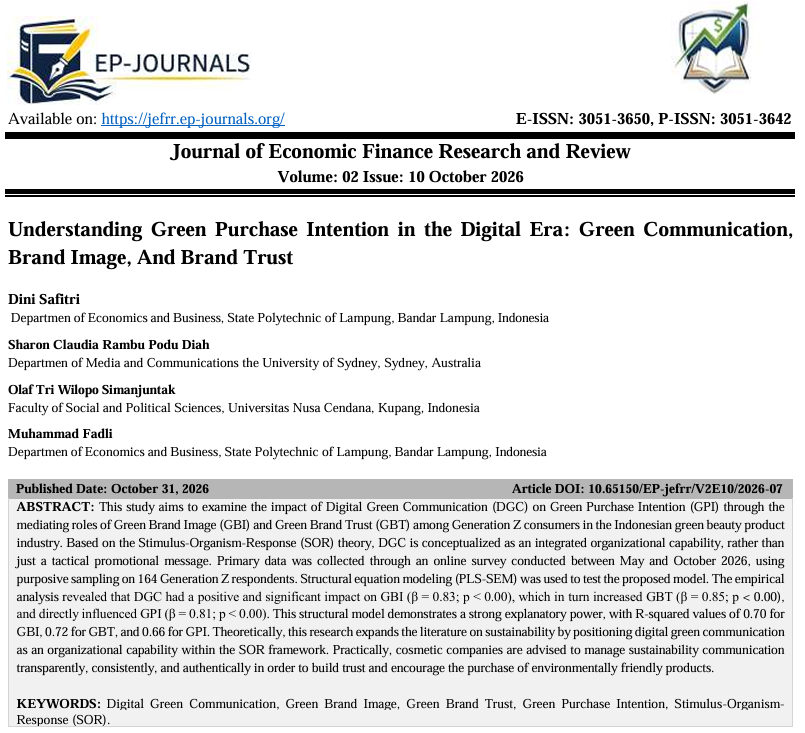
Understanding Green Purchase Intention in the Digital Era: Green Communication, Brand Image, And Brand Trust
DOI:
https://doi.org/10.65150/EP-jefrr/V2E10/2026-07Keywords:
Digital Green Communication, Green Brand Image, Green Brand Trust, Green Purchase Intention, Stimulus-Organism-Response (SOR).Abstract
This study aims to examine the impact of Digital Green Communication (DGC) on Green Purchase Intention (GPI) through the mediating roles of Green Brand Image (GBI) and Green Brand Trust (GBT) among Generation Z consumers in the Indonesian green beauty product industry. Based on the Stimulus-Organism-Response (SOR) theory, DGC is conceptualized as an integrated organizational capability, rather than just a tactical promotional message. Primary data was collected through an online survey conducted between May and October 2026, using purposive sampling on 164 Generation Z respondents. Structural equation modeling (PLS-SEM) was used to test the proposed model. The empirical analysis revealed that DGC had a positive and significant impact on GBI (β = 0.83; p < 0.00), which in turn increased GBT (β = 0.85; p < 0.00), and directly influenced GPI (β = 0.81; p < 0.00). This structural model demonstrates a strong explanatory power, with R-squared values of 0.70 for GBI, 0.72 for GBT, and 0.66 for GPI. Theoretically, this research expands the literature on sustainability by positioning digital green communication as an organizational capability within the SOR framework. Practically, cosmetic companies are advised to manage sustainability communication transparently, consistently, and authentically in order to build trust and encourage the purchase of environmentally friendly products.
References
1) Al-Husain, R. A., Jasim, T. A., Mathew, V., Al-Romeedy, B. S., Khairy, H. A., Mahmoud, H. A., & Alsetoohy, B. (2025). Optimizing sustainability performance through digital dynamic capabilities, green knowledge management, and green technology innovation. Scientific Reports, 15(1), 24217.
2) Alam, M. Z., Silawi, A., Haque, M. I., & Fatima, Z. (2024). Impact of green marketing on brand image and eco-friendly environment of travel & tourism sector,. Migr. Lett, 21, 755–770.
3) Bańbuła, J. (2024). Effects of brand awareness, brand association, perceived quality, and brand loyalty on overall brand equity in sport. A case study of an amateur football sports club,. Phys. Cult. Sport. Stud. Res., 104(1), 36–47.
4) Bashir, S., Khwaja, M. G., Rashid, Y., Turi, J. A., & Waheed, T. (2020). Green brand benefits and brand outcomes: The mediating role of green brand image,. Sage Open, 10(3), 2158244020953156.
5) Bigne, E., Chatzipanagiotou, K., & Ruiz, C. (2020). Pictorial content, sequence of conflicting online reviews and consumer decision-making: The stimulus-organism-response model revisited,. J. Bus. Res., 115, 403–416.
6) Crapa, G., Latino, M. E., & Roma, P. (2024). The performance of green communication across social media: Evidence from large-scale retail industry in Italy,. Corp. Soc. Responsib. Environ. Manag., 31(1), Roma.
7) Dash, G., & Paul, J. (2021). CB-SEM vs PLS-SEM methods for research in social sciences and technology forecasting,. Technol. Forecast. Soc. Change, 173, 121092.
8) DelVecchio, D., Jones, W. J., & Baugh, L. (2024). From easy to known: How fluent brand processing fosters self-brand connection,. Psychol. Mark., 41(4), 754–773.
9) Esmaelnezhad, D., Lagzi, M. D., Antucheviciene, J., Hashemi, S. S., & Khorshidi, S. (2023). Evaluation of green marketing strategies by considering sustainability criteria,. Sustainability, 15(10), 7874.
10) Garg, M., & Bakshi, A. (2024). Exploring the impact of beauty vloggers’ credible attributes, parasocial interaction, and trust on consumer purchase intention in influencer marketing,. Humanit. Soc. Sci. Commun., 11(1), 235.
11) Giacomini, D., Zola, P., Paredi, D., & Mazzoleni, M. (2020). Environmental disclosure and stakeholder engagement via social media: State of the art and potential in public utilities,. Corp. Soc. Responsib. Environ. Manag., 27(4), Zola.
12) Godrati, S., & Bashirkhodaparasti, R. (2024). Investigating the effect of environmental values on green product purchase intention with the mediating role of environmental concerns and the moderating role of green trust (case study: Green food consumers in Tabriz),. Journals Environ. Educ. Sustain. Dev., 12(3), 157–173.
13) Ha, M. T. (2022). Greenwash and green brand equity: The mediating role of green brand image, green satisfaction, and green trust, and the moderating role of green concern,. PLoS One, 17(11), e0277421.
14) Hair Jr, J. F., Hult, G. T. M., Ringle, C. M., Sarstedt, M., Danks, N. P., & Ray, S. (2021). Partial least squares structural equation modeling (PLS-SEM) using R: A workbook. Springer Nature.
15) Henseler, J., Ringle, C. M., & Sarstedt, M. (2016). Testing measurement invariance of composites using partial least squares,. Int. Mark. Rev., 33(3), 405–431.
16) Huang, S., Qu, H., & Wang, X. (2024). Impact of green marketing on peer-to-peer accommodation platform users’ repurchase intention and positive word-of-mouth: mediation of trust and consumer identification,. Int. J. Contemp. Hosp. Manag., 36(3), 691–712.
17) Huang, Y., & Mohamad, S. H. (2026). Unveiling how nano live streamers boost consumer purchase intention: The mediating role of trust in nano live streamer using PLS-SEM,. Acta Psychol. (Amst)., 263, 106345.
18) Huo, C., Hameed, J., Zhang, M., Ali, A. F. B. M., & Hashim, N. A. A. N. (2022). Modeling the impact of corporate social responsibility on sustainable purchase intentions: insights into brand trust and brand loyalty,. Econ. Res. Istraživanja, 35(1), 4710–4739.
19) Jabeen, R., Khan, K. U., Zain, F., & Atlas, F. (2023). Buy green only: Interplay between green marketing, corporate social responsibility and green purchase intention; the mediating role of green brand image,. Bus. Strateg. Dev., 6(3), 503–518.
20) Jha, A. K., & Verma, N. K. (2023). Social media sustainability communication: An analysis of firm behaviour and stakeholder responses,. Inf. Syst. Front., 25(2), 723–742.
21) Kumar, A., Mallick, S. S., Hota, S. L., Vasudevan, A., & Şimşek, S. A. (2024). Green marketing strategies: Enhancing brand image and consumer trust in sustainable development,. Prabandhan Indian J. Manag., 8–27.
22) Lee, M., & Lee, H. H. (2022). Do parasocial interactions and vicarious experiences in the beauty YouTube channels promote consumer purchase intention?,. Int. J. Consum. Stud., 46(1), 235–248.
23) Lee, Y. K. (2020). The relationship between green country image, green trust, and purchase intention of Korean products: Focusing on Vietnamese Gen Z consumers,. Sustainability, 12(12), 5098.
24) Lim, W. M., Koay, K. Y., & Cheah, C. W. (2025). Commercialization of influencer content on social media: the roles of parasocial relationships and sponsorship disclosures,. J. Strateg. Mark., 33(5), 658–684.
25) Lin, J., & Zhou, Z. (2022). The positioning of green brands in enhancing their image: the mediating roles of green brand innovativeness and green perceived value,. Int. J. Emerg. Mark., 17(6), 1404–1424.
26) Mogaji, E., Adeola, O., Adisa, I., Hinson, R. E., Mukonza, C., & Kirgiz, A. (2022). Green marketing in emerging economies: communication and brand perspective: an introduction, (pp. 1–16.).
27) Nekmahmud, M., Naz, F., Ramkissoon, H., & Fekete-Farkas, M. (2022). Transforming consumers’ intention to purchase green products: Role of social media,. Technol. Forecast. Soc. Change, 185, 122067.
28) Nguyen-Viet, B., & Nguyen, A. T. L. (2024). Vietnamese consumer’s perspective on green beauty care products: Exploring the impact of animal welfare concerns and skepticism toward green advertising,. Acta Psychol. (Amst)., 244, 104210.
29) Novita, I. K. (2025). Green Cosmetics: Sejauh Mana Tren Sustainable Beauty Mempengaruhi Niat Pembelian Generasi Muda?,. J. Nusant. Apl. Manaj. Bisnis, 10(2).
30) Oncioiu, I., Priescu, I., Banu, G. S., & Chirca, N. (2023). Green consumers’ responses to integrated digital communication in the context of multichannel retail,. Sustainability, 15(2), 1419.
31) Pooja, K., & Upadhyaya, P. (2025). Does negative online review matter? An investigation of travel consumers,. Int. J. Consum. Stud., 49(2), Upadhyaya.
32) Qayyum, A., Jamil, R. A., & Sehar, A. (2023). Impact of green marketing, greenwashing and green confusion on green brand equity,. Spanish J. Mark., 27(3), 286–305.
33) Rahman, S. U., & Nguyen-Viet, B. (2023). Towards sustainable development: Coupling green marketing strategies and consumer perceptions in addressing greenwashing,. Bus. Strateg. Environ., 32(4), 2420–2433.
34) Research, K. (2026). Global Beauty Market.
35) Riva, F., Magrizos, S., Rizomyliotis, I., & Uddin, M. R. (2024). Beyond the hype: Deciphering brand trust amid sustainability skepticism,. Bus. Strateg. Environ., 33(7), 6491–6506.
36) Ru-Zhue, J., Nui-Suk, C., & Aujirapongpan, S. (2026). Digital Green Communication, Green Innovation, and Customer Behavior in Green Hotels: A Multi-Group Analysis Across Generational Cohorts in Thailand,. J. Open Innov. Technol. Mark. Complex., 100801.
37) Sarmiento-Guede, J. R., Antonovica, A., & Antolín-Prieto, R. (2021). The green image in the spanish hotel sector: Analysis of its consequences from a relational perspective,. Sustainability, 13(9), 4734.
38) Senalasari, W., Maulidani, R. N., & Setiawati, L. (2025). From reviews to purchase intention: The interplay of customer review, influencer review, and trust in Indonesian skincare products,. J. Mark. Innov., 5(1).
39) Sio, S. de, Zamagni, A., Casu, G., & Gremigni, P. (2022). Green trust as a mediator in the relationship between green advertising skepticism, environmental knowledge, and intention to buy green food,. Int. J. Environ. Res. Public Health, 19(24), Gremigni.
40) Suhan, M., Nayak, S., Nayak, R., Spulbar, C., Vidya Bai, G., Birau, R., & Stanciu, C. V. (2022). Exploring the sustainable effect of mediational role of brand commitment and brand trust on brand loyalty: An empirical study. Economic Research-Ekonomska Istraživanja, 35(1), 6422–6444.
41) Tan, L. L., Muthusamy, C., Yuet, C. P. H., & Chellandy, V. (2026). Effective green advertising communication: the role of message credibility on purchase intention,. Glob. Knowledge, Mem. Commun., 1–18.
42) Tewari, N., Goel, S., Haldar, P., Mathur, V. P., & Srivastav, S. (2022). An effective method to summarise the outcomes of questionnaire-based studies in systematic reviews,. Acta Odontol. Scand., 80(8), Haldar.
43) Vanessa, J., & Ariestya, A. (2024). Green advertising effectiveness: Brand image and green trust among generation Y and Z,. J. Komun. Indones., 13(2), 222–241.
44) Wibowo, A., Prihartanti, W., Wibowo, A. E., & Hardiono, H. (2022). The Effect of Green Trust, Green Marketing and Green Perceived Quality on Green Purchase Intention,. Enrich. J. Manag., 12(5), 3945–3956.
45) Wu, M., & Long, R. (2024). How does green communication promote the green consumption intention of social media users?,. Environ. Impact Assess. Rev., 106, 107481.
46) Yu, W., Han, X., Ding, L., & He, M. (2021). Organic food corporate image and customer co-developing behavior: The mediating role of consumer trust and purchase intention,. J. Retail. Consum. Serv., 59, 102377.
47) Zhao, J., Zhou, H., Zhou, M., Zheng, C., Zhou, L., & Yang, F. (2026). From greenwashing to green trust: Understanding the consumer behavior in the fashion industry,. Acta Psychol. (Amst)., 267, 106850.
48) Zickar, M. J., & Keith, M. G. (2023). Innovations in sampling: Improving the appropriateness and quality of samples in organizational research,. Annu. Rev. Organ. Psychol. Organ. Behav., 10(1), 315–337.
Downloads
Published
Issue
Section
License
Copyright (c) 2026 Dini Safitri, Sharon Claudia Rambu Podu Diah, Olaf Tri Wilopo Simanjuntak, Muhammad Fadli (Author)

This work is licensed under a Creative Commons Attribution 4.0 International License.