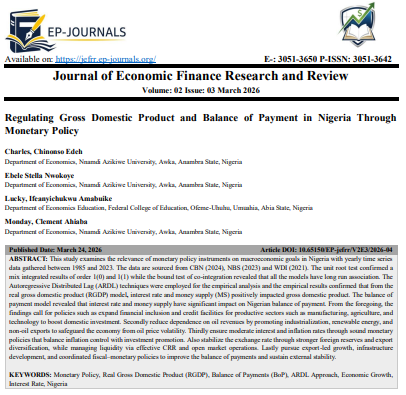
Regulating Gross Domestic Product and Balance of Payment in Nigeria Through Monetary Policy
DOI:
https://doi.org/10.65150/EP-jefrr/V2E3/2026-04Keywords:
Monetary Policy, Real Gross Domestic Product (RGDP), Balance of Payments (BoP), ARDL Approach, Economic Growth, Interest Rate, NigeriaAbstract
This study examines the relevance of monetary policy instruments on macroeconomic goals in Nigeria with yearly time series data gathered between 1985 and 2023. The data are sourced from CBN (2024), NBS (2023) and WDI (2021). The unit root test confirmed a mix integrated results of order 1(0) and 1(1) while the bound test of co-integration revealed that all the models have long run association. The Autoregressive Distributed Lag (ARDL) techniques were employed for the empirical analysis and the empirical results confirmed that from the real gross domestic product (RGDP) model, interest rate and money supply (MS) positively impacted gross domestic product. The balance of payment model revealed that interest rate and money supply have significant impact on Nigerian balance of payment. From the foregoing, the findings call for policies such as expand financial inclusion and credit facilities for productive sectors such as manufacturing, agriculture, and technology to boost domestic investment. Secondly reduce dependence on oil revenues by promoting industrialization, renewable energy, and non-oil exports to safeguard the economy from oil price volatility. Thirdly ensure moderate interest and inflation rates through sound monetary policies that balance inflation control with investment promotion. Also stabilize the exchange rate through stronger foreign reserves and export diversification, while managing liquidity via effective CRR and open market operations. Lastly pursue export-led growth, infrastructure development, and coordinated fiscal–monetary policies to improve the balance of payments and sustain external stability.
References
1) Abbas, S. A., & Raza, A. (2022). Monetary policy and economic growth: Evidence from Pakistan. Pakistan Journal of Commerce and Social Sciences, 16(3), 774-788. Journal of Finance and Accounting, 2(3), 71–81.
2) Adenikinju, A. F. (2020). Energy, unemployment, and economic development in Nigeria.Journal of African Economies, 29(3), 325–348.
3) Adetiloye, K. A., & Afolabi, A. (2022).Monetary policy and inflation dynamics in Nigeria: An ARDL approach. African Journal of Economic and Management Studies, 13(4), 475-488.
4) African Development Bank. Reserve Requirements and Economic Growth in Nigeria. AfDB, 2023.
https://doi.org/10.1016/j.ecomod.2023.06.001
5) Akinlo, A. E., & Adejumo, A. O. (2016). The impact of monetary policy on economic growth in Nigeria. Economics Bulletin, 36(4), 1747–1756.
6) Alimi, O. Y. (2018). The impact of monetary policy on unemployment rate in Nigeria. African Development Review, 30(1), 54-65.
7) Amabuike, L. I (2018). The reflection of public financie on key macroeconomic variable. A proposal on Young Africa Professional Scholarship. Unpublished
8) Aslam, M & Awan, A. G (2018) impact of monetary policy on economic growth- evidence from Pakistan
9) Asongu, S. A., & Nwachukwu, J. C. (2023).Monetary policy, financial inclusion, and economic growth in Africa. Journal of African Business, 24(1), 91-108.
10) Barajas, A., Dolado, J., Galbraith, J. W., & Hendry, D. F. (2023).Cointegration, error correction, and the econometric analysis of non-stationary data. Oxford University Press.
11) Barro, R. J. (1991). Economic growth in a cross section of countries. The Quarterly Journal of Economics, 106(2), 407-443.
12) Barro, R. J.,& Sala-i-Martin, X. (2004). Economic growth (2nd ed.). New York: McGraw- Hill. ISBN 978-0-262-02553-9
13) Beyer, A., & Dovern, J. (2022).The effects of monetary policy on employment: Evidence from a structural VAR analysis. Journal of Economic Dynamics and Control, 135, 104277.
14) Blanchard, O., & Johnson, D. (2021). Macroeconomics.Pearson education.
15) Bukonla, G. O., Sheriffdeen,, A. T. & Bolade, A A. (2024) The empirical analysis of monetary policy on balance of payment adjustments in Nigeria. Journal of European Business and Management 5 (8), 2-12
16) Central Bank of Nigeria (CBN).(2007). Statistical Bulletin. Abuja: CBN.
17) Central Bank of Nigeria. Monetary policy report: Prime lending rate and MPR update. CBN, 2024.http://www.cbn.org/out/publications.
18) Central Bank of Nigeria. Nigeria’s exchange rate policy shift: Analysis and impact. CBN, 2024.http://www.cbn.org/out/publications.
19) Chakraborty, S., & Ghosh, S. (2023).Assessing the impact of monetary policy on employment in India: An ARDL Approach. Journal of South Asian Development, 18(2), 189-207.
20) Durdana, Q. G. & Anul A., (2021).impact of monetary policy on economic growth in Pakistan economy, Journal of Education and Social Studies, Science Impact Publishers, vol. 2(3), pages 95-101.
21) European Central Bank (2017). The definition of inflation.Retrieved 5 December 2017.
22) Field, A. J. (2008). Productivity in David R. Henderson (ed) Concise Encyclopedia of Economics (2nd ed.). Indianapolis: Library of Economics and liberty. ISBN 978-0865976658.
23) Fry, M. J. (2016). The impact of exchange rate policy on the balance of payments in Nigeria.Journal of African Business, 17(2), 211-225.
24) Gujarati, D. N. (2005).Basic econometrics (4th ed.). McGraw-Hill.
25) Idris, M., & Ahmad, T. S. T. (2017). The productivity of public debt borrowing and economic
26) Ilyas, M., Hafiz, M. A., Afzal, M., &Tahir, M. (2010). The determinants of foreign direct investment in Pakistan: An empirical investigation. Journal of International Business and Economics, 10(1), 46-61
27) International Monetary Fund (2023). Nigeria’s economic outlook: Inflation and interest rate analysis.IMF.
28) Ishaq, M., & Bibi, F. (2023). The nexus between monetary policy and economic growth: Evidence from BRICS Countries. Emerging markets finance and trade, 59(2), 558-570.
29) Jahan, S., & Sharma, P. (2023).Monetary policy and employment in emerging markets: Evidence from South Asia.Asian Economic Policy Review, 18(1), 91-107
30) Keynes, J. M. (1936). The General Theory of Employment, Interest, and Money. London: Macmillan.
31) Klein, E. B. (2016). The economic recovery tax act of 1981: A Retrospective. The American Economic Review, 106(5), 86-89.
32) Krugman, P., & Obstfeld, M. (2009). International economics: Theory and policy. Addison-Wesley.
33) Krugman, P., & Wells, R. (2018).Macroeconomics.Worth Publishers.
34) Levin, A. T., & Piger, J. (2022). The role of monetary policy in controlling inflation: Evidence from advanced economies. International Journal of Central Banking, 18(1), 119-146.
35) Lucas, R. E. (1972). Expectations and the neutrality of money. Journal of Economic Theory, 4(2), 103-124.
36) Michaels, R., & Awan, M. (2023). Monetary policy transmission mechanism and economic growth in South Asia: A panel data analysis. Asian economic policy review, 18(1), 125-142.
37) Miller, S. M., & Tatom, J. A. (2022). Monetary policy shocks and the labor market: Evidence from the United States. Applied Economics, 54(7), 779-792.
38) Mishkin, F. S. (2016). The economics of money, banking, and financial markets.Pearson education.
39) Moroney, J. (2022).Money growth, output growth, and inflation: Estimation of a modern quantity theory. Southern Economic Journal , 69 (2), 398–413.
40) National Bureau of Statistics.Trade and investment data overview."NBS, 2023.
41) Ogundipe, A. A., & Adetola, O. J. (2023).Monetary policy transmission mechanisms and inflation in Nigeria: A VAR Approach. “Journal of African Business, 24(1), 65-80.
42) Okoh, J. O. (2020). Restructuring macroeconomic policy for sustainable development in Nigeria.UJAH.21(3), 2020 (Special Edition).http://dx.doi./org/10.4314/ujah.v21i3.16
43) Okun, A. M. (1962). Potential GNP: Its measurement and significance. American Statistical Association, Proceedings of the Business and Economic Statistics Section, 98–104.
44) Omotayo, O. (2022). Monetary policy and economic growth in Nigeria: Evidence from ARDL bounds testing approach. African Journal of Economic and Management Studies, 13(1), 22-36.
45) Onah, E. O., Yua, H., & Ajekwe, T. (2024).Effect of monetary policy on inflation in Nigeria. International Journal of Finance, Accounting and Management studies (IJFAMS), 1(2),82-100
46) Pesaran, M. H., Shin, Y., & Smith, R. J. (2001).Bounds testing approaches to the analysis of level relationships.Journal of Applied Econometrics, 16(3), 289-326. https://doi.org/10.1002/jae.616
47) Proso, T., Inaya, L & Okoye V. (2023) The impact of monetary policy on current account balance in Nigeria. 2023 ISSN: 2581-4664
48) Romer, P. M. (1994).The origins of endogenous growth. The Journal of Economic Perspectives. 8 (1): 3–22. doi:10.1257/jep.8.1.3
49) Todaro, M. P., & Smith, S. C. (2020). Economic Development (12th ed.). Pearson Education Limited.
Downloads
Published
Issue
Section
License
Copyright (c) 2026 Charles, Chinonso EdehEdeh, Ebele Stella Nwokoye, Lucky, Ifeanyichukwu Amabuike, Monday, Clement Ahiaba (Author)

This work is licensed under a Creative Commons Attribution 4.0 International License.