The Influence of Media Attention, Environmental Uncertainty, And Investment Opportunity Set on Tax Avoidance
DOI:
https://doi.org/10.65150/EP-jefrr/V2E5/2026-01Keywords:
Media Attention, Investment Opportunity Set, Environmental Uncertainty, Tax Avoidance, Firm Size, LeverageAbstract
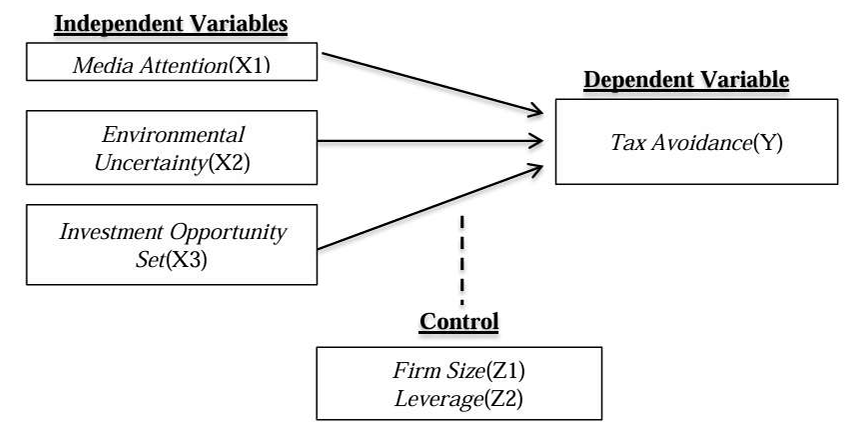
This study aims to analyze the effect of Media Attention, Environmental Uncertainty, and Investment Opportunity Set (IOS) on Tax Avoidance, with Firm Size and Leverage as control variables in manufacturing companies listed on the Indonesia Stock Exchange (IDX) during the 2020–2024 period. Data analysis was conducted using panel data regression with STATA 17 software, after testing the best model and classical assumptions. The results showed that Media Attention and Investment Opportunity Set (IOS) had a significant effect on Tax Avoidance, while Environmental Uncertainty had no effect. The results of testing the control variables showed that Firm Size and Leverage also had no significant effect on Tax Avoidance. The findings of this study indicate that media attention and corporate investment opportunities play a role in influencing corporate tax avoidance policies, while the level of environmental uncertainty and the characteristics of the company's size and financing structure have not been determinants of tax avoidance practices in manufacturing companies in Indonesia.
References
1) Akbar, FS, & Meiryani, M. (2023). The effect of business strategies and environmental uncertainty on tax avoidance in manufacturing companies in Indonesia. International Journal of Economics, Business and Accounting Research (IJEBAR), 7(1), 51–65.
https://doi.org/10.29040/ijebar.v7i1.8143
2) Andalia, A., & Kartini, Y. (2023). The level of tax avoidance in manufacturing companies during the pandemic. Mirai Management Journal, 8(2), 253–261.https://journal.umma.ac.id/index.php/mirai/article/view/14785
3) Boeckx, J., Struyfs, K., & Torsin, W. (2025). Newspaper closures and corporate tax avoidance. SSRN.
https://papers.ssrn.com/sol3/papers.cfm?abstract_id=5264034
4) Dyreng, S. D., Hanlon, M., & Maydew, E. L. (2008). Long-run corporate tax avoidance. The Accounting Review, 83(1), 61–82.
5) Firmansyah, H., & Bayuaji, RP (2019). Investment opportunity set and its influence on financing decisions. Multiparadigma Accounting Journal, 10(3), 537–548.
6) Gujarati, D. N., & Porter, D. C. (2009). Basic econometrics (5th ed.). McGraw-Hill Education.
7) Hanlon, M., & Heitzman, S. (2010). A review of tax research. Journal of Accounting and Economics, 50(2–3), 127–178.https://doi.org/10.1016/j.jacceco.2010.09.002
8) Hidayatulloh, T., Tanzil, ND, & Priyono, AP (2024). Digital transformation, media attention, and tax avoidance: A study of Indonesian multinationals. Journal of Accounting, Finance, and Management (JAKMAN), 6(1), 231–243
https://doi.org/10.35912/jakman.v6i1.3735
9) Huang, LG, & Trisnawati, E. (2025). The effect of environmental uncertainty and executive characteristics on tax avoidance. Dynasty International Journal of Economics, Finance & Accounting (DIJEFA), 5(6), 6250–6255.https://doi.org/10.38035/dijefa.v5i6 10) Hutagaol, J. (2007). Taxation: Contemporary Issues. Science House.
10) Ikhsan, K., & Lastanti, HS (2025). Business strategy in moderating the influence of environmental uncertainty, financial distress, and internal control on tax avoidance. Tax and Business Journal, 6(1), 21–32.
11) Januardi, J., Trisnawati, E., & Firmansyah, A. (2022). Tax risk, environmental uncertainty, and tax avoidance: Does financial distress matter? Sustainability: Journal of Management and Accounting, 7(2), 140–155.
https://doi.org/10.32493/keberlanjutan.v7i2.y2022.p140-155
12) Jensen, M. C., & Meckling, W. H. (1976). Theory of the firm: Managerial behavior, agency costs, and ownership structure. Journal of Financial Economics, 3(4), 305–360.
13) Jiang, Q., Chen, Y., & Sun, T. (2023). Government social media and corporate tax avoidance. China Journal of Accounting Research, 16(2), 100304.https://doi.org/10.1016/j.cjar.2023.100304
14) Khairin, MY, & Firmansyah, A. (2025). The ESG tax avoidance nexus in SOEs: Do investment, strategy, and political ties matter. Journal of Accounting and Investment, 26(1), 87–109.https://doi.org/10.18196/jai.v26i1.23638
15) Kharisma, L., & Cheisviyanny, C. (2025). Media attention and tax avoidance: A case study of LQ45 companies listed on the IDX in 2020–2022. Journal of Accounting Exploration (JEA), 7(1), 388–405.https://doi.org/10.24036/jea.v7i1.1990
16) Lou, Y., Wright, B., Wang, Y., & Zhao, C. (2025). Conforming tax avoidance and earnings persistence. Pacific Accounting Review, 37(1), 89–112.https://doi.org/10.1108/PAR-01-2024-0019
17) Manurung, CBA, Ratnawati, V., & Nasir, A. (2024). Analysis of factors that can influence tax avoidance with institutional ownership as a moderating variable. Owner: Research and Accounting Journal,8(2), 1985–1995.https://doi.org/10.33395/owner.v8i2.2334
18) Mawaddah, SZ, & Darsono. (2022). The influence of internal control, family ownership, and environmental uncertainty on tax avoidance. Diponegoro Journal of Accounting, 11(2), 1–11.
19) McCombs, M. E., & Shaw, D. L. (1972). The agenda-setting function of mass media. Public Opinion Quarterly, 36(2), 176–187.
20) Myers, S. C., & Majluf, N. S. (1984). Corporate financing and investment decisions when firms have information that investors do not have. Journal of Financial Economics, 13, 187–221.https://doi.org/10.1016/0304-405X(84)90023-0
21) Purnomo, H., & Eriandani, R. (2023). The effect of environmental uncertainty and tax avoidance: The role of managerial ability. Journal of Accounting Science and Research, 12(4), 1–18.
22) Putri, RK, & Syafruddin, M. (2021). The effect of contingency fit between business strategy and environmental uncertainty on tax avoidance. Diponegoro Journal of Accounting, 10(2), 1–12.
23) Qi, H., Li, M., & Zhang, H. (2023). The impact of media attention on corporate tax avoidance: A study based on Chinese A-share listed companies. Finance Research Letters, 58, 104594.
24) Sasmitha, IK, & Jati, IK (2025). The effect of sales growth, political connections, good corporate governance, and investment opportunity set on tax avoidance. Al Kharaj: Journal of Islamic Economics, Finance & Business, 7(1), 876–887.
https://doi.org/10.47467/alkharaj.v7i1.5694
25) Tax Justice Network. (2024). State of tax justice 2024.https://taxjustice.net
26) Widodo, YA, Utami, CK, & Nurfauziah, FL (2022). The influence of investment opportunity set (IOS) and intellectual capital on tax avoidance. Proceedings of the National Seminar on Accounting, Finance, and Economics (NSAFE), 2(9), 56–67.
27) Yanto. (2022). Effective tax rate due to investment opportunity set, leverage, capital intensity, and inventory in mining companies listed on the IDX. Journal of Accounting and Taxation, 8(2), 116–133.https://doi.org/10.26905/ap.v8i2.8637
28) Zhou, W., Liu, H., & Wang, Y. (2022). Tax planning and policy uncertainty: Evidence from China. Journal of Accounting and Public Policy, 41(4), 106881.
Downloads
Published
Issue
Section
License
Copyright (c) 2026 Puspa Widania Asih , Vince Ratnawati, Nurrahma Dewi (Author)

This work is licensed under a Creative Commons Attribution 4.0 International License.