A Signal–Trust–Intention Framework for Retail Investor Behavior in Malaysia’s Equity Crowdfunding Market
DOI:
https://doi.org/10.65150/EP-jefrr/V2E5/2026-02Keywords:
Equity crowdfunding, Participation Paradox, Signaling Theory, Trust, Financial Literacy, Investment IntentionAbstract
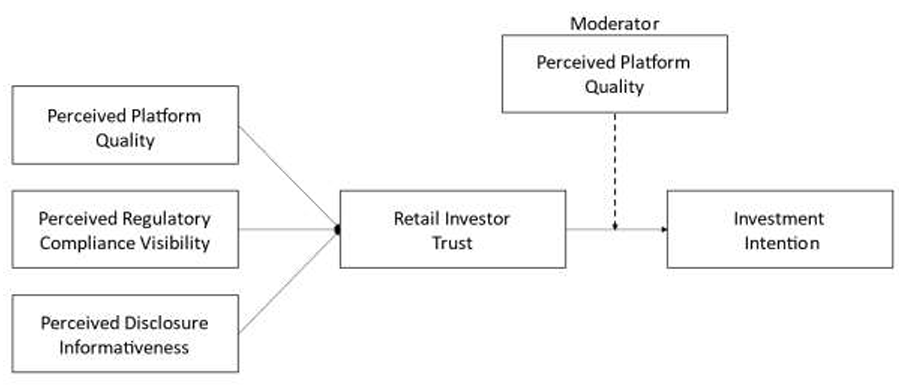
Equity crowdfunding (ECF) has emerged as a key fintech mechanism for entrepreneurial financing, yet increasing institutional strengthening has not consistently translated into sustained retail investor participation. This study develops a conceptual Signal–Trust–Intention framework to explain this inconsistency through the Participation Paradox, defined as the breakdown between institutional credibility and behavioral investment conversion. Integrating Signaling Theory, Trust Theory, and the Elaboration Likelihood Model, the framework explains how perceived platform quality, regulatory compliance visibility, and disclosure informativeness jointly shape retail investor trust, which subsequently influences investment intention under the moderating role of financial literacy. The study advances a behavioral transmission perspective in which institutional signals are not directly converted into action but are cognitively processed and filtered through trust formation and investor capability. By situating the analysis within a regulated equity crowdfunding environment, the framework highlights the limitations of institutional signals in generating behavioral uptake when cognitive processing and interpretive capacity vary across investors. The study contributes to fintech investment literature by offering an integrated explanation of investor behavior under uncertainty and proposing a structured agenda for future empirical validation.
References
1) Adil, M., Singh, Y., & Ansari, M. S. (2022). How financial literacy moderate the relationship between behaviour biases and investment decision? Asian Journal of Accounting Research, 7(1), 17–30. https://doi.org/10.1108/AJAR-09-2020-0086
2) Ahlers, G. K. C., Cumming, D., Günther, C., & Schweizer, D. (2015). Signaling in equity crowdfunding. Entrepreneurship Theory and Practice, 39(4), 955–980. https://doi.org/10.1111/etap.12157
3) Alharbey, M., & Van Hemmen, S. (2021). Investor intention in equity crowdfunding. Does trust matter? Journal of Risk and Financial Management, 14(2), Article 53. https://doi.org/10.3390/jrfm14020053
4) Belleflamme, P., Lambert, T., & Schwienbacher, A. (2014). Crowdfunding: Tapping the right crowd. Journal of Business Venturing, 29(5), 585–609. https://doi.org/10.1016/j.jbusvent.2013.07.003
5) Connelly, B. L., Certo, S. T., Ireland, R. D., & Reutzel, C. R. (2011). Signaling theory: A review and assessment. Journal of Management, 37(1), 39–67. https://doi.org/10.1177/0149206310388419
6) Correia, S., Sousa, M., & Brandão, E. (2024). What do we know about the choices of entrepreneurs before the equity crowdfunding campaign? Small Business Economics, 63(4), 1471–1501. https://doi.org/10.1007/s11187-023-00868-x
7) Cumming, D., Meoli, M., & Vismara, S. (2021). Does equity crowdfunding democratize entrepreneurial finance? Small Business Economics, 56(2), 533–552. https://doi.org/10.1007/s11187-019-00188-z
8) De Crescenzo, V., Ribeiro-Soriano, D. E., & Covin, J. G. (2020). Exploring the viability of equity crowdfunding as a fundraising instrument: A configurational analysis of contingency factors that lead to crowdfunding success and failure. Journal of Business Research, 115, 348–356. https://doi.org/10.1016/j.jbusres.2019.09.051
9) DeLone, W. H., & McLean, E. R. (2003). The DeLone and McLean model of information systems success: A ten-year update. Journal of Management Information Systems, 19(4), 9–30. https://doi.org/10.1080/07421222.2003.11045748
10) Dinç Aydemir, S., & Aren, S. (2017). Do the effects of individual factors on financial risk-taking behavior diversify with financial literacy? Kybernetes, 46(10), 1706–1734. https://doi.org/10.1108/K-10-2016-0281
11) Franke, N., Gruber, M., Harhoff, D., & Henkel, J. (2008). Venture capitalists' evaluations of start-up teams: Trade-offs, knock-out criteria, and the impact of VC experience. Entrepreneurship Theory and Practice, 32(3), 459–483. https://doi.org/10.1111/j.1540-6520.2008.00236.x
12) Friederich, F., Palau-Saumell, R., Matute, J., & Sánchez-Torelló, J. L. (2024). Investors' acceptance and use of investment-based crowdfunding platforms: An integrated perspective. Journal of Financial Services Marketing, 29, 1291–1303. https://doi.org/10.1057/s41264-024-00278-4
13) Gallucci, C., Giakoumelou, A., Santulli, R., & Tipaldi, R. (2023). How financial literacy moderates the relationship between qualitative business information and the success of an equity crowdfunding campaign: Evidence from Mediterranean and Gulf Cooperation Council countries. Technology in Society, 75, 102355. https://doi.org/10.1016/j.techsoc.2023.102355
14) Hornuf, L., & Schwienbacher, A. (2017). Should securities regulation promote equity crowdfunding? Small Business Economics, 49(3), 579–593. https://doi.org/10.1007/s11187-017-9839-9
15) Kang, M., Gao, Y., Wang, T., & Zheng, H. (2016). Understanding the determinants of funders' investment intentions on crowdfunding platforms: A trust-based perspective. Industrial Management and Data Systems, 116(8), 1800–1819. https://doi.org/10.1108/IMDS-07-2015-0312
16) Liang, T. P., Wu, S. P. J., & Huang, C. C. (2019). Why funders invest in crowdfunding projects: Role of trust from the dual-process perspective. Information & Management, 56(1), 70–84. https://doi.org/10.1016/j.im.2018.07.002
17) Li, P. P. (2012). When trust matters the most: The imperatives for contextualising trust research. Journal of Trust Research, 2(2), 101–106. https://doi.org/10.1080/21515581.2012.708494
18) Lusardi, A., & Mitchell, O. S. (2014). The economic importance of financial literacy: Theory and evidence. Journal of Economic Literature, 52(1), 5–44. https://doi.org/10.1257/jel.52.1.5
19) Mabkhot, H., & Piaralal, S. K. (2023). Factors effecting cross-border e-commerce strategic performance of Saudi organizations. International Journal of eBusiness and eGovernment Studies, 15(2), 113–132. https://doi.org/10.34109/ijebeg.2023150206
20) Mayer, R. C., Davis, J. H., & Schoorman, F. D. (1995). An integrative model of organizational trust. Academy of Management Review, 20(3), 709–734. https://doi.org/10.2307/258792
21) McKnight, D. H., & Chervany, N. L. (2001). What trust means in e-commerce customer relationships: An interdisciplinary conceptual typology. International Journal of Electronic Commerce, 6(2), 35–59. https://doi.org/10.1080/10864415.2001.11044235
22) McKnight, D. H., Choudhury, V., & Kacmar, C. (2002). Developing and validating trust measures for e-commerce: An integrative typology. Information Systems Research, 13(3), 334–359. https://doi.org/10.1287/isre.13.3.334.81
23) Meoli, M., Rossi, A., & Vismara, S. (2021). Financial literacy and security-based crowdfunding. Corporate Governance: An International Review, 29(5), 672–688. https://doi.org/10.1111/corg.12355
24) Mochkabadi, K., & Volkmann, C. K. (2020). Equity crowdfunding: A systematic review of the literature. Small Business Economics, 54(1), 75–118. https://doi.org/10.1007/s11187-018-0046-z
25) Mollick, E. (2014). The dynamics of crowdfunding: An exploratory study. Journal of Business Venturing, 29(1), 1–16. https://doi.org/10.1016/j.jbusvent.2013.06.005
26) Moritz, A., Block, J., & Lutz, E. (2015). Investor communication in equity-based crowdfunding: A qualitative-empirical study. Qualitative Research in Financial Markets, 7(3), 309–342. https://doi.org/10.1108/QRFM-07-2014-0021
27) Musacchio, A., & Lazzarini, S. G. (2014). Reinventing state capitalism: Leviathan in business, Brazil and beyond. Harvard University Press.
28) Nose, Y., & Hosomi, C. (2023). What makes equity crowdfunding successful in Japan? Testing the signaling and lack of financial literacy hypotheses. Journal of Entrepreneurship, Management and Innovation, 19(4), 146–183. https://doi.org/10.7341/20231945
29) Othman, W. N., Piaralal, S. K., Singh, H. K. D., Mahmood, N. M., & Saidon, N. A. (2024). Unlocking digital wallet adoption through UTAUT model: Unveiling the factors shaping consumer decisions. Studies in Computational Intelligence, 1161, 59–78. https://doi.org/10.1007/978-3-031-61463-7_4
30) Piaralal, S. K., Veretharajoo, R., Zulkefli, N. A., & Raghavan, S. (n.d.). Antecedents and outcome of satisfaction on continuance intention in online shopping. GSAR Journal of Economics and Finance, 2(3), 1–9.
31) Petty, R. E., & Cacioppo, J. T. (1986). Communication and persuasion: Central and peripheral routes to attitude change. Springer.
32) Rodriguez-Ricardo, Y., Sicilia, M., & López, M. (2019). What drives crowdfunding participation? The influence of altruism and perseverance on donations. Journal of Social Marketing, 9(2), 133–154. https://doi.org/10.1108/JSOCM-12-2017-0098
33) Spence, M. (1973). Job market signaling. Quarterly Journal of Economics, 87(3), 355–374. https://doi.org/10.2307/1882010
34) Securities Commission Malaysia. (2024). Annual report 2023. Securities Commission Malaysia.
35) Supramaniam, T., Zulkefli, N. A., Piaralal, S. K., Raghavan, S., & Veretharajoo, R. (2025). What drives fintech adoption? Examining key predictors among Malaysian users. Journal of Academia, 13(2), 251–262. https://doi.org/10.24191/joa.v13i2.8461
36) Van Rooij, M., Lusardi, A., & Alessie, R. (2011). Financial literacy and stock market participation. Journal of Financial Economics, 101(2), 449–472. https://doi.org/10.1016/j.jfineco.2011.03.006
37) Vismara, S. (2016). Equity retention and social network theory in equity crowdfunding. Small Business Economics, 46(4), 579–590. https://doi.org/10.1007/s11187-016-9710-4
38) Vismara, S. (2018). Information cascades among investors in equity crowdfunding. Entrepreneurship Theory and Practice, 42(3), 467–497. https://doi.org/10.1177/1042258717749429
39) Wasiuzzaman, S. (2021). Regulations, perceived information quality and perceived risk of equity crowdfunding: A study of Malaysian investors. Strategic Change, 30(4), 353–366. https://doi.org/10.1002/jsc.2429
40) Wasiuzzaman, S., Chong, L. L., & Ong, H. B. (2022). Influence of perceived risks on the decision to invest in equity crowdfunding: A study of Malaysian investors. Journal of Entrepreneurship in Emerging Economies, 14(2), 208–230. https://doi.org/10.1108/JEEE-11-2020-0431
41) Williamson, O. E. (1993). Calculativeness, trust, and economic organization. Journal of Law and Economics, 36(1), 453–486. https://doi.org/10.1086/467284
42) Yang, Q., Zhao, X., Cheng, H., & Wang, X. (2019). The influence of platform quality on purchase intention in social commerce: Trust as a mediator. Behaviour and Information Technology, 38(1), 12–24. https://doi.org/10.1080/0144929X.2018.1485744
Downloads
Published
Issue
Section
License
Copyright (c) 2026 Loo Sung King, Shishi Kumar Piaralal, Nur Amalina Zulkefli, Siti Mazlita Yamaludin, Santhi Raghavan (Author)

This work is licensed under a Creative Commons Attribution 4.0 International License.