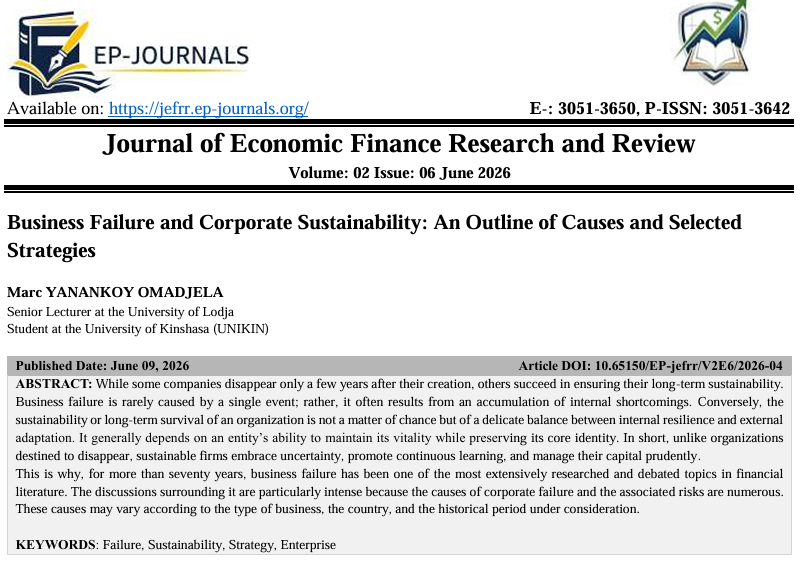
Business Failure and Corporate Sustainability: An Outline of Causes and Selected Strategies
DOI:
https://doi.org/10.65150/EP-jefrr/V2E6/2026-04Keywords:
Failure, Sustainability, Strategy, EnterpriseAbstract
While some companies disappear only a few years after their creation, others succeed in ensuring their long-term sustainability. Business failure is rarely caused by a single event; rather, it often results from an accumulation of internal shortcomings. Conversely, the sustainability or long-term survival of an organization is not a matter of chance but of a delicate balance between internal resilience and external adaptation. It generally depends on an entity’s ability to maintain its vitality while preserving its core identity. In short, unlike organizations destined to disappear, sustainable firms embrace uncertainty, promote continuous learning, and manage their capital prudently.
This is why, for more than seventy years, business failure has been one of the most extensively researched and debated topics in financial literature. The discussions surrounding it are particularly intense because the causes of corporate failure and the associated risks are numerous. These causes may vary according to the type of business, the country, and the historical period under consideration.
References
1) Altman, E. I. (1968). “Financial Ratios, Discriminant Analysis and the Prediction of Corporate Bankruptcy.” The Journal of Finance, 23(4), 589–609.
2) Arend, R. J. (2008). “Differences in RBV Strategic Factors and the Need to Consider Opposing Factors in Turnaround Outcomes.” Managerial and Decision Economics, 29(4), 337–355.
3) Bachmann, et al. (2024). Cross-Impact Analysis of Entrepreneurial Failure and Business Model Innovation: Navigating the Impact of Societal Perceptions. Procedia Computer Science, 232, 2639–2653.
4) Baldwin, C. Y., & Mason, S. P. (1983). “The Resolution of Claims in Financial Distress: The Case of Massey Ferguson.” The Journal of Finance, 38(2), 505–516.
5) Benghozi, J.-P. (2009). “Sustainability: A Ballast or a Gyroscope for the Firm?” French Management Review (Revue Française de Gestion), 35(192), 177–181.
6) Bienaymé. (2011). Business Failure: A Study Based on French Data Between 2000 and 2010. SME Observatory.
7) Bradley, D. B., & Cowdery, C. (2004). Small Business: Causes of Bankruptcy. Small Business Advancement National Center, University of Central Arkansas.
8) Charalambous, C., Charitou, A., & Kaourou, F. (2000). “Comparative Analysis of Artificial Neural Network Models: Application in Bankruptcy Prediction.” Annals of Operations Research, 99(1–4), 403–425.
9) Collins, J. C., & Porras, J. I. (1996). “The major component of the envisioned future entails what organizations aspire to become, achieve, and create.”
10) Daidai, F., Drissi, Z., & Tamnine, L. (2022). “Modelling an Information System for Good Corporate Governance and Its Impact on the Capital Structure.” Journal of System and Management Sciences.
11) De Geus, A. (1997). The Longevity of Companies. Paris: Maxime Laurent du Mesnil.
12) Desreumaux. (1996). “New Organizational Forms and Corporate Evolution.” French Management Review (Revue Française de Gestion), No. 107.
13) Eggrickx, A. (2013). “Reflections on the Epistemology of Control: The Particular Case of Public Organizations.” Proceedings of the 22nd AFC Congress, Montreal.
14) Fernández-Roca, F. J. (2012). “The Strategies of the Spanish Cotton Textile Companies Before the Civil War: The Road to Longevity.” Business History, 54(7), 1023–1054.
15) Ferrier, O. (2002). Very Small Enterprises. De Boeck Supérieur.
16) Gresse, C. (1994). Companies in Difficulty. Economica.
17) Guilhot, B. (2000). “Business Failures: Seventy Years of Theoretical and Empirical Analyses.” French Management Review (Revue Française de Gestion), 130, 52–67.
18) Hautcoeur, P.-C., & Levratto, N. (2018). “Legal vs. Economic Explanations of the Rise in Bankruptcies in Nineteenth-Century France.” Revue d’Économie Industrielle, 160.
19) Jabraoui, S., & Boulahoual, A. (2018). “Determinants of Entrepreneurial Success in Morocco: The Case of the Casablanca Region.” International Conference on Foresight under the Theme Entrepreneurship: Towards an Entrepreneurial Morocco, Casablanca, November 24–25, 2016.
20) Kadji Ngassam, M. (2015). Sustainability of Business Models in Open Collaborative and Community Projects: The Case of Open-Source Software Projects and Communities. Doctoral Dissertation in Management Sciences, University of Versailles Saint-Quentin-en-Yvelines.
21) Kazanjian, R. K. (1988). “Relation of Dominant Problems to Stages of Growth in Technology-Based New Ventures.” Academy of Management Journal, 31(2).
22) Koenig, G. (1996). Strategic Management: Paradoxes, Interactions and Learning. Paris: Nathan.
23) Liang, L., & Wu, D. (2003). “An Application of Pattern Recognition on Scoring Chinese Corporations’ Financial Conditions Based on Backpropagation Neural Network.” Computers & Operations Research, 32(5), 1115–1129.
24) Lahsaoua, K., & Ait Ali, E. (2023). “Failure of Moroccan Companies: A Literature Review.” International Journal of Economic Studies and Management (IJESM), 3(3), 1000–1010.
25) Lotfi, S., & Mesk, H. (2021). “Explanatory Determinants of Moroccan Business Failure.” Global Research Review.
26) Maa, F., & Oumazane, Z. (2024). “Failure of Moroccan Companies: A Johansen Regression Analysis of Macroeconomic and Demographic Factors.” Revue Alternatives Managériales Économiques, 6(1), 112–126.
27) Mignon, S. (2001). Business Sustainability Strategies. Paris: Vuibert.
28) Mignon, S. (2002). “Sustainability of SMEs: The Specificity of the Strategic Process.” International SME Review (Revue Internationale P.M.E.), 15(2), 93–118.
29) Mignon, S. (2009). “Organizational Sustainability: An Analytical Framework – Introduction to the Special Issue on Organizational Sustainability.” French Management Review (Revue Française de Gestion), 35(192), 73–89.
30) Mrani, S., & Loulid, A. (2023). “Business Failure: A Literature Review.” African Scientific Journal, 3(19), 940–976.
31) Naro, G., & Travaillé, D. (2013). “Management Control and Organizational Sustainability: The Balanced Scorecard as a Lever for Interactive Control.” In Sophie Mignon (Ed.), Managing Organizational Sustainability: Standards, Representations and Control (pp. 163–188). Paris: EMS Editions.
32) Nikitin, M. (2006). “What Is a Research Problem in Management Sciences and How Should It Be Taught?” Accounting, Control and Audit (Comptabilité Contrôle Audit), 12(3), 91–110.
33) Ooghe, H., & Waeyaert, N. (2004). Causes of Company Failure and Failure Paths: The Rise and Fall of Fardis. Gate2Growth Academic Network in Entrepreneurship, Innovation and Finance.
34) Shleifer, A., & Vishny, R. W. (1992). “Liquidation Values and Debt Capacity: A Market Equilibrium Approach.” The Journal of Finance, 47(4), 1343–1366.
35) Soparnot, R. (2010). Organizational Strategy. Paris: Hachette Supérieur.
36) Souiri, M., & Ameur, A. H. (2022). “The Combined Effect of Declining Business Creation and GDP on the Failure of Moroccan Companies: An Econometric Analysis.” International Review of Management Sciences, 5(3), 1174–1188.
37) Zopounidis, C. (1995). Assessment of Corporate Failure Risk: Methods and Case Studies. Economica.
Downloads
Published
Issue
Section
License
Copyright (c) 2026 Marc YANANKOY OMADJELA (Author)

This work is licensed under a Creative Commons Attribution 4.0 International License.