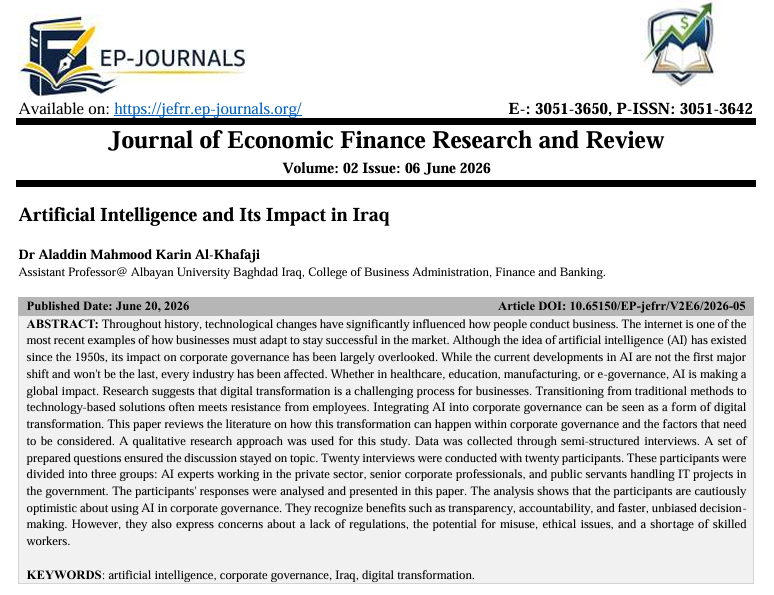
Artificial Intelligence and Its Impact in Iraq
DOI:
https://doi.org/10.65150/EP-jefrr/V2E6/2026-05Keywords:
artificial intelligence, corporate governance, Iraq, digital transformation.Abstract
Throughout history, technological changes have significantly influenced how people conduct business. The internet is one of the most recent examples of how businesses must adapt to stay successful in the market. Although the idea of artificial intelligence (AI) has existed since the 1950s, its impact on corporate governance has been largely overlooked. While the current developments in AI are not the first major shift and won't be the last, every industry has been affected. Whether in healthcare, education, manufacturing, or e-governance, AI is making a global impact. Research suggests that digital transformation is a challenging process for businesses. Transitioning from traditional methods to technology-based solutions often meets resistance from employees. Integrating AI into corporate governance can be seen as a form of digital transformation. This paper reviews the literature on how this transformation can happen within corporate governance and the factors that need to be considered. A qualitative research approach was used for this study. Data was collected through semi-structured interviews. A set of prepared questions ensured the discussion stayed on topic. Twenty interviews were conducted with twenty participants. These participants were divided into three groups: AI experts working in the private sector, senior corporate professionals, and public servants handling IT projects in the government. The participants' responses were analysed and presented in this paper. The analysis shows that the participants are cautiously optimistic about using AI in corporate governance. They recognize benefits such as transparency, accountability, and faster, unbiased decision-making. However, they also express concerns about a lack of regulations, the potential for misuse, ethical issues, and a shortage of skilled workers.
References
1) H. Pfohl, B. Yahsi and T. Kurnaz, “The impact of Industry 4.0 on the supply chain,” in Innovations and Strategies for Logistics and Supply Chains: Technologies, Business Models and Risk Management, Berlin, epubli GmbH, 2015, pp. 31-58.
2) S. Loureiro, J. Guerreiro and I. Tussyadiah, “Artificial intelligence in business: State of the art and future research agenda,” Journal of Business Research, vol. 129, pp. 911-926, 2021.
3) M. Tokmakov, “Artificial intelligence in corporate governance,” in Digital Economy and the New Labor Market: Jobs, Competences and Innovative HR Technologies, Springer International Publishing, 2021, pp. 667-674.
4) W. Spangler, “The role of artificial intelligence in understanding the strategic decision-making process,” IEEE Transactions on Knowledge and Data Engineering, vol. 3, no. 2, pp. 149-159, 1991.
5) M. Kumar, “Artificial Intelligence in Business Decision Making,” Department of Management, MUIT, Lucknow, 2021.
6) S. Nover, “OpenAI’s Altman incident under investigation,” GZero Media, 05 March 2024. [Online]. Available:
https://www.gzeromedia.com/gzero-ai/openais-altman-incident-under-investigation. [Accessed 11 April 2024].
7) UNDP Iraq, “UNDP in Iraq at a Glance,” UNDP, 2024. [Online]. Available: https://www.undp.org/iraq/about-us/at-a-glance. [Accessed 13 April 2024].
8) J. Lee, “New Report on Digital Trends in Iraq,” Iraq-Business News, 18 February 2023. [Online]. Available: https://www.iraq-businessnews.com/2023/02/18/new-report-on-digital-trends-in-iraq. [Accessed 13 April 2024].
9) N. Ismael, S. Sorguli, H. Aziz, B. Sabir, P. Hamza, B. Gardi and F. Al-Kake, “The impact of COVID-19 on small and medium-sized enterprises in Iraq,” Annals of RSCB, pp. 1583-1628, 2021.
10) EIN PressWire, “LigaData Selected by Asiacell to Implement New Data Governance Program,” ABC27 News, 22 January 2023. [Online]. Available: https://www.abc27.com/business/press-releases/ein-presswire/612701210/ligadata-selected-by-asiacell-to-implement-new-data-governance-program/. [Accessed 13 April 2024].
11) K. Schwetner, “Digital transformation of business,” Trakia Journal of Sciences, vol. 15, no. 1, pp. 388-393, 2017.
12) W. Hiwali, A. Manouar and M. Idrissi, “Reaching sustainability during a digital transformation: a PLS approach,” International Journal of Innovation Science, vol. 12, no. 1, pp. 52-79, 2020.
13) B. Berikol and M. Killi, “The effects of digital transformation process on accounting profession and accounting education,” Ethics and Sustainability in Accounting and Finance, vol. II, pp. 219-231, 2021.
14) G. Aguiar and L. Gouveia, “The digital transformation in academic accounting research,” Journal of Organizational Knowledge Management, pp. 1-9, 2020.
15) R. Kitchin and G. McArdle, “What makes Big Data, Big data? Exploring the ontological characteristics of 26 datasets,” Big Data & Society, vol. 3, no. 1, 2016.
16) M. D. Pierro, “What is the blockchain?,” Computing in Science & Engineering, vol. 19, no. 5, pp. 92-95, 2017.
17) M. Yaqoob, A. Alromaihi and Z. Sanad, “Corporate Governance in the Digital Era,” in Artificial Intelligence and Transforming Digital Marketing, Cham, Springer, 2023, pp. 453-460.
18) C. Ntim and T. Soobaroyen, “Corporate governance and performance in socially responsible corporations: New empirical insights from a Neo‐Institutional framework,” Corporate Governance: An International Review, vol. 21, no. 5, pp. 468-494, 2013.
19) S. Posthumusa and R. V. Solms, “IT oversight: an important function of corporate governance,” Computer Fraud & Security, vol. 2005, no. 6, pp. 11-17, 2005.
20) A. Almagtome, M. Khagaany and S. Once, “Corporate governance quality, stakeholders' pressure, and sustainable development: An integrated approach,” International Journal of Mathematical Engineering and Management Sciences, vol. 5, no. 6, 2020.
21) M. Maclean, “Corporate governance in France and the UK: Long-term perspectives on contemporary institutional arrangements,” Business History, vol. 41, no. 1, pp. 88-116, 1999.
22) T. Davenport and R. Ronanki, “HBR: Artificial intelligence for the real world,” Boston Business Journal, 09 January 2018. [Online]. Available: https://www.bizjournals.com/boston/news/2018/01/09/hbr-artificial-intelligence-for-the-real-world.html. [Accessed 16 April 2024].
23) P. Drucker, “The manager and the moron,” McKinsey Quarterly, vol. 3, no. 4, pp. 42-52, 1967.
24) J. Mantas, “Intelligence approaches to AI,” Directorship, pp. 40-45, 2019.
25) B. Libert, M. Beck and M. Boncheck, “AI in the boardroom: the next realm of corporate governance,” MIT Sloan Management Review Blog, 19 October 2017. [Online]. Available: https://sloanreview.mit.edu/article/ai-in-the-boardroom-the-next-realm-of-corporate-governance/. [Accessed 13 April 2024].
26) M. Hilb, “Toward artificial intelligence? The role of artificial intelligence in shaping the future of corporate governance,” Journal of Management and Governance, vol. 24, pp. 851-870, 2020.
27) D. Cossin and E. Metayer, How strategic is your board?, Cambridge: MIT Sloan Business Review, 2014.
28) J. Armour and H. Eidenmueller, “Self-Driving Corporations?,” Harvard Business Law Review, vol. Law Working Paper 475/2019, 2020.
29) T. Simonite, “Tech Firms Move to Put Ethical Guard Rails Around AI,” Wired, 16 May 2018. [Online]. Available:
https://www.wired.com/story/tech-firms-move-to-put-ethical-guard-rails-around-ai/. [Accessed 14 April 2024].
30) M. Baghai, S. Coley, D. White and S. Coley, The alchemy of growth: practical insights for building the enduring enterprise, New York: Basic Books, 2000.
31) P. Cihon, J. Schuett and S. Baum, “Corporate Governance of Artificial Intelligence in the Public Interest,” Information, vol. 12, no. 1, pp. 275-280, 2021.
32) H. Alkhaffaf, K. Idris, A. Abdullah and A. Al-Aidaros, “The Influence of Technology Readiness on Information Technology
Competencies and Civil Conflict Environment,” Indian-Pacific Journal of Accounting and Finance, vol. 2, no. 2, pp. 51-64, 2018.
33) Innov8, “Adopting AI in Iraq,” Channel 8, 18 January 2024. [Online]. Available: https://innov8.channel8.com/530. [Accessed 13 April 2024].
34) P. Scharre, “Four Battlegrounds: Power in the Age of Artificial Intelligence,” CNAS, 28 February 2023. [Online]. Available: https://cnas.org/publications/book/four-battlegrounds-power-in-the-age-of-artificial-intelligence. [Accessed 13 April 2024].
35) PwC, “US $320 million by 2030? The potential impact of Artificial Intelligence in the Middle East,” PwC, 2023. [Online]. Available: https://www.pwc.com/m1/en/publications/potential-impact-artificial-intelligence-middle-east.html. [Accessed 13 April 2024].
36) E. Fossey, C. Harvey, F. McDermott and L. Davidson, “Understanding and evaluating qualitative research,” Australian & New Zealand Journal of Psychiatry, vol. 36, no. 6, pp. 717-732, 2002
37) M. Tavallaei and M. Talib, “A general perspective on role of theory in qualitative research,” Journal of International Social Research, vol. 3, no. 11, pp. 1-8, 2010.
38) J. Sutton and Z. Austin, “Data collection, analysis, and management,” The Canadian Journal of Hospital Pharmacy, vol. 68, no. 3, pp. 226-232, 2015.
39) J. Horton, R. Macve and G. Struyven, “Qualitative research experiences in using semi-structured interviews,” in The Real Life Guide to Accounting Research, Elsevier, 2004, pp. 339-357.
40) C. Iacovou, I. Benbasat and A. Dexter, “Electronic data interchange and small organizations: Adoption and impact of technology,” MIS Quarterly, pp. 465-485, 1995.
Downloads
Published
Issue
Section
License
Copyright (c) 2026 Dr Aladdin Mahmood Karin Al-Khafaji (Author)

This work is licensed under a Creative Commons Attribution 4.0 International License.