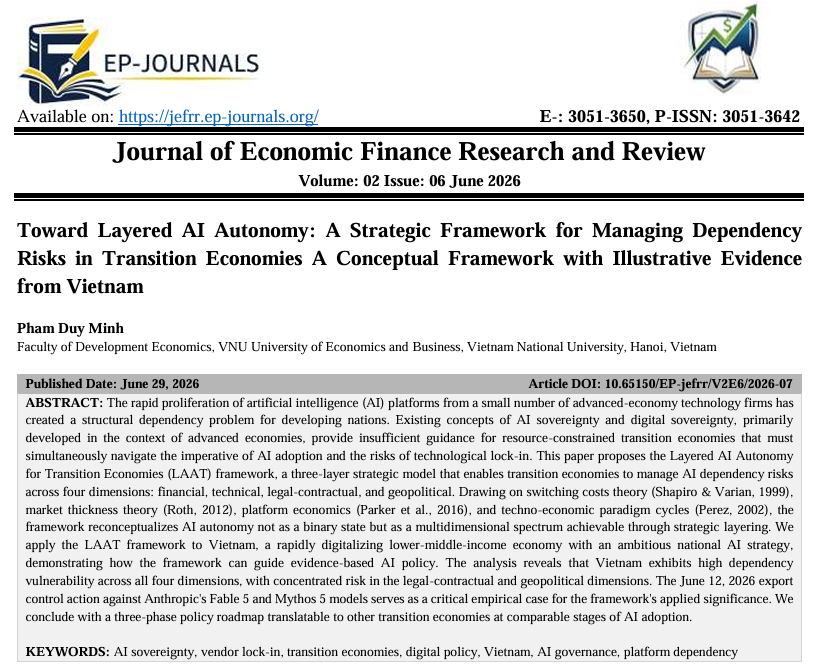
Toward Layered AI Autonomy: A Strategic Framework for Managing Dependency Risks in Transition Economies A Conceptual Framework with Illustrative Evidence from Vietnam
DOI:
https://doi.org/10.65150/EP-jefrr/V2E6/2026-07Keywords:
AI sovereignty, vendor lock-in, transition economies, digital policy, Vietnam, AI governance, platform dependencyAbstract
The rapid proliferation of artificial intelligence (AI) platforms from a small number of advanced-economy technology firms has created a structural dependency problem for developing nations. Existing concepts of AI sovereignty and digital sovereignty, primarily developed in the context of advanced economies, provide insufficient guidance for resource-constrained transition economies that must simultaneously navigate the imperative of AI adoption and the risks of technological lock-in. This paper proposes the Layered AI Autonomy for Transition Economies (LAAT) framework, a three-layer strategic model that enables transition economies to manage AI dependency risks across four dimensions: financial, technical, legal-contractual, and geopolitical. Drawing on switching costs theory (Shapiro & Varian, 1999), market thickness theory (Roth, 2012), platform economics (Parker et al., 2016), and techno-economic paradigm cycles (Perez, 2002), the framework reconceptualizes AI autonomy not as a binary state but as a multidimensional spectrum achievable through strategic layering. We apply the LAAT framework to Vietnam, a rapidly digitalizing lower-middle-income economy with an ambitious national AI strategy, demonstrating how the framework can guide evidence-based AI policy. The analysis reveals that Vietnam exhibits high dependency vulnerability across all four dimensions, with concentrated risk in the legal-contractual and geopolitical dimensions. The June 12, 2026 export control action against Anthropic's Fable 5 and Mythos 5 models serves as a critical empirical case for the framework's applied significance. We conclude with a three-phase policy roadmap translatable to other transition economies at comparable stages of AI adoption.
References
1) Amy Adelaide (2025). Vietnam's fintech power play: MoMo's profit milestone signals a new era for Southeast Asia. 1950.ai. https://www.1950.ai/post/vietnam-s-fintech-power-play-momo-s-profit-milestone-signals-a-new-era-for-southeast-asia
2) Avgerou, C. (2002). Information systems and global diversity. Oxford University Press.
3) Baldwin, C. Y., & Clark, K. B. (2000). Design rules: The power of modularity. MIT Press.
4) Bradford, A. (2023). Digital empires: The global battle to regulate technology. Oxford University Press.
5) Bughin, J., Seong, J., Manyika, J., Chui, M., & Joshi, R. (2018). Notes from the AI frontier: Modeling the impact of AI on the global economy. McKinsey Global Institute.
6) CloudZero. (2026). AI vendor lock-in: How AI is creating a new dependency problem. CloudZero. https://www.cloudzero.com/blog/ai-vendor-lock-in/
7) Flanigan, R. (2026, April 1). Nearly 3 in 4 enterprises say losing AI vendors would disrupt core business operations. Zapier. https://zapier.com/blog/ai-vendor-lock-in-survey/
8) Couldry, N., & Mejias, U. A. (2019). The costs of connection: How data is colonizing human life and appropriating it for capitalism. Stanford University Press.
9) Couture, S., & Toupin, S. (2019). What does the notion of sovereignty mean when referring to the digital? New Media & Society, 21(10), 2305-2322. https://doi.org/10.1177/1461444819865984
10) Csernatoni, R. (2024). Charting the geopolitics and European governance of artificial intelligence. Carnegie Endowment for International Peace. https://carnegieendowment.org/research/2024/03/charting-the-geopolitics-and-european-governance-of-artificial-intelligence
11) Floridi, L. (2020). The fight for digital sovereignty: What it is, and why it matters, especially for the EU. Philosophy & Technology, 33(3), 369-378. https://doi.org/10.1007/s13347-020-00423-6
12) FutureSearch. (2026). OpenAI revenue, losses, and profitability in 2026: Full financial breakdown. FutureSearch AI.
https://futuresearch.ai/openai-revenue-forecast/
13) Government of Vietnam. (2021). Quyet dinh so 127/QD-TTg ngay 26/01/2021 ban hanh Chien luoc quoc gia ve nghien cuu, phat trien va ung dung Tri tue nhan tao den nam 2030 [Decision No. 127/QD-TTg: National strategy for AI research, development and application to 2030]. Office of the Prime Minister.
14) GreenNode. (2025). GreenMind: A next-generation Vietnamese large language model for structured and logical reasoning. arXiv preprint. https://arxiv.org/pdf/2504.16832
15) Gregor, S. (2006). The nature of theory in information systems. MIS Quarterly, 30(3), 611-642. https://doi.org/10.2307/25148742
16) Heeks, R. (2010). Do information and communication technologies (ICTs) contribute to development? Journal of International Development, 22(5), 625-640. https://doi.org/10.1002/jid.1716
17) Inside Global Tech. (2026, June 4). EU tech sovereignty package. Inside Global Tech.
https://www.insideglobaltech.com/2026/06/04/eu-tech-sovereignty-package/
18) Jaakkola, E. (2020). Designing conceptual articles: Four approaches. AMS Review, 10(1-2), 18-26.
https://doi.org/10.1007/s13162-020-00161-0
19) Kleine, D., & Unwin, T. (2009). Technological revolution, evolution and new dependencies: What is new about ICT4D? Third World Quarterly, 30(5), 1045-1067. https://doi.org/10.1080/01436590902959339
20) Koren, K., Kurland, K., & Mehta, A. (2026, June 16). The Department of Commerce restricted access to Anthropic's latest models: What comes next? Center for Strategic and International Studies. https://www.csis.org/analysis/department-commerce-restricted-access-anthropics-latest-models-what-comes-next
21) Markowitz, H. (1952). Portfolio selection. The Journal of Finance, 7(1), 77-91. https://doi.org/10.2307/2975974
22) Masan Group. (2025, September 18). Technology applications optimize supply chain and reduce losses in modern retail. Masan Group News. https://www.masangroup.com/news/masan-news/Technology-Applications-Optimize-Supply-Chain-and-Reduce-Losses-in-Modern-Retail.html
23) Ministry of Electronics and Information Technology. (2024). IndiaAI Mission. Government of India.
https://indiaai.gov.in/indiaai-mission
24) NVIDIA. (2025). Thailand, Vietnam embrace sovereign AI to drive economic growth. NVIDIA Blog.
https://blogs.nvidia.com/blog/thailand-vietnam-sovereign-ai/
25) Parker, G. G., Van Alstyne, M. W., & Choudary, S. P. (2016). Platform revolution: How networked markets are transforming the economy and how to make them work for you. W. W. Norton & Company.
26) Patel, N. (2026, March 9). Yann LeCun's AMI Labs raises $1.03 billion to build world models. TechCrunch.
https://techcrunch.com/2026/03/09/yann-lecuns-ami-labs-raises-1-03-billion-to-build-world-models/
27) Perez, C. (2002). Technological revolutions and financial capital: The dynamics of bubbles and golden ages. Edward Elgar Publishing.
28) Pohle, J., & Thiel, T. (2020). Digital sovereignty. Internet Policy Review, 9(4). https://doi.org/10.14763/2020.4.1532
29) Roberts, H., Cowls, J., Morley, J., Taddeo, M., Wang, V., & Floridi, L. (2021). The Chinese approach to artificial intelligence: An analysis of policy, ethics, and regulation. AI & Society, 36(1), 59-77. https://doi.org/10.1007/s00146-020-00992-2
30) Rochet, J.-C., & Tirole, J. (2003). Platform competition in two-sided markets. Journal of the European Economic Association, 1(4), 990-
1029. https://doi.org/10.1162/154247603322493212
31) Roth, A. E. (2012). The theory and practice of market design. Nobel Prize lecture. Nobel Foundation.
https://www.nobelprize.org/prizes/economic-sciences/2012/roth/lecture/
32) Sculley, D., Holt, G., Golovin, D., Davydov, E., Phillips, T., Ebner, D., Chaudhary, V., Young, M., Crespo, J.-F., & Dennison, D. (2015). Hidden technical debt in machine learning systems. Advances in Neural Information Processing Systems, 28.
https://proceedings.neurips.cc/paper/2015/hash/86df7dcfd896fcaf2674f757a2463eba-Abstract.html
33) Sevilla, J., Heim, L., Ho, A., Besiroglu, T., Hobbhahn, M., & Villalobos, P. (2022). Compute trends across three eras of machine learning.
arXiv preprint arXiv:2202.05924. https://arxiv.org/abs/2202.05924
34) Shapiro, C., & Varian, H. R. (1999). Information rules: A strategic guide to the network economy. Harvard Business School Press.
35) Smart Nation and Digital Government Office. (2023). National artificial intelligence strategy 2.0: AI for the public good, for Singapore and the world. Singapore Government. https://file.go.gov.sg/nais2023.pdf
36) Tilleke & Gibbins. (2025). Vietnam's AI push: Updated national strategy and first AI law by end of 2025. Tilleke & Gibbins Insights. https://www.tilleke.com/insights/vietnams-ai-push-updated-national-strategy-and-first-ai-law-by-end-of-2025/
37) UNDP. (2025). AI landscape and assessment report: Viet Nam 2025. United Nations Development Programme. https://www.undp.org/sites/g/files/zskgke326/files/2025-04/undp_aila_eng_report_2025_final.pdf
38) Thai Khang (2025). Vietnam unveils first Vietnamese LLM on NVIDIA NIM. VietnamNet.
https://vietnamnet.vn/en/vietnam-unveils-first-vietnamese-llm-on-nvidia-nim-2445851.html
39) VietnamPlus. (2026). Vietnam emerges as new hotspot for AI data centre investment. Vietnam News Agency.
Downloads
Published
Issue
Section
License
Copyright (c) 2026 Pham Duy Minh (Author)

This work is licensed under a Creative Commons Attribution 4.0 International License.