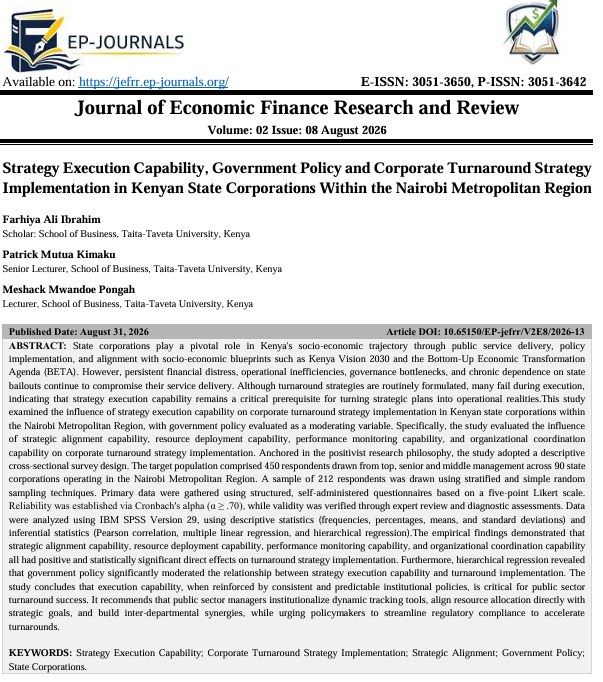
Strategy Execution Capability, Government Policy and Corporate Turnaround Strategy Implementation in Kenyan State Corporations Within the Nairobi Metropolitan Region
DOI:
https://doi.org/10.65150/EP-jefrr/V2E8/2026-13Keywords:
Strategy Execution Capability, Corporate Turnaround Strategy Implementation, Strategic Alignment, Government Policy, State Corporations.Abstract
State corporations play a pivotal role in Kenya's socio-economic trajectory through public service delivery, policy implementation, and alignment with socio-economic blueprints such as Kenya Vision 2030 and the Bottom-Up Economic Transformation Agenda (BETA). However, persistent financial distress, operational inefficiencies, governance bottlenecks, and chronic dependence on state bailouts continue to compromise their service delivery. Although turnaround strategies are routinely formulated, many fail during execution, indicating that strategy execution capability remains a critical prerequisite for turning strategic plans into operational realities.This study examined the influence of strategy execution capability on corporate turnaround strategy implementation in Kenyan state corporations within the Nairobi Metropolitan Region, with government policy evaluated as a moderating variable. Specifically, the study evaluated the influence of strategic alignment capability, resource deployment capability, performance monitoring capability, and organizational coordination capability on corporate turnaround strategy implementation. Anchored in the positivist research philosophy, the study adopted a descriptive cross-sectional survey design. The target population comprised 450 respondents drawn from top, senior and middle management across 90 state corporations operating in the Nairobi Metropolitan Region. A sample of 212 respondents was drawn using stratified and simple random sampling techniques. Primary data were gathered using structured, self-administered questionnaires based on a five-point Likert scale. Reliability was established via Cronbach's alpha (α ≥ .70), while validity was verified through expert review and diagnostic assessments. Data were analyzed using IBM SPSS Version 29, using descriptive statistics (frequencies, percentages, means, and standard deviations) and inferential statistics (Pearson correlation, multiple linear regression, and hierarchical regression).The empirical findings demonstrated that strategic alignment capability, resource deployment capability, performance monitoring capability, and organizational coordination capability all had positive and statistically significant direct effects on turnaround strategy implementation. Furthermore, hierarchical regression revealed that government policy significantly moderated the relationship between strategy execution capability and turnaround implementation. The study concludes that execution capability, when reinforced by consistent and predictable institutional policies, is critical for public sector turnaround success. It recommends that public sector managers institutionalize dynamic tracking tools, align resource allocation directly with strategic goals, and build inter-departmental synergies, while urging policymakers to streamline regulatory compliance to accelerate turnarounds.
References
1) Barney, J. (1991). Firm resources and sustained competitive advantage. Journal of Management, 17(1), 99–120.https://doi.org/10.1177/014920639101700108
2) Bryson, J. M. (2018). Strategic planning for public and nonprofit organizations: A guide to strengthening and sustaining organizational achievement (5th ed.). Jossey-Bass.
3) Creswell, J. W., & Creswell, J. D. (2023). Research design: Qualitative, quantitative, and mixed methods approaches (6th ed.). SAGE Publications.
4) Gujarati, D. N., Porter, D. C., & Gunasekar, S. (2021). Basic econometrics. McGraw-Hill Education.
5) Hair, J. F., Black, W. C., Babin, B. J., & Anderson, R. E. (2022). Multivariate data analysis (8th ed.). Cengage.
6) Hrebiniak, L. G. (2005). Making strategy work: Leading effective execution and change. Wharton School Publishing.
7) Kaplan, R. S., & Norton, D. P. (2008). The execution premium: Linking strategy to operations for competitive advantage. Harvard Business Press.
8) Kimaku, P. M., Omwenga, J., & Nzulwa, J. D. (2019). Determinants of successful implementation of strategic change in state corporations in Kenya. The Strategic Journal of Business & Change Management, 6(2), 82–95. https://doi.org/10.61426/sjbcm.v6i2.1101
9) Lepore, B. N., Kimaku, P. M., & Omido, K. H. (2026). Strategic management practices and post-pandemic performance of agricultural firms in Kenya. International Journal of Social Science and Humanities Research, 4(1), 79–98. https://doi.org/10.61108/ijsshr.v4i1.251
10) Majani, L. V., Kimaku, P. M., & Omido, K. H. (2026). Managing resistance to change and its effect on performance of state corporations in Nairobi Metropolitan Area, Kenya. International Journal of Social Science and Humanities Research, 4(1), 118–138. https://doi.org/10.61108/ijsshr.v4i1.253
11) Mathu, S. W., Gichinga, L., & Kimaku, P. (2026). Strategic decision-making approaches and organisational performance of commercial state corporations in Kenya. The Strategic Journal of Business & Change Management, 13(3).
12) Meyer, J. W., & Rowan, B. (1977). Institutionalized organizations: Formal structure as myth and ceremony. American Journal of Sociology, 83(2), 340–363. https://doi.org/10.1086/226550
13) Okumus, F. (2003). A framework to implement strategies in organizations. Management Decision, 41(9), 871–882.https://doi.org/10.1108/00251740310499555
14) Pallant, J. (2020). SPSS survival manual: A step by step guide to data analysis using IBM SPSS (7th ed.). Routledge.
15) Saunders, M. N. K., Lewis, P., & Thornhill, A. (2023). Research methods for business students (9th ed.). Pearson.
16) Scott, W. R. (2021). Institutions and organizations: Ideas, interests, and identities. SAGE Publications.
17) Teece, D. J. (2007). Explicating dynamic capabilities: The nature and microfoundations of (sustainable) enterprise performance. Strategic Management Journal, 28(13), 1319–1350. https://doi.org/10.1002/smj.640
18) Teece, D. J. (2018). Business models and dynamic capabilities. Long Range Planning, 51(1), 40–49.
https://doi.org/10.1016/j.lrp.2017.06.007
19) Teece, D. J. (2020). Hand in glove: Open innovation and the dynamic capabilities framework. Strategic Management Review, 1(2), 233–253.
20) Teece, D. J., Pisano, G., & Shuen, A. (1997). Dynamic capabilities and strategic management. Strategic Management Journal, 18(7), 509–533. https://doi.org/10.1002/(SICI)1097-0266(199708)18:7%3C509::AID-SMJ882%3E3.0.CO;2-Z
21) Trahms, C. A., Ndofor, H. A., & Sirmon, D. G. (2013). Organizational decline and turnaround: A review and agenda for future research. Journal of Management, 39(5), 1277–1307. https://doi.org/10.1177/0149206312471390
22) Wernerfelt, B. (1984). A resource-based view of the firm. Strategic Management Journal, 5(2), 171–180. https://doi.org/10.1002/smj.4250050207
23) Yamane, T. (1967). Statistics: An introductory analysis (2nd ed.). Harper & Row.
Downloads
Published
Issue
Section
License
Copyright (c) 2026 Farhiya Ali Ibrahim, Patrick Mutua Kimaku, Meshack Mwandoe Pongah (Author)

This work is licensed under a Creative Commons Attribution 4.0 International License.