Digital Financial Innovation and Financial Performance of Deposit Taking Savings and Credit Cooperative Societies in Mombasa County, Kenya
DOI:
https://doi.org/10.65150/EP-jefrr/V2E8/2026-03Keywords:
Digital Financial Innovation, Financial Performance, Technology Adoption Capacity, Digital Transformation, Financial Inclusion.Abstract
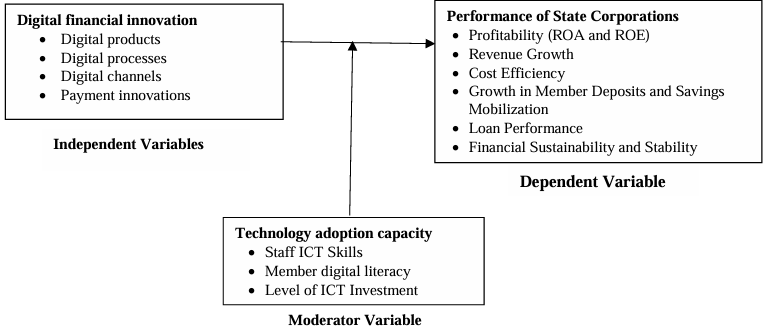
This study examined the effect of digital financial innovation on the financial performance of DT-SACCOs in Mombasa County, Kenya, while assessing the moderating effect of technology adoption capacity. Specifically, the study evaluated the influence of digital products, digital processes, digital channels, and payment innovations on financial performance and determined whether technology adoption capacity strengthened these relationships. The study was anchored on Schumpeter's Theory of Economic Change, Transaction Cost Theory, and Diffusion of Innovation Theory. The study adopted a descriptive and explanatory research design targeting management and technical employees drawn from the sixteen licensed DT-SACCOs operating in Mombasa County. A stratified random sampling technique was used to select 87 respondents from a target population of 96 employees. Primary data were collected using a structured questionnaire and analyzed using the Statistical Package for Social Sciences (SPSS). Descriptive statistics summarized respondent characteristics and study variables, while correlation and multiple regression analyses were employed to test the study hypotheses. Reliability and validity of the research instrument were established through Cronbach's alpha and expert review respectively, while regression diagnostic tests were conducted to confirm compliance with statistical assumptions. The findings established that digital financial innovation significantly improves the financial performance of DT-SACCOs. Digital products, digital processes, digital channels, and payment innovations each exhibited a positive and statistically significant influence on financial performance. The study further established that technology adoption capacity positively moderated the relationship between digital financial innovation and financial performance, indicating that institutions with stronger ICT infrastructure, staff digital competencies, and organizational readiness derive greater financial benefits from digital innovation. Overall, digital financial innovation enhanced operational efficiency, service delivery, competitiveness, profitability, and financial sustainability among DT-SACCOs. The study concludes that successful implementation of digital financial innovations, supported by adequate technology adoption capacity, is essential for improving the financial performance of DT-SACCOs. It recommends that DT-SACCO management continue investing in digital financial technologies, strengthen ICT infrastructure, enhance staff digital competencies through continuous training, and promote member digital literacy. Policymakers and regulators, particularly the Sacco Societies Regulatory Authority (SASRA), should formulate supportive policies that encourage digital transformation while strengthening cybersecurity, innovation, and digital governance within the SACCO sector. Future studies should employ longitudinal designs and extend the investigation to DT-SACCOs in other counties to enhance the generalizability of the findings.
References
1) Abu Al-Haija, E., Al-Haraizah, A., Lataifeh, A. S., Meqdade, M., & Yousef, N. (2026). The impact of digital banking transformation (DBT) platforms on the profitability and efficiency of Islamic banking. Journal of Islamic Marketing, 17(3), 1080–1100.
2) Ahmad, R. A., Mainoma, M. A., Ibrahim, M., & Kolo, I. (2024). Effect of digital financial services on liquidity of the Nigerian capital market. International Journal of Innovation Research and Advanced Studies.
3) Alkhawaldeh, B., Alhawamdeh, H., Al-Afeef, M., Al-Smadi, A., Almarshad, M., Fraihat, B., ... Alaa, A. (2023). The effect of financial technology on financial performance in Jordanian SMEs: The role of financial satisfaction. Uncertain Supply Chain Management, 11(3), 1019–1030.
4) Alonso, S. L. N., Jorge-Vázquez, J., Sastre-Hernández, B., & Ziçbicki, B. (2023). Do credit unions contribute to financial inclusion and local economic development? Empirical evidence from Poland. Economics & Sociology, 16(4), 110–129.
5) Alonso, S. L. N., Jorge-Vázquez, J., Sastre-Hernández, B., & Ziębicki, B. (2023). Do credit unions contribute to financial inclusion and local economic development? Empirical evidence from Poland. Economics & Sociology, 16(4), 110–129. https://doi.org/10.14254/2071-789X.2023/16-4/5
6) Babar, Z. (2026). Developing an AI-powered automation framework to streamline IT support tasks in public sector organizations, boosting service delivery and digital accessibility. Review of Applied Science and Technology, 5(1), 38–79.
7) Boehme, M., (Complete author details require verification). (2023). (Reference details to be verified; cited in the manuscript as evidence on U.S. credit unions and digital banking.)
8) Calderon, A. A. (2025). Digital payments and their role in enhancing financial transactions efficiency. International Journal of Economics and Financial Issues, 15(1), 182.
9) Campbell, D., Grant, A., & Thorp, S. (2022). Reducing credit card delinquency using repayment reminders. Journal of Banking & Finance, 142, 106549.
10) Chamakany, L. B., & Mbuva, G. (2024). Payment automation and profitability of Mwalimu National Deposit Taking SACCO, Kenya. International Academic Journal of Economics and Finance, 4(3), 263–276.
11) Chelangat, M. N., Kiprop, S., & Mutai, J. K. (2022). Effects of payment cards on financial performance of commercial banks in Kenya. Journal of Finance and Accounting, 6(1), 46–56.
12) Chepkemoi, W., & Waruguru, M. (2026). Mobile banking payment services and financial performance of deposit-taking SACCOs in Kericho and Bomet counties, Kenya. International Journal of Research in Social Science and Humanities, 7(4), 122–131.
13) Coase, R. H. (1937). The nature of the firm. Economica, 4(16), 386–405. https://doi.org/10.1111/j.1468-0335.1937.tb00002.x
14) Das, D. K. (2024). Exploring the symbiotic relationship between digital transformation, infrastructure, service delivery, and governance for smart sustainable cities. Smart Cities, 7(2), 806–835.
15) Desyatnyuk, O., & Ptashchenko, O. (2025). Digital transformation of the financial market as a factor for strengthening financial inclusion and expanding access to financing. Європейський науковий журнал Економічних та Фінансових інновацій, 4(18), 795–802.
16) Ekhorutomwen, A. A., & Peters, O. B. (2021). Relationship between co-operative society governance and members satisfaction: A case study of the Ambrose Alli University Workers/Farmers Multi-Purpose Cooperative Society, Edo State, Nigeria. International Journal of Knowledge Content Development & Technology, 11(4), 87–99. https://doi.org/10.5865/IJKCT.2021.11.4.087
17) Francisco, F. E., Costa, A. C., & Oliveira, O. J. (2026). Enhancing environmental quality and operational efficiency: A framework for the development and maintenance of integrated management systems. Management of Environmental Quality: An International Journal, 1–24. (Advance online publication.)
18) Gatimu, P., Ndung'u, S., & Nyambura, P. O. (2025). Financial innovation and financial performance of deposit-taking SACCOs in North Rift Region, Kenya. Journal of Finance and Accounting, 9(3), 10–32.
19) Green, S. B. (1991). How many subjects does it take to do a regression analysis? Multivariate Behavioral Research, 26(3), 499–510.
https://doi.org/10.1207/s15327906mbr2603_7
20) Green, S. B. (1991). How many subjects does it take to do a regression analysis? Multivariate Behavioral Research, 26(3), 499–510.
https://doi.org/10.1207/s15327906mbr2603_7
21) International Cooperative Alliance. (2022). World cooperative monitor 2022: Exploring the cooperative economy. International Cooperative Alliance.
22) Kaddumi, T. A., Baker, H., Nassar, M. D., & A-Kilani, Q. (2023). Does financial technology adoption influence bank's financial performance? The case of Jordan. Journal of Risk and Financial Management, 16(9), 413.
23) Kasuni, J. S., Mandere, E. N., & Njeru, P. W. (2022). Investigating the influence of strategic leadership on financial performance of commercial banks in Kenya. International Academic Journal of Human Resource and Business Administration, 3(10), 313–328.
24) Kimaku, P. M. (2021). Determinants of strategic change implementation in state corporations in Kenya (Doctoral dissertation, Jomo Kenyatta University of Agriculture and Technology).
25) Kimaku, P. M., Omwenga, J., & Nzulwa, J. D. (2019). Determinants of successful implementation of strategic change in state corporations in Kenya. The Strategic Journal of Business & Change Management, 6(2), 82–95.
26) Kuria, C. W. (2023). Effects of mobile lending on loan repayment in commercial banks in Kenya. International Academic Journal of Economics and Finance, 4(1), 1–20.
27) Leonard, O. E. (2026). NEO artificial intelligence investments and financial performance of listed deposit money banks in Nigeria
28) Liu, J., Zhou, K., Zhang, Y., & Tang, F. (2023). The effect of financial digital transformation on financial performance: The intermediary effect of information symmetry and operating costs. Sustainability, 15(6), 5059.
29) Makut, M. D., & Ibrahim, U. A. (2021). Effect of internal control on performance of cooperatives in Nigeria: A case study of CSM Cooperative Society Abuja, Nigeria. Science Journal of Business and Management, 9(3), 197–202.
https://doi.org/10.11648/j.sjbm.20210903.16
30) Mandre, J., & Nannono, Z. (2026). The relationships between digital capability, digital orientation, digital innovation and firm performance: A study on savings and credit cooperative societies (SACCOs). Journal of Economic and Administrative Sciences. Advance online publication.
31) Marango, P. (2023). (Reference cited in the manuscript; complete bibliographic details require verification.)
32) Ministry of Trade, Industry and Cooperatives. (2024). Annual performance report on savings and credit cooperative societies in Uganda. Government of Uganda.
33) Musa, S. K., & Njeru, A. W. (2023). Effect of digital financial innovation on the financial performance of small and medium enterprises in Nairobi City Centre, Kenya. International Journal of Social Science and Humanities Research, 1(1), 466–482.
34) Mwakima, J. M., Kimaku, P. M., & Mwithiga, M. (2025). Public participation in strategic policy management and sustainable socio-economic development in Taita Taveta County, Kenya. International Academic Journal of Economics and Finance, 4(4), 137–187.
35) Nasiri, M., Saunila, M., & Ukko, J. (2022). Digital orientation, digital maturity, and digital intensity: Determinants of financial success in digital transformation settings. International Journal of Operations & Production Management, 42(13), 274–298.
36) Nipa, M. N., Khan, S. R., Milon, M. E. H., Chowdhury, M., & Mahtab, R. (2025). Assessing The Role of Mobile Financial Services in Promoting Financial Inclusion in Bangladesh. Rezwan, ASSESSING THE ROLE OF MOBILE FINANCIAL SERVICES IN PROMOTING FINANCIAL INCLUSION IN BANGLADESH (January 01, 2025).
37) Nyakundi, R., Nyadawa, M., & Mwangi, J. (2022). Effect of recharge and abstraction on groundwater levels. Civil Engineering Journal, 8(5), 910-925.
38) Okello, E. O., Kimaku, P. M., & Mutisya, E. (2026). Building Information Modelling (BIM) adoption and project delivery efficiency among selected counties in Kenya. Journal of Management Research and Review, 2(5). https://doi.org/10.65150/EP-jmrr/V2E5/2026-09
39) Payovela, R. P., Shao, P. E., Ngahemelwa, J. B., & Magoti, S. N. (2025). Unlocking saccos' potential through IOT to enhance efficiency, risk profiling, and member engagement.
40) Rogers, E. M. (2003). Diffusion of innovations (5th ed.). Free Press.
41) Sacco Societies Regulatory Authority. (2023). SASRA supervision annual report 2023. SASRA.
42) Sacco Societies Regulatory Authority. (2024). SASRA supervision annual report 2024. SASRA.
43) Sacco Societies Regulatory Authority. (2025). SASRA supervision annual report 2025. SASRA.
44) Schumpeter, J. A. (1934). The theory of economic development: An inquiry into profits, capital, credit, interest, and the business cycle. Harvard University Press.
45) Seneyia, J. K., Kimaku, P. M., & Omido, K. H. (2026). Strategic change management and organizational performance of the National Government Administration Officers (NGAOs) in Kenya. Journal of Social Science and Human Research Studies, 2(6), 673–686. https://doi.org/10.65150/EP-jsshrs/V2E6/2026-03
46) Ugulumu, E. S., Nyankweli, E., & Lyanga, T. (2025). Impact of investment in financial services on financial inclusion in Iringa Hope Joint SACCOs in Southern Highland Zone of Tanzania. International Journal of Finance and Banking Research, 11(1), 1–11.
47) Venanzi, D., & Matteucci, P. (2022). The largest cooperative banks in continental Europe: A sustainable model of banking. International Journal of Sustainable Development & World Ecology, 29(1), 84–97.
48) Venanzi, D., & Matteucci, P. (2022). The largest cooperative banks in continental Europe: A sustainable model of banking. International Journal of Sustainable Development & World Ecology, 29(1), 84–97.
49) Veronica Wanjiku, K., Rintari, N., & Kirigia, P. (2025). Influence of Operational Transformation on Firm Performance Among DT-SACCOs in Meru County, Kenya.
50) Williamson, O. E. (1985). The economic institutions of capitalism: Firms, markets, relational contracting. Free Press.
Downloads
Published
Issue
Section
License
Copyright (c) 2026 Edith Chepkemboi Simatwa, Irene Esther Njeri, Edward Kiring’a Simiyu, Patrick Mutua Kimaku (Author)

This work is licensed under a Creative Commons Attribution 4.0 International License.