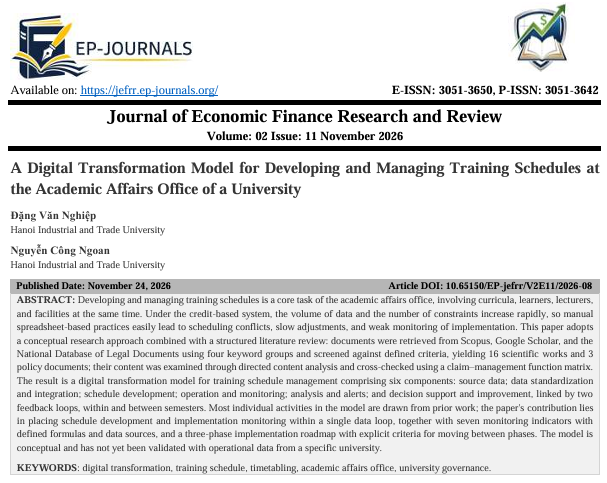
A Digital Transformation Model for Developing and Managing Training Schedules at the Academic Affairs Office of a University
DOI:
https://doi.org/10.65150/EP-jefrr/V2E11/2026-08Keywords:
digital transformation, training schedule, timetabling, academic affairs office, university governance.Abstract
Developing and managing training schedules is a core task of the academic affairs office, involving curricula, learners, lecturers, and facilities at the same time. Under the credit-based system, the volume of data and the number of constraints increase rapidly, so manual spreadsheet-based practices easily lead to scheduling conflicts, slow adjustments, and weak monitoring of implementation. This paper adopts a conceptual research approach combined with a structured literature review: documents were retrieved from Scopus, Google Scholar, and the National Database of Legal Documents using four keyword groups and screened against defined criteria, yielding 16 scientific works and 3 policy documents; their content was examined through directed content analysis and cross-checked using a claim–management function matrix. The result is a digital transformation model for training schedule management comprising six components: source data; data standardization and integration; schedule development; operation and monitoring; analysis and alerts; and decision support and improvement, linked by two feedback loops, within and between semesters. Most individual activities in the model are drawn from prior work; the paper's contribution lies in placing schedule development and implementation monitoring within a single data loop, together with seven monitoring indicators with defined formulas and data sources, and a three-phase implementation roadmap with explicit criteria for moving between phases. The model is conceptual and has not yet been validated with operational data from a specific university.
References
1) Prime Minister, 2020. Decision No. 749/QD-TTg dated 3 June 2020 approving the National Digital Transformation Programme to 2025, with orientation to 2030. Hanoi (in Vietnamese).
2) Prime Minister, 2022. Decision No. 131/QD-TTg dated 25 January 2022 approving the Scheme on Strengthening the Application of Information Technology and Digital Transformation in Education and Training for the 2022–2025 period, with orientation to 2030. Hanoi (in Vietnamese).
3) Benavides, L. M. C., Tamayo Arias, J. A., Arango Serna, M. D., Branch Bedoya, J. W., Burgos, D., 2020. Digital transformation in higher education institutions: A systematic literature review. Sensors, 20(11), 3291. DOI: https://doi.org/10.3390/s20113291.
4) Alenezi, M., 2021. Deep dive into digital transformation in higher education institutions. Education Sciences, 11(12), 770.DOI: https://doi.org/10.3390/educsci11120770.
5) Ministry of Education and Training, 2021. Circular No. 08/2021/TT-BGDDT dated 18 March 2021 promulgating the Regulation on undergraduate training. Hanoi (in Vietnamese).
6) Schaerf, A., 1999. A survey of automated timetabling. Artificial Intelligence Review, 13(2), 87–127.DOI: https://doi.org/10.1023/A:1006576209967.
7) Ceschia, S., Di Gaspero, L., Schaerf, A., 2023. Educational timetabling: Problems, benchmarks, and state-of-the-art results. European Journal of Operational Research, 308(1), 1–18. DOI: https://doi.org/10.1016/j.ejor.2022.07.011.
8) Vial, G., 2019. Understanding digital transformation: A review and a research agenda. The Journal of Strategic Information Systems, 28(2), 118–144.
DOI: ttps://doi.org/10.1016/j.jsis.2019.01.003.
9) Rodríguez-Abitia, G., Bribiesca-Correa, G., 2021. Assessing digital transformation in universities. Future Internet, 13(2), 52.DOI: https://doi.org/10.3390/fi13020052.
10) Mohamed Hashim, M. A., Tlemsani, I., Matthews, R., 2022. Higher education strategy in digital transformation. Education and Information Technologies, 27(3), 3171–3195. DOI: https://doi.org/10.1007/s10639-021-10739-1.
11) Daniel, B., 2015. Big Data and analytics in higher education: Opportunities and challenges. British Journal of Educational Technology, 46(5), 904–920.
DOI: https://doi.org/10.1111/bjet.12230.
12) Burke, E. K., Petrovic, S., 2002. Recent research directions in automated timetabling. European Journal of Operational Research, 140(2), 266–280.
DOI: https://doi.org/10.1016/S0377-2217(02)00069-3.
13) Lewis, R., 2008. A survey of metaheuristic-based techniques for university timetabling problems. OR Spectrum, 30(1), 167–190.
DOI: https://doi.org/10.1007/s00291-007-0097-0.
14) Babaei, H., Karimpour, J., Hadidi, A., 2015. A survey of approaches for university course timetabling problem. Computers & Industrial Engineering, 86, 43–59.
DOI: https://doi.org/10.1016/j.cie.2014.11.010.
15) Chen, M. C., Sze, S. N., Goh, S. L., Sabar, N. R., Kendall, G., 2021. A survey of university course timetabling problem: Perspectives, trends and opportunities. IEEE Access, 9, 106515–106529. DOI: https://doi.org/10.1109/ACCESS.2021.3100613.
16) Rudová, H., Müller, T., Murray, K., 2011. Complex university course timetabling. Journal of Scheduling, 14(2), 187–207.DOI: https://doi.org/10.1007/s10951-010-0171-3.
17) Müller, T., Rudová, H., 2016. Real-life curriculum-based timetabling with elective courses and course sections. Annals of Operations Research, 239(1), 153–170.
DOI: https://doi.org/10.1007/s10479-014-1643-1.
18) Dumas, M., La Rosa, M., Mendling, J., Reijers, H. A., 2018. Fundamentals of Business Process Management (2nd ed.). Springer, Berlin. DOI: https://doi.org/10.1007/978-3-662-56509-4.
19) Sarikaya, A., Correll, M., Bartram, L., Tory, M., Fisher, D., 2019. What do we talk about when we talk about dashboards? IEEE Transactions on Visualization and Computer Graphics, 25(1), 682–692. DOI: https://doi.org/10.1109/TVCG.2018.2864903.
20) Jaakkola, E., 2020. Designing conceptual articles: Four approaches. AMS Review, 10(1–2), 18–26.DOI: https://doi.org/10.1007/s13162-020-00161-0.
21) Snyder, H., 2019. Literature review as a research methodology: An overview and guidelines. Journal of Business Research, 104, 333–339.
DOI: https://doi.org/10.1016/j.jbusres.2019.07.039.
22) Hsieh, H.-F., Shannon, S. E., 2005. Three approaches to qualitative content analysis. Qualitative Health Research, 15(9), 1277–1288.
Downloads
Published
Issue
Section
License
Copyright (c) 2026 Đặng Văn Nghiệp, Nguyễn Công Ngoan (Author)

This work is licensed under a Creative Commons Attribution 4.0 International License.