Challenges and Prospects of IPSAS Implementation in the Ghanaian Public Sector: A Case Study of the Western Regional Coordinating Council
DOI:
https://doi.org/10.65150/EP-jefrr/V2E3/2026-05Keywords:
IPSAS challenges, IPSAS prospects, public sector accounting reform, accrual accounting, Ghana, Western Regional Coordinating CouncilAbstract
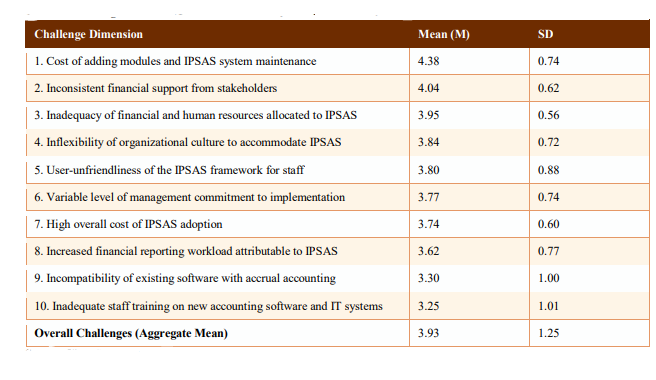
This study examines the challenges and prospects associated with the adoption and implementation of International Public Sector Accounting Standards (IPSAS) at the Western Regional Coordinating Council (WRCC) in Ghana. Drawing on a quantitative descriptive research design with a census sample of 84 finance, audit, and management personnel, the study employs descriptive statistics including means and standard deviations to analyze responses collected via a structured five-point Likert scale questionnaire. The findings reveal that IPSAS implementation at the WRCC is confronted with significant challenges, most prominently high maintenance and module costs (M = 4.38, SD = 0.74), inconsistent stakeholder financial support (M = 4.04, SD = 0.62), inadequate financial and human resources (M = 3.95, SD = 0.56), and inflexible organizational culture (M = 3.84, SD = 0.72). Despite these barriers, respondents identify a broadly favorable outlook for IPSAS, with anticipated benefits including enhanced performance evaluation (M = 4.19, SD = 0.57), superior asset acquisition decision support (M = 4.32, SD = 0.72), improved financial comparability (M = 4.09, SD = 0.57), and reduced fraud and corruption (M = 3.53, SD = 0.83). The overall prospects mean of 3.48 (SD = 0.60) reflects a cautiously optimistic consensus. The study is theoretically grounded in New Public Management theory and Stakeholder theory, offering a nuanced analysis of how resource constraints and institutional cultures mediate the IPSAS reform agenda. The findings carry actionable implications for policymakers, public financial management practitioners, and institutional leaders seeking to advance IPSAS adoption in Ghana and comparable developing-country contexts.
References
1) Abimbola, A. O., Adebayo, O. S., & Olayinka, O. M. (2017). The impact of IPSAS adoption on local government financial accountability in Oyo State, Nigeria. International Journal of Accounting, 53, 1–14.
2) Ademola, G. O., Musa, J. N., & Oke, M. I. (2020). Stakeholder perceptions and IPSAS implementation outcomes in Nigerian public sector entities. Journal of Public Financial Management, 12(1), 33–50.
3) Andriani, Y., Kober, R., & Ng, J. (2010). Decision usefulness of cash and accrual information: Public sector managers' perceptions. Australian Accounting Review, 20(2), 144–153.
4) Andrews, M. (2020). The capability trap in public financial management reform: How reform efforts succeed and fail in developing countries. Development Policy Review, 38(3), 318–336.
5) Atieno, R. O. (2019). The impact of IPSAS implementation on public sector accounting practices in developing countries: A case study of Kenya. Journal of Public Administration and Finance Law, 14(2), 1–18.
6) Azrina, A., & Nafsiah, M. (2014). Readiness of Malaysian public sector employees in accounting roles toward accrual accounting: A study of the Ministry of Education. Journal of Public Sector Accounting, 6(2), 14–29.
7) Balogun, J. A. (2019). Challenges of IPSAS implementation in developing countries: A review of the literature. International Journal of Accounting, 58, 1–16.
8) Bevir, M. (2011). Governance and governmentality after neoliberalism. Policy & Politics, 39(4), 457–471.
9) Breen, S. (2018). Ghana gets one step closer to implementing International Public Sector Accounting Standards. CIPFA. Retrieved from https://www.cipfa.org
10) Brown, A., & Pallot, J. (2019). IPSAS implementation and financial reporting transparency: Evidence from the Pacific region. International Journal of Public Administration, 42(7), 565–578.
11) Christiaens, J., Vanhee, C., Manes-Rossi, F., Aversano, N., & Van Cauwenberge, P. (2015). The effect of IPSAS on reforming governmental financial reporting: An international comparison. International Review of Administrative Sciences, 81(1), 158–177. https://doi.org/10.1177/0020852314546580
12) Creswell, J. W. (2013). Research design: Qualitative, quantitative, and mixed methods approaches (4th ed.). SAGE Publications.
13) Dambrin, C., Lambert, C., & Sponem, S. (2007). Control and change: Analysing the process of institutionalisation. Management Accounting Research, 18(2), 172–208.
14) De Luca, F., & Prather-Kinsey, J. (2018). Legitimacy theory may explain the failure of global adoption of IFRS: The case of Europe and the US. Journal of Management and Governance, 22(3), 501–534.
15) DiMaggio, P. J., & Powell, W. W. (1983). The iron cage revisited: Institutional isomorphism and collective rationality in organizational fields. American Sociological Review, 48(2), 147–160.
16) Dissanayake, T. (2017). The diffusion of new public financial management innovation in developing countries: Evidence from Sri Lanka (Doctoral dissertation, RMIT University).
17) Ekeatte, K. O., Essien, E., & Ukoh, N. E. (2019). The effectiveness of IPSAS implementation in developing countries: A case study of Nigeria. International Journal of Accounting, 57, 1–14.
18) Freeman, R. E. (1984). Strategic management: A stakeholder approach. Pitman.
19) Freeman, R. E., Wicks, A. C., & Parmar, B. (2004). Stakeholder theory and 'the corporate objective revisited'. Organization Science, 15(3), 364–369.
20) Ghana Local Governance Act (Act 936). (2016). Parliament of the Republic of Ghana.
21) Hancock, D. R., & Algozzine, B. (2017). Doing case study research: A practical guide for beginning researchers (3rd ed.). Teachers College Press.
22) Heo, M., Kim, N., & Faith, M. S. (2015). Statistical power as a function of Cronbach alpha of instrument questionnaire items. BMC Medical Research Methodology, 15(1), 1–9.
23) Hood, C. (1991). A public management for all seasons? Public Administration, 69(1), 3–19.
24) Institute of Chartered Accountants, Ghana (ICAG). (2010). Public sector accounting. ICAG.
25) Institute of Chartered Accountants, Ghana (ICAG). (2015). Public sector accounting (revised ed.). ICAG.
26) IPSASB. (2015). The International Public Sector Accounting Standards (IPSASs) Handbook. International Federation of Accountants.
27) Ijeoma, N. B., & Oghoghomeh, T. (2014). Adoption of international public sector accounting standards in Nigeria: Expectations, benefits and challenges. Journal of Investment and Management, 3(1), 21–29.
28) Jayasinghe, K., Nath, N. D., & Othman, R. (2015). The public sector accounting, accountability and auditing in emerging economies: Insights, gaps and some new ways forward. Emerald Group Publishing.
29) Kotter, J. P. (1996). Leading change. Harvard Business School Press.
30) Krejcie, R. V., & Morgan, D. W. (1970). Determining sample size for research activities. Educational and Psychological Measurement, 30(3), 607–610.
31) Majid, J. A., & Adam, N. C. (2015). Resistance to institutional change through decoupling. Mediterranean Journal of Social Sciences, 6(4), 531–540.
32) Meyer, J. W., & Rowan, B. (1977). Institutionalized organizations: Formal structure as myth and ceremony. American Journal of Sociology, 83(2), 340–363.
33) Miraj, J., & Wang, Z. (2019). Factors influencing the implementation of International Public Sector Accounting Standards in Pakistan. International Journal of Business and Management, 14(9), 15–22.
34) Moawiah, A. A., & Rosnia, M. R. (2018). Issues on public sector accounting reform in Jordan. Journal of Modern Accounting and Auditing, 16(3), 130–139.
35) Mohammed, A. H. A. (2014). Government accounting system reform and the adoption of IPSAS in Iraq. Research Journal of Finance and Accounting, 5(24), 1–20.
36) Nkwagu, N., Ogbogu, E. E., & Chukwunta, S. C. (2018). The impact of IPSAS adoption on the quality of financial reporting in Nigeria. International Journal of Accounting, 56, 115–130.
37) Nor-Aziah, A. K., & Scapens, R. W. (2007). Corporatisation and accounting change: The role of accounting and accountants in a Malaysian public utility. Management Accounting Research, 18(2), 209–247.
38) Orlando, D., Florio, C. D., & D'Onofrio, D. (2019). The impact of IPSAS adoption on financial reporting quality in Italy: A multi-level analysis. Journal of Accounting and Public Policy, 67, 106429.
39) PricewaterhouseCoopers. (2013). Towards a new era in government accounting and reporting. PwC Public Sector Research Centre.
40) Salia, H., & Atuilik, W. A. (2018). Factors influencing the implementation of IPSAS in Liberia. Journal of Public Sector Accounting, 10(1), 44–61.
41) Sarstedt, M., Bengart, P., Shaltoni, A. M., & Lehmann, S. (2018). The use of sampling methods in advertising research: A gap between theory and practice. International Journal of Advertising, 37(4), 650–663.
42) Saunders, M., Lewis, P., & Thornhill, A. (2019). Research methods for business students (8th ed.). Pearson Education.
43) Vasicek, O., & Roje, S. (2019). Harmonization of accounting standards in the world: The role of IFRS, IPSASs and EFRAG. International Journal of Accounting, 58, 1–22.
44) Whitefield, A. A., & Savvas, P. (2016). The adoption and implementation of the International Public Sector Accounting Standards: Challenges faced by the United Nations in producing UN-IPSAS compliant financial reports in Kenya. International Journal of Finance and Accounting, 1(1), 75–91.
45) World Bank. (2013). Public financial management reform in Sub-Saharan Africa: What does the evidence tell us? World Bank Poverty Reduction and Economic Management Network.
Downloads
Published
Issue
Section
License
Copyright (c) 2026 Eric Hope, Reginald Asiaw, Emmanuel Amoah, John Kwame Adu Jack, Kofi Obeng Acheampong (Author)

This work is licensed under a Creative Commons Attribution 4.0 International License.