Psychological Contract and Organisational Citizen Behaviour in the Nigerian Context
DOI:
https://doi.org/10.65150/EP-jefrr/V2E4/2026-05Keywords:
Psychological contract, transactional contract, relational contract, transitional contract, balanced contract, organisational citizenship behaviourAbstract
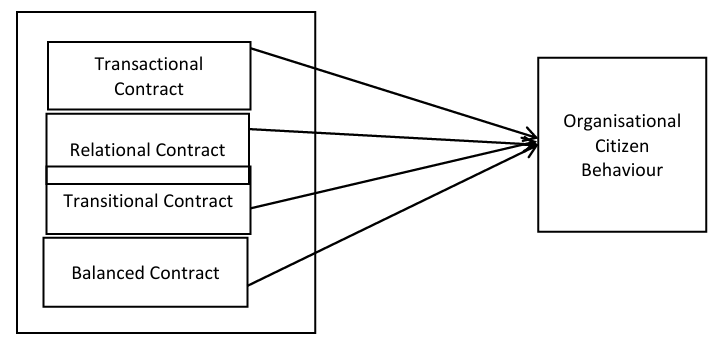
In the Nigerian context, limited empirical research exists on voluntary work behaviours as influenced by the psychological contract, which is essential for a nuanced understanding of the employment relationship. This study, therefore, examined the effect of psychological contract on organisational citizenship behaviour (OCB). A cross-sectional research design was adopted, and primary data were obtained through the administration of structured questionnaires. The data were analysed using both descriptive and inferential statistical techniques. The findings revealed that psychological contract significantly predicts OCB in the Nigerian context (R² = .420, F = 29.845, p < .001). Specifically, transactional contract (β = .388, t = 4.120, p < .001) and balanced contract (β = .761, t = 3.651, p < .001) had significant positive effects on OCB. However, relational and transitional contracts did not show any statistically significant influence on OCB. The study concludes that psychological contract is a key determinant of organisational citizenship behaviour in Nigeria. The findings have important implications for stakeholders in the employment sector, particularly in addressing brain drain and enhancing employee retention strategies for improved individual and organisational performance.
References
1) Adebayo, D. O., Akanmode, J. A., & Udegbe, I. B. (2007). The importance of spirituality in the relationship between psychological contract violation and cynicism in the Nigeria police. The police journal, 80(2), 141-166. Suggestion
2) Aluko, H. A., Aluko, A., & Ogunjimi, F. (2022). The implications of psychological contract on employee job performance in education service delivery: a study of ebonyi state university. Open Journal of Business and Management, 10(2), 978-999.
3) Akinselure, J. O. (2021). Necessity of Disclosing Reasons for Termination of Employment: Dissecting the Radical Departure from the Common Law Principle of Termination at Will. Journal of Commercial and Property Law, 8(3), 126-134.
4) Akinwale, A. A., Shadare, A. O., & Aliyu, M. O. (2021). Breach of psychological contracts and discretionary behaviour in Nigerian academics. Journal of Business Management and Accounting (JBMA), 11(1), 21-44.
5) Aliyu, M. O., Akinwal, A. A., & Shadar, A. O. (2020). Psychological Contracts And Discretionary Behaviour In Nigerian Academics. Acta Oeconomica Universitatis Selye, 9(1).
6) Anyaoku, C. (2022). Role of psychological contract on perceived organizational support and job satisfaction among hotel workers in Awka, Anambra State, Nigeria. Journal of Psychology and Behavioural Disciplines, Coou, 2(1), 42-52. Aykan, E. (2014). Effects of perceived psychological
7) Armstrong, M. (2009). Armstrong’s handbook of human resource management practice 11th edition.
8) Balogun, A. G. (2023). Examining the interplay of perceived organizational justice and psychological contract breach on police corruption in Nigeria. Policing: A Journal of Policy and Practice, 17, paac103.
9) Blau, P. M. (1964). Justice in social exchange. Sociological inquiry, 34(2).
10) Chahar, B. (2019). Psychological contract and organizational citizenship behavior: Exploring the interelatedness through cross validation. Academy of Strategic Management Journal, 18(1), 1-15.
11) Deas, A. (2021). Psychological contract of digital natives: are we measuring what they expect?. Redefining the psychological contract in the digital era: Issues for research and practice, 297-313.
12) Dhanpat, N. (2021). Psychological contract: What to expect?. Redefining the psychological contract in the digital era: Issues for research and practice, 9-36.
13) Du, Y., & Liu, H. (2020). Analysis of the influence of psychological contract on employee safety behaviors against COVID-19. International Journal of Environmental Research and Public Health, 17(18), 6747.
14) Gouldner, A. W. (1960). The norm of reciprocity: A preliminary statement. American sociological review, 161-178.
15) Guest, D. E. (1998). Is the psychological contract worth taking seriously?. Journal of Organizational Behavior: The International Journal of Industrial, Occupational and Organizational Psychology and Behavior, 19(S1), 649-664.
16) Joel, O., Moses, C., Igbinoba, E., Maxwell, O., Salau, O., & Omobolanle, A. (2022). Psychological contract and employee performance in the Nigerian manufacturing industry: A conceptual review. Academy of Entrepreneurship Journal, 28(1), 1-10.
17) Kanu, G. C., Ugwu, L. E., Ogba, F. N., Ujoatuonu, I. V., Ezeh, M. A., Eze, A., ... & Ugwu, L. I. (2022, March). Psychological contract breach and turnover intentions among lecturers: The moderating role of organizational climate. In Frontiers in Education (Vol. 7, p. 784166). Frontiers.
18) Kelloway, E. K., Weigand, H., Mckee, M. C., & Das, H. (2013). Positive leadership and employee well-being. Journal of Leadership & Organizational Studies, 20(1), 107-117.
19) Low, C. H., Bordia, P., & Bordia, S. (2016). What do employees want and why? An exploration of employees’ preferred psychological contract elements across career stages. Human Relations, 69(7), 1457-1481.
20) Mehmood, K., Jabeen, F., Iftikhar, Y., Yan, M., Khan, A. N., AlNahyan, M. T., ... & Alhammadi, B. A. (2022). Elucidating the effects of organisational practices on innovative work behavior in UAE public sector organisations: the mediating role of employees’ wellbeing. Applied Psychology: Health and Well‐Being, 14(3), 715-733.
21) Nnaji-Ihedinmah, N., Osisioma, H., & Ugwu, K. E. (2020). Psychological contract and employee performance in the construction industry in South-East Nigeria. The International Journal of Business & Management ISSN, 2321-8916.
22) Ogbeide, D. O., & Etafo, B. (2022). Psychological contract breach and engagement of academics in tertiary institutions in Nigeria. Journal of Academic Research in Economics, 14(2), 195-227.
23) Organ, D. W. (1988). Organizational citizenship behavior: The good soldier syndrome. Lexington books/DC heath and com.
24) Rousseau, D. M. (1989). Psychological and implied contracts in organizations. Employee responsibilities and rights journal, 2, 121-139.
25) Santos, G. G., Pinho, J. C., Ferreira, A. P., & Vieira, M. (2024). Psychological contract breach and organizational citizenship behaviours: the moderating role of contract type. Management Research Review, 47(1), 18-44.
26) Schein, E. H. (1965). Organizational Psychology, Prentice-Hall, Englewood Clis, NJ
27) Srivastava, S., & Madan, P. (2016). Understanding the roles of organizational identification, trust and corporate ethical values in employee engagement–organizational citizenship behaviour relationship: A study on indian managers. Management and Labour Studies, 41(4), 314-330.
Downloads
Published
Issue
Section
License
Copyright (c) 2026 Idowu Owoeye (Author)

This work is licensed under a Creative Commons Attribution 4.0 International License.