After-Sales Service Quality and Customer Satisfaction in Emerging Banking Markets: Evidence from Vietnam
DOI:
https://doi.org/10.65150/EP-jefrr/V2E4/2026-07Keywords:
After-sales service quality; Customer satisfaction; Banking sector; SERVQUAL; Emerging marketsAbstract
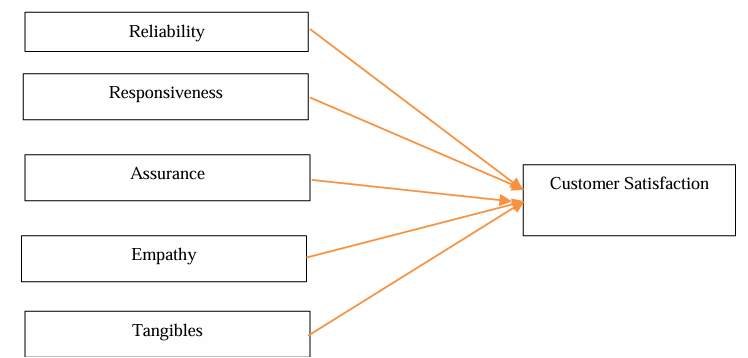
This study examines the impact of after-sales service quality on customer satisfaction in the banking sector, focusing on an emerging market context. Drawing on the SERVQUAL framework and integrating insights from Expectation-Confirmation Theory and Relationship Marketing, the study analyzes data collected from 316 customers of a commercial bank. Using exploratory factor analysis and multiple regression, the results indicate that all five dimensions of service quality significantly influence customer satisfaction. Among these, tangibles and reliability exert the strongest effects, highlighting the importance of physical service evidence and consistent service performance in shaping customer perceptions. The findings extend existing literature by repositioning service quality within the after-sales context and emphasizing its role as a relational mechanism. Managerially, the study suggests that banks should enhance post-service interactions to improve customer experience and sustain long-term relationships.
References
1) Cronin, J. J., & Taylor, S. A. (1992). Measuring service quality: A reexamination and extension. Journal of Marketing, 56(3), 55–68.
2) Hair, J. F., Black, W. C., Babin, B. J., & Anderson, R. E. (2010). Multivariate data analysis (7th ed.). Pearson.
3) Jahan, N., Fang, Y., Wu, R., & Alam, M. J. (2023). SERVQUAL to determine relationship quality and behavioral intentions: An SEM approach in retail banking. Sustainability, 15(8), 6536
4) Khan, F. N., Arshad, M. U., & Munir, M. (2023). Impact of e-service quality on e-loyalty of online banking customers: The mediating role of e-satisfaction. Future Business Journal, 9(23).
5) Kim, L., Jindabot, T., & Yeo, S. F. (2024). Understanding customer loyalty in banking industry: A systematic review and meta-analysis. Heliyon, 10(17), e36619
6) Lassar, W. M., Manolis, C., & Winsor, R. D. (2000). Service quality perspectives and satisfaction in private banking. Journal of Services Marketing, 14(3), 244–271
7) Morgan, R. M., & Hunt, S. D. (1994). The commitment-trust theory of relationship marketing. Journal of Marketing, 58(3), 20–38.
8) Nguyen, H. M., Ho, T. K. T., & Ngo, T. T. (2024). The impact of service innovation on customer satisfaction and customer loyalty: A case in Vietnamese retail banks. Future Business Journal, 10(61).
9) Oliver, R. L. (1980). A cognitive model of the antecedents and consequences of satisfaction decisions. Journal of Marketing Research, 17(4), 460–469.
10) Parasuraman, A., Zeithaml, V. A., & Berry, L. L. (1988). SERVQUAL: A multiple-item scale for measuring consumer perceptions of service quality. Journal of Retailing, 64(1), 12–40.
11) Wang, C.-K., Masukujjaman, M., Alam, S. S., Ahmad, I., Lin, C.-Y., & Ho, Y.-H. (2023). The effects of service quality performance on customer satisfaction for non-banking financial institutions in an emerging economy. International Journal of Financial Studies, 11(1), 33.
Downloads
Published
Issue
Section
License
Copyright (c) 2026 Nguyen Thi Viet Ha, Nguyen Thi Thuy Trang (Author)

This work is licensed under a Creative Commons Attribution 4.0 International License.