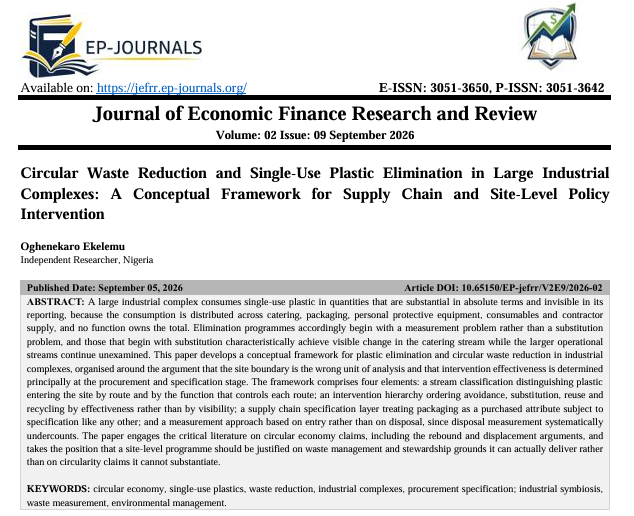
Circular Waste Reduction and Single-Use Plastic Elimination in Large Industrial Complexes: A Conceptual Framework for Supply Chain and Site-Level Policy Intervention
DOI:
https://doi.org/10.65150/EP-jefrr/V2E9/2026-02Keywords:
circular economy, single-use plastics, waste reduction, industrial complexes, procurement specification, industrial symbiosis, waste measurement, environmental management.Abstract
A large industrial complex consumes single-use plastic in quantities that are substantial in absolute terms and invisible in its reporting, because the consumption is distributed across catering, packaging, personal protective equipment, consumables and contractor supply, and no function owns the total. Elimination programmes accordingly begin with a measurement problem rather than a substitution problem, and those that begin with substitution characteristically achieve visible change in the catering stream while the larger operational streams continue unexamined. This paper develops a conceptual framework for plastic elimination and circular waste reduction in industrial complexes, organised around the argument that the site boundary is the wrong unit of analysis and that intervention effectiveness is determined principally at the procurement and specification stage. The framework comprises four elements: a stream classification distinguishing plastic entering the site by route and by the function that controls each route; an intervention hierarchy ordering avoidance, substitution, reuse and recycling by effectiveness rather than by visibility; a supply chain specification layer treating packaging as a purchased attribute subject to specification like any other; and a measurement approach based on entry rather than on disposal, since disposal measurement systematically undercounts. The paper engages the critical literature on circular economy claims, including the rebound and displacement arguments, and takes the position that a site-level programme should be justified on waste management and stewardship grounds it can actually deliver rather than on circularity claims it cannot substantiate.
References
1) Abdulhadi, B. M., & Hamdan, A. M. (2026a). Carbon-driven decision gates: Integrating embodied carbon accounting into construction project lifecycle governance. Research Journal of Pure Science and Technology, 9(5), 48-82.https://doi.org/10.56201/rjpst.vol.9.no5.2026.pg48.82
2) Abdulhadi, B. M., & Hamdan, A. M. (2026c). Sustainability-linked contracting and incentive alignment in integrated project delivery: A conceptual framework. International Journal of Social Sciences and Management Research, 12(6), 466-501.https://doi.org/10.56201/ijssmr.vol.12no6.2026.pg466.501
3) Abetoh, N. F., & Atakpa, M. I. (2024). Audit analytics in healthcare financial oversight: Leveraging data science to strengthen accountability in multilateral grant ecosystems. International Journal of Scientific Research in Computer Science, Engineering and Information Technology, 10(6), 2710-2747. https://doi.org/10.32628/CSEIT2410791
4) Abioye, K. M., Ike, C. C., Sam-Bulya, N. J., Mustapha, A. Y., & Ayodeji, D. C. (2023). Automated ESG reporting in energy projects: A framework for improving transparency and compliance. International Journal of Multidisciplinary Research and Growth Evaluation, 4(6), 998-1005.
5) Abrahams, L. S., Samaras, C., Griffin, W. M., & Matthews, H. S. (2015). Life cycle greenhouse gas emissions from U.S. liquefied natural gas exports: Implications for end uses. Environmental Science and Technology, 49(5), 3237-3245.
6) Adegbite, M. P., Adebayo, A., & Ahmed, M. O. (2022). A security architecture model for IT and OT convergence in regulated energy networks: Design principles and governance alignment. International Journal of Computer Science and Mathematical Theory, 8(2), 81-132. https://doi.org/10.56201/ijcsmt.v8.no2.2022.pg81.132
7) Adegbite, M. P., Adebayo, A., & Ahmed, M. O. (2025). A cyber risk quantification and governance architecture for critical infrastructure: From posture measurement to executive reporting. International Journal of Computer Science and Mathematical Theory, 11(12), 232-293. https://doi.org/10.56201/ijcsmt.vol.11.no12.2025.pg232.293
8) Adelanwa, A., Basnet, A., & Anene, U. N. (2024). Performance intelligence models for optimization and outcome measurement in large scale public services. Shodhshauryam, International Scientific Refereed Research Journal, 6(1).
9) Adenuga, O. M. (2023). Power electronics and energy efficiency in modern power systems: A comprehensive review of devices, converter topologies, and system-level practice. International Journal of Engineering and Modern Technology, 9(3), 287-312.
https://doi.org/10.56201/ijcsmt.v9.no3.2023.pg287.312
10) Adeyelu, O. O., & Dagodzo, D. (2024a). A maturity model for predicting airport safety audit outcomes in resource-constrained regulatory environments. International Journal of Scientific Research in Civil Engineering, 8(4), 132-170. https://doi.org/10.32628/IJSRCE248423
11) Adeyelu, O. O. (2018). A predictive compliance monitoring framework for detecting systemic safety risks through aviation consumer complaint data. Iconic Research and Engineering Journals, 1(8), 250-276. https://doi.org/10.64388/IREV1I8-1718478
12) Adeyelu, O. O. (2019). An adaptive safety management system implementation model for aerodromes in developing economy contexts. Iconic Research and Engineering Journals, 3(4), 628-654. https://doi.org/10.64388/IREV3I4-1718479
13) Adeyelu, O. O. (2026). A root-cause investigation framework for recurring runway wildlife hazards and standardized corrective action protocols at Nigerian international airports. International Journal of Social Sciences and Management Research, 12(5), 842-880. https://doi.org/10.67163/ijssmr.vol.12no5.2026.pg842.880
14) Adikwu, F. E., Erhueh, O. V., Esiri, A. E., Aderamo, A. T., & Akano, O. A. (2024). Global HSE regulatory frameworks and their impact on operational efficiency in the energy sector. International Journal of Frontiers in Engineering and Technology Research, 7(2), 57-69.
15) Adikwu, F. E., Ozobu, C. O., Odujobi, O., Onyekwe, F. O., & Nwulu, E. O. (2025). A comprehensive review of health risk assessments and their impact on occupational health programs in large-scale manufacturing plants. International Journal of Multidisciplinary Research and Growth Evaluation, 6(1), 1525-1538.
16) Afrihyia, E., Akinse, S. G., & Ojukwu, P. U. (2024). Comparative governance of AI-driven healthcare management: Executive oversight, regulatory structures, and accountability in the United States and developing countries. International Journal of Advanced Multidisciplinary Research and Studies, 4(6), 3087-3102. https://doi.org/10.62225/2583049X.2024.4.6.5920
17) Afrihyia, E., Ojukwu, P. U., & Akinse, S. G. (2024). Privacy-preserving health data governance models: A comparative review of blockchain and cryptographic strategies in U.S. and developing healthcare systems. International Journal of Advanced Multidisciplinary Research and Studies, 4(6), 3071-3086. https://doi.org/10.62225/2583049X.2024.4.6.5919
18) Agbabiaka, J., Okonkwo, C. S., Ogunwole, O., Mayo, W., & Okeke, O. T. (2019). Supply chain risk management model for EPC and gas processing projects. IRE Journals, 3(2), 968-980.
19) Agu, M. U., Akomolafe, O., & Bello, A. (2023a). A comparative review of SOX compliance frameworks in cross-border financial auditing. International Journal of Advanced Multidisciplinary Research and Studies, 3(6), 2297-2306.https://doi.org/10.62225/2583049X.2023.3.6.5362
20) Ahiaeke Patrick, M. C., Okonkwo, C. S., Mayo, W., & Okeke, O. T. (2021). Model for data driven vendor evaluation and bid selection using geospatial intelligence. Shodhshauryam, International Scientific Refereed Research Journal, 4(4), 426-443.https://doi.org/10.32628/SHISRRJ214461
21) Aifuwa, S. E., Oshoba, T. O., Ogbuefi, E., Ike, P. N., Nnabueze, S. B., & Olatunde-Thorpe, J. (2020). Predictive analytics models enhancing supply chain demand forecasting accuracy and reducing inventory management inefficiencies. International Journal of Multidisciplinary Research and Growth Evaluation, 1(3), 171-181. https://doi.org/10.54660/.IJMRGE.2020.1.3.171-181
22) Akanbi, O., & Sunday, E. A. (2024). An integrated path-planning and slotting optimization model for AMR-enabled high-density warehousing. International Journal of Advanced Multidisciplinary Research and Studies, 4(6), 3226-3243.https://doi.org/10.62225/2583049X.2024.4.6.6181
23) Akinleye, O. K., & Adeyoyin, O. (2021). Process automation framework for enhancing procurement efficiency and transparency. Shodhshauryam, International Scientific Refereed Research Journal, 4(4), 356-387.
24) Akinleye, O. K. (2023). Framework for quantitative evaluation of ESG adoption within SME supply chains in emerging economies. International Journal of Advanced Multidisciplinary Research and Studies, 3(6), 2317-2334.
25) Akin-Oluyomi, O. T., Atima, M. E., & Akinleye, O. K. (2023a). Green procurement strategies for balancing cost efficiency with long-term environmental responsibility. International Journal of Advanced Multidisciplinary Research and Studies, 3(6), 2183-2193.
26) Akin-Oluyomi, O. T., Atima, M. E., & Akinleye, O. K. (2024). Cross-border supplier relationship management frameworks for pharmaceutical and global construction sectors. International Journal of Multidisciplinary Research and Growth Evaluation, 5(6), 1709-1718.
27) Akomolafe, O., Agu, M. U., & Bello, A. (2023a). A conceptual model for implementing risk-based auditing in strategic financial management. International Journal of Advanced Multidisciplinary Research and Studies, 3(6), 2274-2286.https://doi.org/10.62225/2583049X.2023.3.6.5359
28) Akomolafe, O., Agu, M. U., & Bello, A. (2025). A conceptual model for advancing risk governance through data-driven compliance analytics in financial institutions. Journal of Accounting and Financial Management, 11(11), 211-228.https://doi.org/10.56201/jafm.vol.11.no11.2025.pg211.228
29) Akomolafe, O., Olaogun, B. O., Adesuyi, M. O., Ndukwe, V. U., & Sakyi, J. K. (2022). Smart contract automation model for supplier payment systems and performance benchmarking. International Journal of Multidisciplinary Research and Growth Evaluation, 3(6), 827-836. https://doi.org/10.54660/.IJMRGE.2022.3.6.827-836
30) Aliliele, C., Mbonu, I. S., & Iwuanyanwu, U. (2024a). A conceptual framework for enterprise data sensitivity classification and regulatory traceability mechanisms. International Journal of Advanced Multidisciplinary Research and Studies, 4(6), 3103-3124.https://doi.org/10.62225/2583049X.2024.4.6.5991
31) Amadi, C. E., Ale, O. K., Okorafor, U. C., Okwah, M. N., Akanbi, P. O., Mbakwem, A. C., & Ajuluchukwu, J. N. (2026). Unmasking the contemporary burden of hypertension in Lagos, Nigeria: Insights from an opportunistic screening. BMC Public Health. Advance online publication. https://doi.org/10.1186/s12889-026-26310-x
32) Amayo, E. B., Owulade, O. A., & Isi, L. R. (2023a). Optimizing project governance in multinational infrastructure projects: Insights from General Electric's global operations. International Journal of Multidisciplinary Research and Growth Evaluation, 4(1), 975-983.https://doi.org/10.54660/.IJMRGE.2023.4.1.975-983
33) Amayo, E. B., Owulade, O. A., & Isi, L. R. (2023b). Risk management strategies and compliance frameworks in healthcare infrastructure projects: Case studies from West Africa. International Journal of Management and Organizational Research, 2(1), 161-168.https://doi.org/10.54660/IJMOR.2023.2.1.161-168
34) Amayo, E. B., Owulade, O. A., & Isi, L. R. (2024a). Best practices for managing data center lifecycle projects: Ensuring security, efficiency, and compliance in U.S. enterprises. Iconic Research and Engineering Journals, 7(7), 598-617.
35) American Petroleum Institute. (2016). Process safety performance indicators for the refining and petrochemical industries (API Recommended Practice 754, 2nd ed.). API Publishing Services.
36) Aminu-Ibrahim, A. Y., & Ogbete, J. C. (2023). Healthcare infrastructure as a public health intervention using evidence from large laboratory networks. Shodhshauryam, International Scientific Refereed Research Journal, 6(1), 256-286.https://doi.org/10.32628/SHISRRJ23678
37) Anene, U. N., & Clement, T. (2022). A resilient logistics framework for humanitarian supply chains: Integrating predictive analytics, IoT, and localized distribution to strengthen emergency response systems. International Journal of Scientific Research in Computer Science, Engineering and Information Technology, 8(5), 398-424.
38) Aniji, I. F., Chizoba, C. E., & Ahmed, M. O. (2026). Digitalizing procurement processes: An online automated auction system: Design, implementation and evaluation. Middle East Journal of Applied Science and Technology, 9(1), 11-22.https://doi.org/10.46431/mejast.2026.9102
39) Annan, A. O. (2022). Data privacy governance models for cross-border digital platforms. International Journal of Multidisciplinary Research and Growth Evaluation, 3(6), 949-964.
40) Annan, A. O. (2025b). Cybersecurity compliance as a source of competitive advantage in technology markets. International Journal of Scientific Research in Computer Science, Engineering and Information Technology, 11(5), 456-487.
41) Arumosoye, O. M., & Obriki, O. D. (2020). A governance-oriented conceptual model for contractor safety performance in multi-contract industrial projects. International Journal of Multidisciplinary Research and Growth Evaluation, 1(5), 728-740.https://doi.org/10.54660/.IJMRGE.2020.1.5.728-740
42) Arumosoye, O. M., Obriki, O. D., & Ozobu, C. O. (2025). Conceptual framework for environmental risk control and ESG performance through waste handling and operational discipline. Gyanshauryam, International Scientific Refereed Research Journal, 8(4), 177-198.
43) Asiedu, C. S., & Asiedu, A. A. (2024b). Reconceptualizing quality assurance in pharmaceutical manufacturing as a determinant of supply reliability. International Journal of Health and Pharmaceutical Research, 9(5), 148-173.https://doi.org/10.56201/ijhpr.v9.no5.2024.pg148.173
44) Asiedu, C. S. (2026). Toward a systems-level framework for healthcare access, affordability, and supply chain resilience. International Journal of Health and Pharmaceutical Research, 11(5), 128-156. https://doi.org/10.56201/ijhpr.vol.11.no5.2026.pg128.156
45) Asiedu, W., & Quainoo, R. (2023b). Toward maintenance free wireless infrastructure: Simulating performance and reliability in large scale intermittently powered IoT networks. Gyanshauryam, International Scientific Refereed Research Journal, 6(1), 489-510.
46) Asiedu, W., Quainoo, R., & Asiedu, A. (2026). Predictive power management for intermittent IoT devices using lightweight machine learning under uncertain energy harvest. Gulf Journal of Engineering and Technology, 2(4), 108-118.
47) Babatope, O. M., Akokodaripon, D. A., Akinleye, O. K., & Okoruwa, P. O. (2023). The role of data visualization in enhancing strategic procurement decision-making effectiveness. International Journal of Advanced Multidisciplinary Research and Studies, 3(6), 2205-2212.
48) Badmus, O., Dosunmu, A. A., & Ozowara, D. E. (2019a). A conceptual model for ETL design and data integration in Salesforce-centric enterprise architectures. Iconic Research and Engineering Journals, 3(5).
49) Balcombe, P., Anderson, K., Speirs, J., Brandon, N., & Hawkes, A. (2017). The natural gas supply chain: The importance of methane and carbon dioxide emissions. ACS Sustainable Chemistry and Engineering, 5(1), 3-20.
50) Bello, A., Akomolafe, O., & Agu, M. U. (2023). A conceptual framework for data-driven procurement risk management in multinational enterprises. International Journal of Advanced Multidisciplinary Research and Studies, 3(6), 2307-2316.https://doi.org/10.62225/2583049X.2023.3.6.5363
51) Bello, K. A., Azeez, T. M., Tawose, O. M., Odesanya, K. O., Odumosu, O. A., & Oyelaran, O. A. (2023). Investigating the influence of rubber seed oil and used cooking oil on diesel. E3S Web of Conferences, 430, Article 01217.https://doi.org/10.1051/e3sconf/202343001217
52) Bello, K. A., Oyelaran, O. A., Tawose, O. M., Omoyi, C. O., & Yussouff, A. A. (2024). Development of a gum production machine from Manihot esculenta waste peels. FUOYE Journal of Innovation Science and Technology, 2(1).https://www.jist.fuoye.edu.ng/index.php/jist/article/view/48
53) Blomsma, F., & Brennan, G. (2017). The emergence of circular economy: A new framing around prolonging resource productivity. Journal of Industrial Ecology, 21(3), 603-614.
54) Bocken, N. M. P., de Pauw, I., Bakker, C., & van der Grinten, B. (2016). Product design and business model strategies for a circular economy. Journal of Industrial and Production Engineering, 33(5), 308-320.
55) Boiral, O. (2007). Corporate greening through ISO 14001: A rational myth? Organization Science, 18(1), 127-146.
56) Borrelle, S. B., Ringma, J., Law, K. L., Monnahan, C. C., Lebreton, L., McGivern, A., Murphy, E., Jambeck, J., Leonard, G. H., Hilleary, M. A., Eriksen, M., Possingham, H. P., De Frond, H., Gerber, L. R., Polidoro, B., Tahir, A., Bernard, M., Mallos, N., Barnes, M., & Rochman, C. M. (2020). Predicted growth in plastic waste exceeds efforts to mitigate plastic pollution. Science, 369(6510), 1515-1518.
57) Carter, C. R., & Rogers, D. S. (2008). A framework of sustainable supply chain management: Moving toward new theory. International Journal of Physical Distribution and Logistics Management, 38(5), 360-387.
58) Center for Chemical Process Safety. (2007). Guidelines for risk based process safety. Wiley.
59) Center for Chemical Process Safety. (2010). Guidelines for process safety metrics. Wiley.
60) Chertow, M. R. (2000). Industrial symbiosis: Literature and taxonomy. Annual Review of Energy and the Environment, 25, 313-337.
61) Chertow, M. R. (2007). Uncovering industrial symbiosis. Journal of Industrial Ecology, 11(1), 11-30.
62) Cho, C. H., Laine, M., Roberts, R. W., & Rodrigue, M. (2015). Organized hypocrisy, organizational facades, and sustainability reporting. Accounting, Organizations and Society, 40, 78-94.
63) Corvellec, H., Stowell, A. F., & Johansson, N. (2022). Critiques of the circular economy. Journal of Industrial Ecology, 26(2), 421-432.
64) Dagodzo, D., & Ahiaeke Patrick, M. C. (2021b). An integrated framework for UAV, LiDAR, and GIS in infrastructure corridor management. International Journal of Scientific Research in Computer Science, Engineering and Information Technology, 7(5), 497-524. https://doi.org/10.32628/CSEIT217566
65) Dahlén, L., & Lagerkvist, A. (2008). Methods for household waste composition studies. Waste Management, 28(7), 1100-1112.
66) Dekker, S. (2003). Failure to adapt or adaptations that fail: Contrasting models on procedures and safety. Applied Ergonomics, 34(3), 233-238.
67) Delmas, M. A., & Burbano, V. C. (2011). The drivers of greenwashing. California Management Review, 54(1), 64-87.
68) Digitemie, W. N., Onyeke, F. O., Adewoyin, M. A., & Dienagha, I. N. (2025). Implementing circular economy principles in oil and gas: Addressing waste management and resource reuse for sustainable operations. International Journal of Multidisciplinary Research and Growth Evaluation, 6(1), 99-104.
69) Dosunmu, A. A., & Ogundele, P. O. (2019). Security audit and enterprise risk assessment frameworks for resilient information systems. Iconic Research and Engineering Journals, 3(5), 434-447. https://doi.org/10.64388/IREV3I5-1713225
70) Dosunmu, A. A., & Ogundele, P. O. (2024a). Breach and attack simulation frameworks for continuous validation of enterprise security controls. International Journal of Scientific Research in Computer Science, Engineering and Information Technology, 10(3), 1100-1119.
71) Dosunmu, A. A., & Ogundele, P. O. (2024b). Cyber risk quantification models for prioritizing enterprise security investment decisions. International Journal of Multidisciplinary Research and Growth Evaluation, 5(6), 1777-1785.https://doi.org/10.54660/.IJMRGE.2024.5.6.1777-1785
72) Dosunmu, A. A., & Ogundele, P. O. (2024d). Threat informed defence engineering models for measuring security control effectiveness at scale. International Journal of Advanced Multidisciplinary Research and Studies, 4(6), 2847-2858.
73) Dosunmu, A. A., & Ogundele, P. O. (2025b). Cyber defense performance measurement frameworks for executive and board level governance. Computer Science and IT Research Journal, 6(11), 895-913. https://doi.org/10.51594/csitrj.v6i11.2164
74) Ebhojie, O., Dogbatsey, E. A., & Oyeleye, A. O. (2023a). Audit liaison, corrective action planning, and control compliance in multinational organisations: A systematic literature review. International Journal of Advanced Multidisciplinary Research and Studies, 3(6), 2839-2850. https://doi.org/10.62225/2583049X.2023.3.6.6200
75) Edivri, J., & Oteri, O. (2024). A conceptual KPI-driven decision and optimization framework for IT service delivery, portfolio performance, and adoption. Gyanshauryam, International Scientific Refereed Research Journal, 7(1), 167-187.https://doi.org/10.32628/GISRRJ246643
76) Edjabou, M. E., Jensen, M. B., Götze, R., Pivnenko, K., Petersen, C., Scheutz, C., & Astrup, T. F. (2015). Municipal solid waste composition: Sampling methodology, statistical analyses, and case study evaluation. Waste Management, 36, 12-23.
77) Efobi, O. Z., Akinleye, O. K., & Fasawe, O. (2022a). Conceptual framework for sustainable procurement practices in local manufacturing enterprises in Africa. Gyanshauryam, International Scientific Refereed Research Journal, 5(6), 248-266.
78) Efobi, O. Z., Akinleye, O. K., & Fasawe, O. (2022b). Conceptual model for data-driven lean supply chain optimization in manufacturing and retail operations. International Journal of Scientific Research in Computer Science, Engineering and Information Technology, 8(2), 703-734. https://doi.org/10.32628/CSEIT2541335
79) Elvidge, C. D., Zhizhin, M., Baugh, K., Hsu, F.-C., & Ghosh, T. (2016). Methods for global survey of natural gas flaring from Visible Infrared Imaging Radiometer Suite data. Energies, 9(1), 14.
80) Eyetsemitan, R. A., Ambali, K. B., Oyeleye, A. O., & Fadayomi, O. (2020). Multi-stakeholder governance alignment in joint venture operations: A conceptual framework for coordinating business processes in highly regulated environments. Iconic Research and Engineering Journals, 4(4), 418-441. https://doi.org/10.64388/IREV4I4-1716955
81) Eyetsemitan, R. A., Ambali, K. B., Oyeleye, A. O., & Fadayomi, O. (2025). An integrated lean-digital framework for scaling small business operations: Synthesizing SOP design, automation, compliance, and change management. International Journal of Multidisciplinary Research and Growth Evaluation, 6(6), 1341-1360. https://doi.org/10.54660/IJMRGE.2025.6.6.1341-1360
82) Eyetsemitan, R. A., Oyeleye, A. O., Ambali, K. B., & Fadayomi, O. (2022). Standard operating procedures as strategic assets in small business operations: A systematic review and implementation framework. Gyanshauryam, International Scientific Refereed Research Journal, 5(2), 438-465. https://doi.org/10.32628/GISRRJ225356
83) Eyetsemitan, R. A., Oyeleye, A. O., Ambali, K. B., & Fadayomi, O. (2024b). Data-driven process optimization in micro-enterprises: A conceptual framework for funnel analysis and bottleneck identification. International Journal of Multidisciplinary Research and Growth Evaluation, 5(6), 1950-1968. https://doi.org/10.54660/IJMRGE.2024.5.6.1950-1968
84) Eze, F. I., Akinleye, O. K., & Anene, U. N. (2024a). Development of a cross-border regulatory harmonization model for African pharmaceutical markets: The ARCH-Model framework. International Journal of Health and Pharmaceutical Research, 9(5), 148-186.https://doi.org/10.56201/ijhpr.v9.no5.2024.pg148.186
85) Eze, F. I., Anene, U. N., & Akinleye, O. K. (2022b). Design of an integrated regulatory readiness maturity model for pharmaceutical companies seeking global market entry. International Journal of Health and Pharmaceutical Research, 7(1), 77-112.https://doi.org/10.56201/ijhpr.v7.no1.2022.pg77.112
86) Eze, F. I., Anene, U. N., & Akinleye, O. K. (2023). Pharmaceutical supply chain governance, environmental risk management, and sustainable access to essential medicines in emerging economies: The PSCG-ERM framework. International Journal of Health and Pharmaceutical Research, 8(4), 192-241. https://doi.org/10.56201/ijhpr.v8.no4.2023.pg192.241
87) Falegan, O. C., & Aniebonam, S. O. (2022). Conceptual framework for lifecycle risk assessment in offshore produced water management. Gyanshauryam, International Scientific Refereed Research Journal, 5(5), 322-345.
88) Falegan, O. C., & Aniebonam, S. O. (2025). Resource recovery and beneficial reuse of produced water in energy operations: A review of sustainable pathways. International Journal of Advanced Multidisciplinary Research and Studies, 5(6), 1959-1969.
89) Filani, O. M., Nnabueze, S. B., Ike, P. N., & Wedraogo, L. (2022). Real-time risk assessment dashboards using machine learning in hospital supply chain management systems. International Journal of Multidisciplinary Evolutionary Research, 3(1), 65-76. https://doi.org/10.54660/IJMER.2022.3.1.65-76
90) Finnveden, G., Hauschild, M. Z., Ekvall, T., Guinée, J., Heijungs, R., Hellweg, S., Koehler, A., Pennington, D., & Suh, S. (2009). Recent developments in life cycle assessment. Journal of Environmental Management, 91(1), 1-21.
91) Flin, R., O'Connor, P., & Crichton, M. (2008). Safety at the sharp end: A guide to non-technical skills. Ashgate.
92) Flyvbjerg, B. (2014). What you should know about megaprojects and why: An overview. Project Management Journal, 45(2), 6-19.
93) Fobellah, A. N. (2025a). Cognitive biases in financial decision-making: Implications for audit and risk management in large corporations: A conceptual review. International Journal of Science and Research Archive, 16(2), 17-22. https://doi.org/10.30574/ijsra.2025.16.2.2273
94) Font Vivanco, D., Kemp, R., & van der Voet, E. (2016). How to deal with the rebound effect? A policy-oriented approach. Energy Policy, 94, 114-125.
95) Galbraith, J. R. (1974). Organization design: An information processing view. Interfaces, 4(3), 28-36.
96) Geissdoerfer, M., Savaget, P., Bocken, N. M. P., & Hultink, E. J. (2017). The circular economy: A new sustainability paradigm? Journal of Cleaner Production, 143, 757-768.
97) Geyer, R., Jambeck, J. R., & Law, K. L. (2017). Production, use, and fate of all plastics ever made. Science Advances, 3(7), e1700782.
98) Gharfalkar, M., Court, R., Campbell, C., Ali, Z., & Hillier, G. (2015). Analysis of waste hierarchy in the European waste directive 2008/98/EC. Waste Management, 39, 305-313.
99) Ghisellini, P., Cialani, C., & Ulgiati, S. (2016). A review on circular economy: The expected transition to a balanced interplay of environmental and economic systems. Journal of Cleaner Production, 114, 11-32.
100) Githinji, L., & Atobatele, F. (2025b). Belonging-centered retention: A conceptual model linking mentorship, advising, and institutional belonging to persistence among underrepresented STEM students. Journal of Humanities and Social Policy, 11(10), 138-152. https://doi.org/10.56201/jhsp.vol.11.no10.2025.pg138.152
101) Grandia, J., Steijn, B., & Kuipers, B. (2015). It is not easy being green: Increasing sustainable public procurement behaviour. Innovation: The European Journal of Social Science Research, 28(3), 243-260.
102) Gray, R. (2010). Is accounting for sustainability actually accounting for sustainability, and how would we know? Accounting, Organizations and Society, 35(1), 47-62.
103) Hale, A., & Borys, D. (2013). Working to rule, or working safely? Part 1: A state of the art review. Safety Science, 55, 207-221.
104) Health and Safety Executive. (2006). Developing process safety indicators: A step-by-step guide for chemical and major hazard industries (HSG254). HSE Books.
105) Health and Safety Executive. (2007). Managing competence for safety-related systems. HSE Books.
106) Hellweg, S., & Milà i Canals, L. (2014). Emerging approaches, challenges and opportunities in life cycle assessment. Science, 344(6188), 1109-1113.
107) Hopewell, J., Dvorak, R., & Kosior, E. (2009). Plastics recycling: Challenges and opportunities. Philosophical Transactions of the Royal Society B, 364(1526), 2115-2126.
108) Hopkins, A. (2009). Thinking about process safety indicators. Safety Science, 47(4), 460-465.
109) Øien, K., Utne, I. B., & Herrera, I. A. (2011). Building safety indicators: Part 1, Theoretical foundation. Safety Science, 49(2), 148-161.
110) Ihwughwavwe, S. I., & Usiagu, G. S. (2024). Analyzing effective project management approaches to reduce LNG environmental footprint. International Journal of Scientific Research in Computer Science, Engineering and Information Technology, 10(4), 887-898.
111) Ike, C. C., Abioye, K. M., Sam-Bulya, N. J., Mustapha, A. Y., & Ayodeji, D. C. (2025). Digital twin-driven environmental compliance models for sustainable procurement in oil, gas, and utilities. International Journal of Multidisciplinary Research and Growth Evaluation, 6(1), 1461-1468.
112) Ike, P. N., Aifuwa, S. E., Nnabueze, S. B., Olatunde-Thorpe, J., Ogbuefi, E., Oshoba, T. O., & Akokodaripon, D. (2024a). Quantitative risk architecture for public-private partnerships: A multi-layered model for allocating public and private risk. International Journal of Advanced Multidisciplinary Research and Studies, 4(6), 2669-2682. https://doi.org/10.62225/2583049X.2024.4.6.5021
113) Ike, P. N., Ogbuefi, E., Nnabueze, S. B., Olatunde-Thorpe, J., Aifuwa, S. E., Oshoba, T. O., & Akokodaripon, D. (2021). Supplier relationship management strategies fostering innovation, collaboration, and resilience in global supply chain ecosystems. International Journal of Multidisciplinary Evolutionary Research, 2(2), 52-62. https://doi.org/10.54660/IJMER.2021.2.2.52-62
114) Ilodigwe, L., & Adesemoye, A. C. (2020). Advances in pharmacy-led delivery and access models for strengthening primary healthcare systems and expanding medicine availability in emerging markets. International Journal of Health and Pharmaceutical Research, 5(3), 78-96. https://doi.org/10.56201/ijhpr.vol.5.no3.2020.pg78.96
115) Ilodigwe, L., & Adesemoye, A. C. (2024b). Beyond technology: A strategic framework for building sustainable and resilient health systems through organizational strategy, operational excellence, and workforce capability. International Journal of Medical Evaluation and Physical Report, 8(6), 299-319. https://doi.org/10.56201/ijmepr.v8.no6.2024.pg299.319
116) International Organization for Standardization. (2006). Environmental management: Life cycle assessment, principles and framework (ISO 14040). ISO.
117) International Organization for Standardization. (2015). Environmental management systems: Requirements with guidance for use (ISO 14001). ISO.
118) Isiekwu, C. P., Oluwo, K., & Dada, T. (2021). A conceptual model for CFO-led strategic finance in joint venture and cross-border partnerships. Iconic Research and Engineering Journals, 4(7), 383-400. https://doi.org/10.64388/IREV4I7-1714350
119) Jambeck, J. R., Geyer, R., Wilcox, C., Siegler, T. R., Perryman, M., Andrady, A., Narayan, R., & Law, K. L. (2015). Plastic waste inputs from land into the ocean. Science, 347(6223), 768-771.
120) Jimoh, H. O., Ahmed, M. O., & Fagbade, M. O. (2023). The role of frameworks in cybersecurity governance. Journal of Behavioural Informatics, Digital Humanities and Development Research, 9(4), 7-16. https://doi.org/10.22624/AIMS/BHI/V9N4P2
121) Kerr, S. (1975). On the folly of rewarding A, while hoping for B. Academy of Management Journal, 18(4), 769-783.
122) Kirchherr, J., Piscicelli, L., Bour, R., Kostense-Smit, E., Muller, J., Huibrechtse-Truijens, A., & Hekkert, M. (2018). Barriers to the circular economy: Evidence from the European Union. Ecological Economics, 150, 264-272.
123) Kirchherr, J., Reike, D., & Hekkert, M. (2017). Conceptualizing the circular economy: An analysis of 114 definitions. Resources, Conservation and Recycling, 127, 221-232.
124) Komi, N. M., & Adamolekun, A. (2024). Quantifying a just transition: An econometric and skills-mapping analysis of worker displacement in the coal-to-renewable shift. International Journal of Scientific Research in Computer Science, Engineering and Information Technology, 10(3), 1242-1299. https://doi.org/10.32628/CSEIT25113587
125) Komi, N. M., & Adamolekun, A. (2026). A unified socio-technical design framework for equitable energy transition in resource-dependent regions. Global Journal of Engineering and Technology Review, 2(6), 189-221. https://doi.org/10.65150/EP-gjetr/V2E6/2026-04
126) Komi, N. M., & Ganiu, O. S. (2025). When universal programs deepen inequality: A critical review of intersectional frameworks for climate justice and energy poverty. International Journal of Advanced Multidisciplinary Research and Studies, 5(6), 2380-2412. https://doi.org/10.62225/2583049X.2025.5.6.6458
127) Komi, N. M. (2024). Turning social license into a measurable variable: Predicting community trust in renewable energy development. International Journal of Engineering and Modern Technology, 10(11), 239-296. https://doi.org/10.56201/ijemt.v10.no11.2024.pg239.296
128) Korhonen, J., Honkasalo, A., & Seppälä, J. (2018). Circular economy: The concept and its limitations. Ecological Economics, 143, 37-46.
129) Kpoka, M. I. (2024). Terminological challenges in the translation of civil registry and administrative documents. International Journal of Social Sciences and Management Research, 10(11), 552-578. https://doi.org/10.56201/ijssmr.v10.no11.2024.pg.552.578
130) Ladapo, O. O., Dosunmu, A. A., Jooda, D., & Abolaji, T. O. (2023b). An IT service management literature review: Challenges, benefits, opportunities, and implementation practices. International Journal of Advanced Multidisciplinary Research and Studies, 3(6), 2875-2889. https://doi.org/10.62225/2583049X.2023.3.6.6205
131) Ladapo, O. O., Dosunmu, A. A., Jooda, D., & Abolaji, T. O. (2025). Migration of applications and information systems to cloud computing infrastructure: Lessons from a South African retail bank. International Journal of Multidisciplinary Research and Growth Evaluation, 6(6), 1361-1375. https://doi.org/10.54660/.IJMRGE.2025.6.6.1361-1375
132) Law, K. L. (2017). Plastics in the marine environment. Annual Review of Marine Science, 9, 205-229.
133) Lawal, O. A., & Oduleye, T. E. (2021a). A conceptual decision model for capital allocation using financial analytics. Gyanshauryam, International Scientific Refereed Research Journal, 4(2), 269-295.
134) Lawrence, P. R., & Lorsch, J. W. (1967). Differentiation and integration in complex organizations. Administrative Science Quarterly, 12(1), 1-47.
135) Lebersorger, S., & Schneider, F. (2011). Discussion on the methodology for determining food waste in household waste composition studies. Waste Management, 31(9-10), 1924-1933.
136) Lebreton, L., & Andrady, A. (2019). Future scenarios of global plastic waste generation and disposal. Palgrave Communications, 5, 6.
137) Liadi, K. O. (2022a). A policy alignment model for Nigeria's foreign policy and global climate diplomacy goals. International Journal of Multidisciplinary Research and Growth Evaluation, 3(6), 790-801. https://doi.org/10.54660/.IJMRGE.2022.3.6.790-801
138) Liadi, K. O. (2023c). Designing an oil diplomacy diversification model: Assessing the shift from petroleum influence to broader economic engagement. Shodhshauryam, International Scientific Refereed Research Journal, 6(3), 418-447.https://doi.org/10.32628/SHISRRJ236925
139) Lilian, I. N., Liadi, K. O., & Yeboah, T. J. (2025a). Intersectionality, language, and identity: Multilingual perspectives on inclusion and social justice. Iconic Research and Engineering Journals, 8(9), 1761-1788. https://doi.org/10.64388/IREV8I9-1713695
140) Lilian, I. N., Liadi, K. O., Yeboah, T. J., & Apelehin, A. A. (2020). Understanding cross-cultural communication: Identity, diversity, and global interaction. Gyanshauryam, International Scientific Refereed Research Journal, 3(4), 153-176.https://doi.org/10.32628/GISRRJ21352
141) Lombardi, D. R., & Laybourn, P. (2012). Redefining industrial symbiosis: Crossing academic-practitioner boundaries. Journal of Industrial Ecology, 16(1), 28-37.
142) Lyon, T. P., & Montgomery, A. W. (2015). The means and end of greenwash. Organization and Environment, 28(2), 223-249.
143) MacLeod, M., Arp, H. P. H., Tekman, M. B., & Jahnke, A. (2021). The global threat from plastic pollution. Science, 373(6550), 61-65.
144) Marquis, C., Toffel, M. W., & Zhou, Y. (2016). Scrutiny, norms, and selective disclosure: A global study of greenwashing. Organization Science, 27(2), 483-504.
145) Merrow, E. W. (2011). Industrial megaprojects: Concepts, strategies, and practices for success. Wiley.
146) Michael, O. N., & Ogunsola, O. E. (2021d). Investigating the contribution of climate-smart agricultural practices to household food security and income stability. International Journal of Multidisciplinary Research and Growth Evaluation, 1(2), 209-219.https://doi.org/10.54660/IJMRGE.2020.1.2.209-219
147) Michael, O. N., & Ogunsola, O. E. (2023a). Applying quantitative agricultural economics models to improve food system efficiency and policy decision-making. Shodhshauryam, International Scientific Refereed Research Journal, 6(1), 228-255.
148) Michael, O. N., & Ogunsola, O. E. (2024b). Developing circular economy frameworks for waste reduction and resource efficiency in agricultural systems. International Journal of Scientific Research in Computer Science, Engineering and Information Technology, 10(8), 271-300.
149) Milios, L., Holm Christensen, L., McKinnon, D., Christensen, C., Rasch, M. K., & Hallstrom Eriksen, M. (2018). Plastic recycling in the Nordics: A value chain market analysis. Waste Management, 76, 180-189.
150) Mokhatab, S., Mak, J. Y., Valappil, J. V., & Wood, D. A. (2014). Handbook of liquefied natural gas. Gulf Professional Publishing.
151) Monye, S. I., Bello, K. A., Omotehinse, S. A., Ikumapayi, O. M., Tawose, O. M., Adeleke, T. B., Awogbemi, O., Monye, N. S., & Boboye, O. (2025). Achieving energy sustainability in Nigeria's telecommunications industry through renewable propane. NIPES Journal of Science and Technology Research, 7(2), 3320-3325. https://doi.org/10.37933/nipes/7.4.2025.SI398
152) Murray, A., Skene, K., & Haynes, K. (2017). The circular economy: An interdisciplinary exploration of the concept and application in a global context. Journal of Business Ethics, 140(3), 369-380.
153) Neves, A., Godina, R., Azevedo, S. G., & Matias, J. C. O. (2020). A comprehensive review of industrial symbiosis. Journal of Cleaner Production, 247, 119113.
154) Nnabueze, S. B., Ike, P. N., Olatunde-Thorpe, J., Aifuwa, S. E., Oshoba, T. O., Ogbuefi, E., & Akokodaripon, D. (2021). End-to-end visibility frameworks improving transparency, compliance, and traceability across complex global supply chain operations. International Journal of Multidisciplinary Futuristic Development, 2(2), 50-60. https://doi.org/10.54660/IJMFD.2021.2.2.50-60
155) Obogo, S. F., Arumosoye, O. M., & Obriki, O. D. (2020a). Advances in internal QHSE audit systems for industrial engineering operations. Iconic Research and Engineering Journals, 4(4), 399-417. https://doi.org/10.64388/IREV4I4-1715499
156) Obogo, S. F., Arumosoye, O. M., & Obriki, O. D. (2024). Review of sustainable environmental practices in occupational safety management systems. International Journal of Scientific Research in Civil Engineering, 8(3), 164-196.
157) Obogo, S. F., Ozobu, C. O., & Nwafor, M. I. (2024). Conceptual environmental safety compliance framework for construction and infrastructure projects. International Journal of Scientific Research in Civil Engineering, 8(3), 132-163.
158) Obogo, S. F., Ozobu, C. O., & Uduokhai, D. O. (2019a). Advances in leadership driven safety culture transformation in large construction workforces. Iconic Research and Engineering Journals, 3(5), 507-523. https://doi.org/10.64388/IREV3I5-1715497
159) Obogo, S. F., Ozobu, C. O., & Uduokhai, D. O. (2019b). Development of a construction safety risk governance model for multi contractor high rise projects. Iconic Research and Engineering Journals, 2(9), 502-522. https://doi.org/10.64388/IREV2I9-1715495
160) Obogo, S. F., Uduokhai, D. O., & Ozobu, C. O. (2019). Systematic review of hazard identification and risk control practices in urban construction projects. Iconic Research and Engineering Journals, 2(12), 666-681. https://doi.org/10.64388/IREV2I12-1715496
161) Obogo, S. F., Uduokhai, D. O., & Ozobu, C. O. (2021). Review of contractor safety compliance systems in infrastructure engineering projects. International Journal of Scientific Research in Civil Engineering, 5(4), 76-100. https://doi.org/10.32628/IJSRCE215412
162) Obriki, O. D., & Arumosoye, O. M. (2018). Conceptual modeling of data-driven occupational safety risk control in large-scale energy infrastructure projects. Iconic Research and Engineering Journals, 1(7), 169-189. https://doi.org/10.64388/IREV1I7-1714414
163) Obriki, O. D., Obogo, S. F., & Arumosoye, O. M. (2022a). Advances in workforce safety training models for operational risk reduction. Gyanshauryam, International Scientific Refereed Research Journal, 5(6), 349-382. https://doi.org/10.32628/GISRRJ225638
164) Oduleye, T. E., & Medon, J. J. (2023a). A predictive model for optimizing cash flow and working capital management in corporations. Gyanshauryam, International Scientific Refereed Research Journal, 6(5), 739-754. https://doi.org/10.32628/GISRRJ236537
165) Ogbete, J. C., Aminu-Ibrahim, A. Y., & Ambali, K. B. (2018). Optimizing laboratory spatial planning strategies to improve diagnostic accuracy, safety, and clinical throughput. Iconic Research and Engineering Journals, 2(1), 87-113. https://doi.org/10.64388/IREV1I7-1713587
166) Ogbete, J. C., Aminu-Ibrahim, A. Y., & Ambali, K. B. (2019). Regulatory compliant design systems for molecular and pathology laboratories in highly controlled environments. Iconic Research and Engineering Journals, 3(4), 607-631.https://doi.org/10.64388/IREV3I4-1713589
167) Ogbete, J. C., Aminu-Ibrahim, A. Y., & Ambali, K. B. (2022). Design standards and operational planning frameworks for scalable blood collection networks. Gyanshauryam, International Scientific Refereed Research Journal, 5(6), 267-300.https://doi.org/10.32628/GISRRJ225635
168) Ogbete, J. C., Aminu-Ibrahim, A. Y., & Ambali, K. B. (2023). Lifecycle performance evaluation of purpose built diagnostic laboratories supporting long term healthcare delivery. International Journal of Advanced Multidisciplinary Research and Studies, 3(6), 2605-2621.https://doi.org/10.62225/2583049X.2023.3.6.5698
169) Ogbu, A. D., Eyo-Udo, N. L., Adeyinka, M. A., Ozowe, W., & Ikevuje, A. H. (2023). A conceptual procurement model for sustainability and climate change mitigation in the oil, gas, and energy sectors. World Journal of Advanced Research and Reviews, 20(3), 1935-1952.
170) Ogundairo, K. M., & Ayivi-Donkor, S. S. (2024a). Bridging the "adoption gap": Why supply chain AI fails without product marketing principles. International Journal of Marketing and Communication Studies, 8(5), 169-205.https://doi.org/10.56201/ijmcs.v8.no5.2024.pg169.205
171) Ogundairo, K. M. (2025). Hardening the autonomous value chain: Lean Six Sigma guardrails and multi-enterprise ETL architecture for agentic supply chain orchestration. IIARD International Journal of Economics and Business Management, 11(12), 441-478. https://doi.org/10.56201/ijebm.vol.11.no12.2025.pg441.478
172) Okojie, J. S., & Abioye, R. F. (2020). Reconciling chemical safety with circular-economy targets: A decision framework for post-consumer recycled polymers in consumer-goods packaging balancing REACH compliance, lifecycle GHG footprint, and regulatory risk. International Journal of Multidisciplinary Research and Growth Evaluation, 1(5), 992-1006.
173) Okojie, J. S., Filani, O. M., Ike, P. N., Okojokwu-Idu, J. O., Nnabueze, S. B., & Ihwughwavwe, S. I. (2023a). Integrating AI with ESG metrics in smart infrastructure auditing for high-impact urban development projects. International Journal of Multidisciplinary Futuristic Development, 4(1), 32-44. https://doi.org/10.54660/IJMFD.2023.4.1.32-44
174) Okonkwo, C. S., Agbabiaka, J., Mayo, W., & Okeke, O. T. (2024a). Conceptual framework for digital supply chain governance in energy and infrastructure sectors. Gyanshauryam, International Scientific Refereed Research Journal, 7(4), 335-356.https://doi.org/10.32628/GISRRJ247423
175) Okonkwo, C. S., Agbabiaka, J., Mayo, W., & Okeke, O. T. (2024c). Model for predictive procurement planning to sustain operational uptime. International Journal of Scientific Research in Humanities and Social Sciences, 1(2), 909-928.https://doi.org/10.32628/IJSRSSH242772
176) Okonkwo, C. S., Agbabiaka, J., Mayo, W., & Okeke, O. T. (2024d). Review of advances in procurement strategy, ERP adoption, and logistics performance. International Journal of Advanced Multidisciplinary Research and Studies, 4(6), 2827-2835.https://doi.org/10.62225/2583049X.2024.4.6.5495
177) Okonkwo, C. S., Agbabiaka, J., Ogunwole, O., Mayo, W., & Okeke, O. T. (2020). Model for demurrage elimination and port logistics efficiency in emerging economies. International Journal of Multidisciplinary Research and Growth Evaluation, 1(5), 552-562.https://doi.org/10.54660/IJMRGE.2020.1.5.552-562
178) Okonkwo, C. S., Agbabiaka, J., Ogunwole, O., Mayo, W., & Okeke, O. T. (2021). Conceptual model for materials readiness and maintenance-driven supply chain performance. International Journal of Multidisciplinary Research and Growth Evaluation, 2(6), 584-594.
179) Okonkwo, C. S., Agbabiaka, J., Okeke, O. T., & Mayo, W. (2025). Framework for national-scale supply chain optimization through integrated IT and procurement systems. Gulf Journal of Advance Business Research, 3(12), 1610-1625.https://doi.org/10.51594/gjabr.v3i12.189
180) Okonkwo, C. S., Ahiaeke Patrick, M. C., Okeke, O. T., & Mayo, W. (2023). Framework for integrating IT systems engineering with supply chain operations. International Journal of Advanced Multidisciplinary Research and Studies, 3(6), 2580-2589.https://doi.org/10.62225/2583049X.2023.3.6.5500
181) Okonkwo, C. S., Mayo, W., & Okeke, O. T. (2023). Conceptual model for asset lifecycle management and inventory visibility. International Journal of Scientific Research in Computer Science, Engineering and Information Technology, 10(1), 809-824.https://doi.org/10.32628/CSEIT2391568
182) Okonkwo, C. S., Ogunwole, O., & Okeke, O. T. (2018a). Framework for strategic procurement optimization in oil and gas operations. IRE Journals, 1(7), 153-168.
183) Okonkwo, C. S., Ogunwole, O., Mayo, W., & Okeke, O. T. (2021). Framework for regulatory-compliant procurement in high-risk energy environments. International Journal of Multidisciplinary Research and Growth Evaluation, 2(6), 595-605.https://doi.org/10.54660/IJMRGE.2021.2.6.595-605
184) Okonkwo, C. S., Ogunwole, O., Okeke, O. T., & Mayo, W. (2019). Conceptual framework for cost reduction through contract negotiation and vendor governance. IRE Journals, 2(9), 468-482.
185) Okoruwa, P. O., Babatope, O. M., Akokodaripon, D. A., & Akinleye, O. K. (2025). Digital procurement transformation approaches for strengthening efficiency in global supply chain management. International Journal of Multidisciplinary Research and Growth Evaluation, 6(5), 975-985.
186) Oladepo, O. O., & Oyediji, K. (2025a). A conceptual model for enterprise financial transformation, process optimization, and digital control systems. Gyanshauryam, International Scientific Refereed Research Journal, 8(6), 130-157.
187) Oladepo, O. O., & Oyediji, K. (2025b). A systematic review of project finance and public private partnership structures for infrastructure development. International Journal of Advanced Multidisciplinary Research and Studies, 5(6), 1765-1778.
188) Oladepo, O. O., & Oyediji, K. (2025c). A theoretical framework for executive compensation, incentive alignment, and performance management in capital intensive industries. Shodhshauryam, International Scientific Refereed Research Journal, 8(6), 97-127.
189) Olaogun, B. O., Adesuyi, M. O., Akomolafe, O., Ndukwe, V. U., & Sakyi, J. K. (2023). Regulatory compliance adaptation model for cross-border payment product redesign. International Journal of Advanced Multidisciplinary Research and Studies, 3(1), 1651-1662.https://doi.org/10.62225/2583049X.2023.3.1.5279
190) Oloto, A. M., & Yeboah, T. J. (2023). A systematic review of behavior intervention plan effectiveness in secondary special education programs. Gyanshauryam, International Scientific Refereed Research Journal, 6(6), 385.
191) Oluwadele, J. F., Tawose, O. M., Ekeocha, A. H., Adika, O. A., Arowosegbe, P. D., & Akinlabi, E. Y. (2025a). Alternative feeds for West African dwarf rams: A cost-benefit relationship and their long-term effect. Journal of the Selva Andina Animal Science, 12(1), 45-57.https://doi.org/10.36610/j.jsaas.2025.120100045
192) Oluwadele, J. F., Tawose, O. M., Ekeocha, A. H., Akinlabi, E. Y., Adeitan, O. O., & Bello, K. A. (2023). Physiological indicators and stress index of scavenging chickens at LAFARGE (Ewekoro) and DANGOTE (Ibese) cement factory areas of Ogun State, Nigeria. Journal of Austrian Society of Agricultural Economics, 19(4). https://www.sagepublisher.com/volume/JASAE/19/04
193) Omo Enabulele, A. B., Oyebamiji, I., Ikubanni, O., Okwah, M. N., Babalola, W. S., Azeez, O. M., & Olaniyi, A. O. (2025). A coordinated project-management approach to multisite implementation of motor-rehabilitation programs for children with autism spectrum disorder in United States healthcare systems: A narrative review. Cureus, 17(12), e100513. https://doi.org/10.7759/cureus.100513
194) Onche, V. O., Adegbite, M. P., & Ogbonna, C. S. (2026). Human factors in information security: A capability framework for administrative professionals in the digital workplace. World Journal of Innovation and Modern Technology, 10(5), 154-179. https://doi.org/10.56201/wjimt.v10.no5.2026.pg154.179
195) Onche, V. O., Ogbonna, C. S., & Adegbite, M. P. (2024). Effectiveness of cybersecurity awareness training on insider-threat behavior among university administrators: An integrative academic review. International Journal of Computer Science and Mathematical Theory, 10(2), 117-144. https://doi.org/10.56201/ijcsmt.v10.no2.2024.pg117.144
196) Orise, C., & Niniola, S. (2024). Digital equity in healthcare education: A systematic review of access frameworks and interventions for underrepresented learners in clinical training. International Journal of Scientific Research in Humanities and Social Sciences, 1(2), 1233-1246.
197) Oteri, O., & Edivri, J. (2024). Applied performance optimization frameworks for managing high-demand enterprise technology programs and system rollouts. Gyanshauryam, International Scientific Refereed Research Journal, 7(1), 188-210.
198) Oteri, O., & Edivri, J. (2026). An operational reliability and service assurance framework for enterprise IT systems supporting large user populations. Gulf Journal of Engineering and Technology, 2(1), 1-19. https://doi.org/10.51594/gjet.v2i1.205
199) Oyeleke, A. V., Eze, F. C., & Asiedu, W. (2026). Reliability-centered maintenance strategies for minimizing downtime and maximizing performance in high-density GPU cluster environments. International Journal of Engineering Technology Research & Management, 10(7), 18-38.
200) Ozobu, C. O., Adikwu, F. E., Odujobi, O., Onyekwe, F. O., & Nwulu, E. O. (2022). A conceptual model for reducing occupational exposure risks in high-risk manufacturing and petrochemical industries through industrial hygiene practices. International Journal of Social Science Exceptional Research, 1(1), 26-37.
201) Ozobu, C. O., Adikwu, F. E., Odujobi, O., Onyekwe, F. O., & Nwulu, E. O. (2025). A review of health risk assessment and exposure control models for hazardous waste management operations in Africa. International Journal of Advanced Multidisciplinary Research and Studies, 5(2), 570-582.
202) Ozowara, D. E., Adebayo, A., & Anunagba, C. O. (2025). Advanced conceptual model for strengthening audit quality using data analytics across financial institutions. International Journal of Advanced Multidisciplinary Research and Studies, 5(6), 2246-2268.https://doi.org/10.62225/2583049X.2025.5.6.6050
203) Ozowe, C., Ukato, A., Jambol, D. D., & Daramola, G. O. (2024). Technological innovations in liquefied natural gas operations: Enhancing efficiency and safety. Engineering Science and Technology Journal, 5(6), 1909-1929.
204) Preuss, L. (2009). Addressing sustainable development through public procurement: The case of local government. Supply Chain Management, 14(3), 213-223.
205) Ragaert, K., Delva, L., & Van Geem, K. (2017). Mechanical and chemical recycling of solid plastic waste. Waste Management, 69, 24-58.
206) Reason, J. (1997). Managing the risks of organizational accidents. Ashgate.
207) Reike, D., Vermeulen, W. J. V., & Witjes, S. (2018). The circular economy: New or refurbished as CE 3.0? Resources, Conservation and Recycling, 135, 246-264.
208) Reiman, T., & Pietikäinen, E. (2012). Leading indicators of system safety: Monitoring and driving the organizational safety potential. Safety Science, 50(10), 1993-2000.
209) Roman-White, S. A., Littlefield, J. A., Fleury, K. G., Allen, D. T., Balcombe, P., Konschnik, K. E., Ewing, J., Ross, G. B., & George, F. (2021). LNG supply chains: A supplier-specific life-cycle assessment for improved emission accounting. ACS Sustainable Chemistry and Engineering, 9(32), 10857-10867.
210) Sanni, J. O. (2026c). Marketing analytics frameworks addressing governance risk compliance decision making gaps for executives. International Journal of Marketing and Communication Studies, 10(1), 37-64. https://doi.org/10.56201/ijmcs.v10.no1.2026.pg37.64
211) Sanni, J. O., Ajiga, D., & Atima, M. E. (2020a). Analytical models addressing measurement challenges of marketing return on investment in regulated services. International Journal of Multidisciplinary Research and Growth Evaluation, 1(5), 636-648.https://doi.org/10.54660/IJMRGE.2020.1.5.636-648
212) Sanni, J. O., Atima, M. E., & Attah, A. (2022). Systematic review of attribution modeling methods resolving bias in multi-touch journeys. Shodhshauryam, International Scientific Refereed Research Journal, 5(1), 304-334. https://doi.org/10.32628/SHISRRJ247135
213) Sanni, J. O., Iwuanyanwu, U. A., & Essien, M. A. (2025). Problem-oriented process mining for auditable marketing automation lifecycle control. International Journal of Advanced Multidisciplinary Research and Studies, 5(6), 1933-1947.https://doi.org/10.62225/2583049X.2025.5.6.5650
214) Schmidt, C., Krauth, T., & Wagner, S. (2017). Export of plastic debris by rivers into the sea. Environmental Science and Technology, 51(21), 12246-12253.
215) Seuring, S., & Müller, M. (2008). From a literature review to a conceptual framework for sustainable supply chain management. Journal of Cleaner Production, 16(15), 1699-1710.
216) Singh, N., Hui, D., Singh, R., Ahuja, I. P. S., Feo, L., & Fraternali, F. (2017). Recycling of plastic solid waste: A state of art review and future applications. Composites Part B: Engineering, 115, 409-422.
217) Tawose, O. M., & Oluwadele, J. F. (2025). Comparative analysis of the nutritional potentials of selected tuber peel meals as feed supplements for ruminant animals. Nigerian Journal of Agriculture and Agricultural Technology, 5(3A).https://njaat.com.ng/index.php/njaat/article/view/1169
218) Tawose, O. M., Ekeocha, A. H., & Oluwadele, J. F. (2023). Nutritional quality and utilization of water hyacinth-cassava peels silage by West African dwarf (WAD) goats. FUOYE Journal of Agriculture and Human Ecology, 6(1), 35-45.
219) Testa, F., Rizzi, F., Daddi, T., Annunziata, E., Iraldo, F., & Frey, M. (2014). EMAS and ISO 14001: The differences in effectively improving environmental performance. Journal of Cleaner Production, 68, 165-173.
220) Thompson, J. D. (1967). Organizations in action: Social science bases of administrative theory. McGraw-Hill.
221) Tonoyan, A., Dada, O., & Ayivi-Donkor, S. S. (2024a). Advances in supply chain resilience: Predictive models for vendor risk assessment and procurement cost optimization. International Journal of Social Sciences and Management Research, 10(11), 525-551.
https://doi.org/10.56201/ijssmr.v10.no11.2024.pg.525.551
222) Tonoyan, A., Dada, O., & Ayivi-Donkor, S. S. (2025). A conceptual model for real-time route optimization: Algorithmic pathways to delivery profitability and logistics cost reduction. World Journal of Innovation and Modern Technology, 9(12), 308-364.https://doi.org/10.56201/wjimt.v9.no12.2025.pg308.364
223) Uduokhai, D. O., Nwafor, M. I., Sanusi, A. N., & Garba, B. M. P. (2024). System dynamics modeling of circular economy integration within the African construction industry. International Journal of Scientific Research in Humanities and Social Sciences, 1(2), 871-887.
224) Van Ewijk, S., & Stegemann, J. A. (2016). Limitations of the waste hierarchy for achieving absolute reductions in material throughput. Journal of Cleaner Production, 132, 122-128.
225) Verghese, K., & Lewis, H. (2007). Environmental innovation in industrial packaging: A supply chain approach. International Journal of Production Research, 45(18-19), 4381-4401.
226) Vollmer, I., Jenks, M. J. F., Roelands, M. C. P., White, R. J., van Harmelen, T., de Wild, P., van der Laan, G. P., Meirer, F., Keurentjes, J. T. F., & Weckhuysen, B. M. (2020). Beyond mechanical recycling: Giving new life to plastic waste. Angewandte Chemie International Edition, 59(36), 15402-15423.
227) Walawalkar, G., Adesuyi, M. O., Kalu, A., & Oduleye, T. E. (2025). Executive financial dashboards for real-time strategic oversight. International Journal of Advanced Multidisciplinary Research and Studies, 5(6), 2042-2054.
228) Walker, H., & Brammer, S. (2009). Sustainable procurement in the United Kingdom public sector. Supply Chain Management, 14(2),128-137.
229) Yeboah, B. K., & Ike, P. N. (2020). Programmatic strategy for renewable energy integration: Lessons from large-scale solar projects. International Journal of Multidisciplinary Research and Growth Evaluation, 1(3), 306-315.https://doi.org/10.54660/.IJMRGE.2020.1.3.306-315
230) Yeboah, T. J., & Oloto, A. M. (2023). Conceptual models for monitoring IEP implementation fidelity and educational service delivery outcomes. International Journal of Scientific Research in Computer Science, Engineering and Information Technology, 9(3), 944-973.
231) Yeboah, T. J., Bobga, M. A., Boakye, K., & Ogbona, C. S. (2019). Professional development and teacher competence in managing exceptional learners: A Ghanaian perspective. Iconic Research and Engineering Journals, 2(12), 618-636.https://doi.org/10.64388/IREV2I12-1714177
232) Yeboah, T. J., Bobga, M. A., Boakye, K., & Ogbona, C. S. (2022). Data-driven teaching: Using student progress data to personalize learning in special education classrooms. Journal of Frontiers in Multidisciplinary Research, 3(2), 225-240.https://doi.org/10.54660/.JFMR.2022.3.2.225-240
233) Yeboah, T. J., Bobga, M. A., Boakye, K., & Ogbona, C. S. (2025). Teacher resilience and retention in special education: Understanding the psychological factors behind burnout. International Journal of Advanced Multidisciplinary Research and Studies, 5(6), 2069-2086.
234) Zink, T., & Geyer, R. (2017). Circular economy rebound. Journal of Industrial Ecology, 21(3), 593-602.
Downloads
Published
Issue
Section
License
Copyright (c) 2026 Oghenekaro Ekelemu (Author)

This work is licensed under a Creative Commons Attribution 4.0 International License.