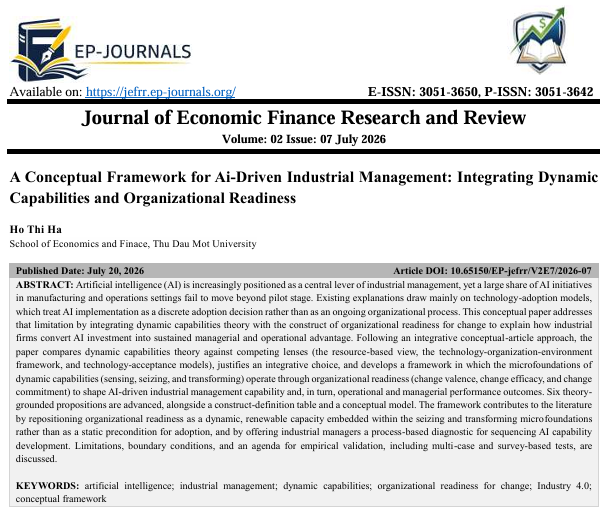
A Conceptual Framework for Ai-Driven Industrial Management: Integrating Dynamic Capabilities and Organizational Readiness
DOI:
https://doi.org/10.65150/EP-jefrr/V2E7/2026-07Keywords:
artificial intelligence, industrial management, dynamic capabilities, organizational readiness for change, Industry 4.0; conceptual frameworkAbstract
Artificial intelligence (AI) is increasingly positioned as a central lever of industrial management, yet a large share of AI initiatives in manufacturing and operations settings fail to move beyond pilot stage. Existing explanations draw mainly on technology-adoption models, which treat AI implementation as a discrete adoption decision rather than as an ongoing organizational process. This conceptual paper addresses that limitation by integrating dynamic capabilities theory with the construct of organizational readiness for change to explain how industrial firms convert AI investment into sustained managerial and operational advantage. Following an integrative conceptual-article approach, the paper compares dynamic capabilities theory against competing lenses (the resource-based view, the technology-organization-environment framework, and technology-acceptance models), justifies an integrative choice, and develops a framework in which the microfoundations of dynamic capabilities (sensing, seizing, and transforming) operate through organizational readiness (change valence, change efficacy, and change commitment) to shape AI-driven industrial management capability and, in turn, operational and managerial performance outcomes. Six theory-grounded propositions are advanced, alongside a construct-definition table and a conceptual model. The framework contributes to the literature by repositioning organizational readiness as a dynamic, renewable capacity embedded within the seizing and transforming microfoundations rather than as a static precondition for adoption, and by offering industrial managers a process-based diagnostic for sequencing AI capability development. Limitations, boundary conditions, and an agenda for empirical validation, including multi-case and survey-based tests, are discussed.
References
1) Alsheibani, S., Cheung, Y., & Messom, C. (2018). Artificial intelligence adoption: AI-readiness at firm-level. In Proceedings of the Pacific Asia Conference on Information Systems (PACIS) 2018. Association for Information Systems.
2) Armenakis, A. A., Harris, S. G., & Mossholder, K. W. (1993). Creating readiness for organizational change. Human Relations, 46(6), 681–703. https://doi.org/10.1177/001872679304600601
3) Chatterjee, S., Rana, N. P., Dwivedi, Y. K., & Baabdullah, A. M. (2021). Understanding AI adoption in manufacturing and production firms using an integrated TAM-TOE model. Technological Forecasting and Social Change, 170, Article 120880.
https://doi.org/10.1016/j.techfore.2021.120880
4) Davenport, T. H., & Ronanki, R. (2018). Artificial intelligence for the real world. Harvard Business Review, 96(1), 108–116.
5) Eisenhardt, K. M., & Martin, J. A. (2000). Dynamic capabilities: What are they? Strategic Management Journal, 21(10–11), 1105–1121. https://doi.org/10.1002/1097-0266(200010/11)21:10/11%3C1105::AID-SMJ133%3E3.0.CO;2-E
6) Fountaine, T., McCarthy, B., & Saleh, T. (2019). Building the AI-powered organization. Harvard Business Review, 97(4), 62–73.
7) Frank, A. G., Dalenogare, L. S., & Ayala, N. F. (2019). Industry 4.0 technologies: Implementation patterns in manufacturing companies. International Journal of Production Economics, 210, 15–26. https://doi.org/10.1016/j.ijpe.2019.01.004
8) Ghobakhloo, M. (2020). Industry 4.0, digitalization, and opportunities for sustainability. Journal of Cleaner Production, 252, Article 119869. https://doi.org/10.1016/j.jclepro.2019.119869
9) Holt, D. T., Armenakis, A. A., Feild, H. S., & Harris, S. G. (2007). Readiness for organizational change: The systematic development of a scale. The Journal of Applied Behavioral Science, 43(2), 232–255. https://doi.org/10.1177/0021886306295295
10) Jaakkola, E. (2020). Designing conceptual articles: Four approaches. AMS Review, 10(1–2), 18–26.https://doi.org/10.1007/s13162-020-00161-0
11) Jöhnk, J., Weißert, M., & Wyrtki, K. (2021). Ready or not, AI comes—An interview study of organizational AI readiness factors. Business & Information Systems Engineering, 63(1), 5–20. https://doi.org/10.1007/s12599-020-00676-7
12) Mikalef, P., & Gupta, M. (2021). Artificial intelligence capability: Conceptualization, measurement calibration, and empirical study on its impact on organizational creativity and firm performance. Information & Management, 58(3), Article 103434.
https://doi.org/10.1016/j.im.2021.103434
13) Rogers, E. M. (2003). Diffusion of innovations (5th ed.). Free Press.
14) Teece, D. J. (2007). Explicating dynamic capabilities: The nature and microfoundations of (sustainable) enterprise performance. Strategic Management Journal, 28(13), 1319–1350. https://doi.org/10.1002/smj.640
15) Teece, D. J., Pisano, G., & Shuen, A. (1997). Dynamic capabilities and strategic management. Strategic Management Journal, 18(7), 509–533. https://doi.org/10.1002/(SICI)1097-0266(199708)18:7%3C509::AID-SMJ882%3E3.0.CO;2-Z
16) Tornatzky, L. G., & Fleischer, M. (1990). The processes of technological innovation. Lexington Books.
17) Venkatesh, V., Morris, M. G., Davis, G. B., & Davis, F. D. (2003). User acceptance of information technology: Toward a unified view. MIS Quarterly, 27(3), 425–478. https://doi.org/10.2307/30036540
18) Wamba, S. F., Gunasekaran, A., Akter, S., Ren, S. J. F., Dubey, R., & Childe, S. J. (2017). Big data analytics and firm performance: Effects of dynamic capabilities. Journal of Business Research, 70, 356–365. https://doi.org/10.1016/j.jbusres.2016.08.009
19) Warner, K. S. R., & Wäger, M. (2019). Building dynamic capabilities for digital transformation: An ongoing process of strategic renewal. Long Range Planning, 52(3), 326–349. https://doi.org/10.1016/j.lrp.2018.12.001
20) Weiner, B. J. (2009). A theory of organizational readiness for change. Implementation Science, 4, Article 67. https://doi.org/10.1186/1748-5908-4-67
Downloads
Published
Issue
Section
License
Copyright (c) 2026 Ho Thi Ha (Author)

This work is licensed under a Creative Commons Attribution 4.0 International License.