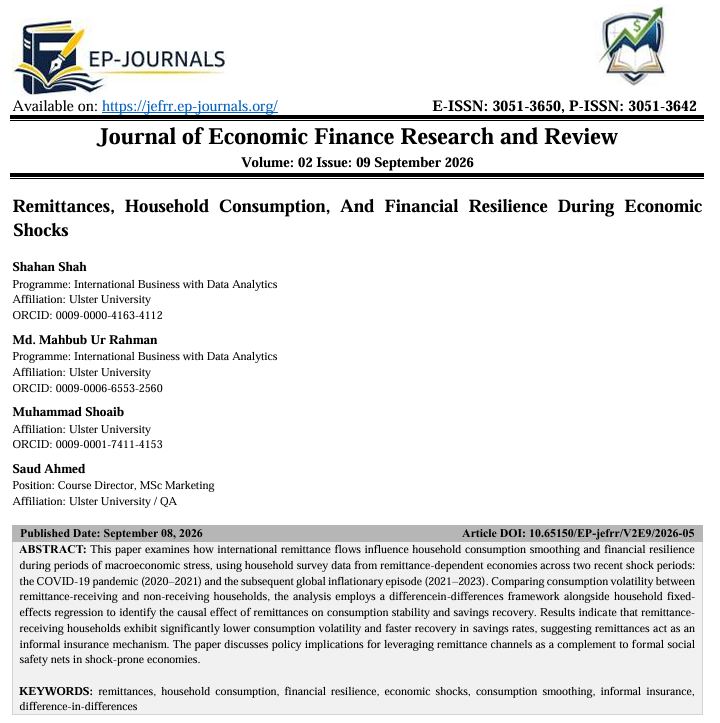
Remittances, Household Consumption, And Financial Resilience During Economic Shocks
DOI:
https://doi.org/10.65150/EP-jefrr/V2E9/2026-05Keywords:
remittances, household consumption, financial resilience, economic shocks, consumption smoothing, informal insurance, difference-in-differencesAbstract
This paper examines how international remittance flows influence household consumption smoothing and financial resilience during periods of macroeconomic stress, using household survey data from remittance-dependent economies across two recent shock periods: the COVID-19 pandemic (2020–2021) and the subsequent global inflationary episode (2021–2023). Comparing consumption volatility between remittance-receiving and non-receiving households, the analysis employs a differencein-differences framework alongside household fixed-effects regression to identify the causal effect of remittances on consumption stability and savings recovery. Results indicate that remittance-receiving households exhibit significantly lower consumption volatility and faster recovery in savings rates, suggesting remittances act as an informal insurance mechanism. The paper discusses policy implications for leveraging remittance channels as a complement to formal social safety nets in shock-prone economies.
References
1) Frankel, J. (2011). Are bilateral remittances countercyclical? Open Economies Review, 22(1), 1–16.
2) Lucas, R.E.B., & Stark, O. (1985). Motivations to remit: Evidence from Botswana. Journal of Political Economy, 93(5), 901–918.
3) Townsend, R.M. (1994). Risk and insurance in village India. Econometrica, 62(3), 539–591.
4) World Bank. (2021). Resilience: COVID-19 crisis through a migration lens. Migration and Development Brief 33. World Bank Group.
5) World Bank. (2024). Remittances remain resilient but are slowing. Migration and Development Brief 40. World Bank Group.
6) Acosta, P., Calderon, C., Fajnzylber, P., & Lopez, H. (2008). What is the impact of international remittances on poverty and inequality in Latin America? World Development, 36(1), 89–114.
7) Adams, R.H., & Page, J. (2005). Do international migration and remittances reduce poverty in developing countries? World Development, 33(10), 1645–1669.
8) Amuedo-Dorantes, C., & Pozo, S. (2011). New evidence on the role of remittances on healthcare expenditures by Mexican households. Review of Economics of the Household, 9(1), 69–98.
9) De la Briere, B., Sadoulet, E., De Janvry, A., & Lambert, S. (2002). The roles of destination, gender, and household composition in explaining remittances. Journal of Development Economics, 68(2), 309–328.
10) Giuliano, P., & Ruiz-Arranz, M. (2009). Remittances, financial development, and growth. Journal of Development Economics, 90(1), 144–152.
11) Gupta, S., Pattillo, C.A., & Wagh, S. (2009). Effect of remittances on poverty and financial development in Sub-Saharan Africa. World Development, 37(1), 104– 115.
12) Ratha, D. (2013). The impact of remittances on economic growth and poverty reduction. Migration Policy Institute Policy Brief,8,1–13.
13) Singer, D.A. (2010). Migrant remittances and exchange rate regimes in the developing world. American Political Science Review, 104(2), 307–323.
14) Catrinescu, N., Leon-Ledesma, M., Piracha, M., & Quillin, B. (2009). Remittances, institutions, and economic growth. World Development, 37(1), 81–92.
15) Mundaca, B.G. (2009). Remittances, financial market development, and economic growth: The case of Latin America and the Caribbean. Review of Development Economics, 13(2), 288–303.
Downloads
Published
Issue
Section
License
Copyright (c) 2026 Shahan Shah , Muhammad Shoaib, Haseeb Anwar (Author)

This work is licensed under a Creative Commons Attribution 4.0 International License.