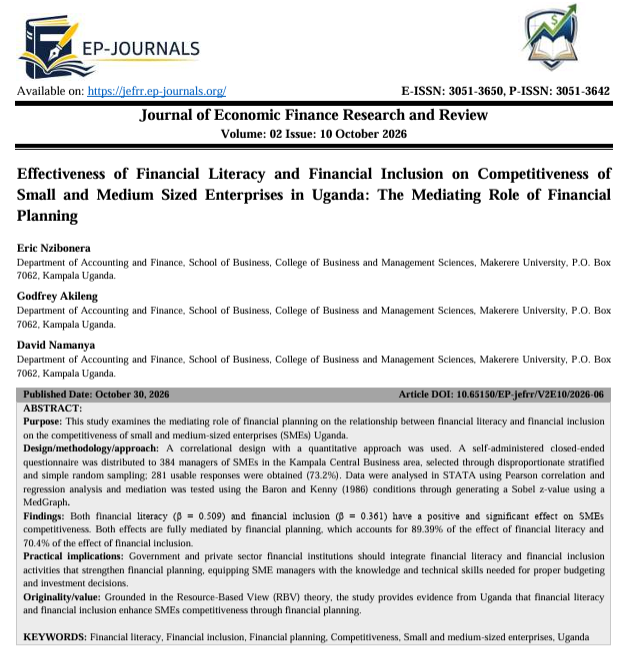
Effectiveness of Financial Literacy and Financial Inclusion on Competitiveness of Small and Medium Sized Enterprises in Uganda: The Mediating Role of Financial Planning
DOI:
https://doi.org/10.65150/EP-jefrr/V2E10/2026-06Keywords:
Financial literacy, Financial inclusion, Financial planning, Competitiveness, Small and medium-sized enterprises, UgandaAbstract
Purpose: This study examines the mediating role of financial planning on the relationship between financial literacy and financial inclusion on the competitiveness of small and medium-sized enterprises (SMEs) Uganda.
Design/methodology/approach: A correlational design with a quantitative approach was used. A self-administered closed-ended questionnaire was distributed to 384 managers of SMEs in the Kampala Central Business area, selected through disproportionate stratified and simple random sampling; 281 usable responses were obtained (73.2%). Data were analysed in STATA using Pearson correlation and regression analysis and mediation was tested using the Baron and Kenny (1986) conditions through generating a Sobel z-value using a MedGraph.
Findings: Both financial literacy (β = 0.509) and financial inclusion (β = 0.361) have a positive and significant effect on SMEs competitiveness. Both effects are fully mediated by financial planning, which accounts for 89.39% of the effect of financial literacy and 70.4% of the effect of financial inclusion.
Practical implications: Government and private sector financial institutions should integrate financial literacy and financial inclusion activities that strengthen financial planning, equipping SME managers with the knowledge and technical skills needed for proper budgeting and investment decisions.
Originality/value: Grounded in the Resource-Based View (RBV) theory, the study provides evidence from Uganda that financial literacy and financial inclusion enhance SMEs competitiveness through financial planning.
References
1) Adeosun, O. T., Shittu, A. I., & Ugbede, D. (2023). Disruptive financial innovations: The case of Nigerian micro-entrepreneurs. Journal of Business and Socio-Economic Development, 3(1), 17–35. https://doi.org/10.1108/JBSED-01-2021-0006
2) Agungu, S. S.H., & Chandra, W. (2020). Analysis of the effect of Financial literacy on financial planning for retirement: A case study of Lecturers and Administrative staffs in Universtas Indonesia. International Journal of Management, 11(5):741-750.
3) Akumu, O. R., Abuga, V. M., & Baraza,E. (2022). Effect of financial planning on growth of Small and Medium Enterprises in Kisumu City, Kenya. International Journal of Social Sciences and Information Technology, 3(2):16-28.
4) Amadasun, D.O.E., & Mutezo, A. T. (2022). Influence of access to finance on the competitive growth of SMEs in Lesotho. Journal of Innovation and Entrepreneurship (2022) 11:56 https://doi.org/10.1186/s13731-022-00244-1
5) Amram,R. B., Heni,M.S., & Maria . (2022). The role of competencies, Financial planning and access to Finance in explaining SMEs Financial Innovation. JMK (24) (1):44 -51.
6) Baranger, D. A., Finsaas, M. C., Goldstein, B. L., Vize, C. E., Lynam, D. R., & Olino, T. M. (2023). Tutorial: Power analyses for interaction effects in cross-sectional regressions. Advances in Methods and Practices in Psychological Science, 6(3), 2515.
7) Barney, J. (1991). Firm resources and sustained competitive advantage. Journal of management, 17(1), 99-120.
8) Baron, M.R & Kenny, A.D (1986). The moderator-mediator variable distinction in social psychological research: conceptual, strategic and statistical considerations. Journal of Personality and Social Psychology. 51(6), 1173-1182.
9) Basha, S.A., Bennasr, H. & Goaied, M. (2023). Financial literacy, financial development and leverage of small firms. International Review of Financial Analysis, 86 (2023), 102510.
10) Beal, D., & Delpachitra, S. (2003). Financial literacy among Australian university students. Economic Papers: A journal of applied economics and policy, 22(1), 65-78.
11) Creswell, J. W. (2014). Research Design: Qualitative, Quantitative, and Mixed Methods Approaches (4th ed.). London: Sage.
12) Ermawati. Y. (2025). Limited Access to Capital for SMEs and its Impact on Growth in Competitive Markets. Advances in Economics & Financial Studies, 3(1), 2025. 1 - 14 DOI: https://doi.org/10.60079/aefs.v3i1.426
13) Fariba, M., Fatin, A.P., Seth, S., Hamidreza,K. & Zaleha, I. (2012). Masterly goal, performance goals, student’s beliefs and academic success: Metacognition as a mediator. Procedia- Social and Behavioral sciences, 46 (2012): 3603 – 3608.
14) Fuller, L., Simons, J., & Garcia, P. (2020). Measuring reliability in survey research: Cronbach’s alpha revisited. Social Science Journal, 57(4), 412–425.
15) Ghimire, A., Danuwar, R. K., Gurung, B. K., Dhakal, A., Timalsina, D.P.& Baral, D.K. (2023). Financial Literacy and Personal Financial Planning among the House Holds of Migrant Workers in Rainas Municipality, Lamjung, Nepal. Interdisciplinary Journal of Innovation and Nepalese Academia, 2(2): 147-157
16) Grisna, A. and Qaanita, Y. M. (2014). Identification of factors influencing the performance of Small Medium Enterprises (SMEs). Journal of Social and Behavioural Sciences, (115), 415-423
17) Goncalves, J.M., Ferreira, F. A. F., Ferreira, J. J. M. & Farinha. (2018). A multiple criteria group decision – making approach for the assessment of small and medium sized-enterprise competitiveness. Management Review, 57(2), 480-500.
18) Habor, G. (2013). Reliability analysis in educational research instruments. Educational Measurement Review, 25(1), 75–83.
19) Hidayat-ur-Rehman, I. (2025). The role of financial literacy in enhancing firm’s sustainable performance through Fintech adoption: a moderated mediation analysis. International Journal of Innovation Science, 17(4):754-785
20) Ismanto, H., Pratiwi, T., Zuliant, N., and Qofur, A.A. (2022). The role of competencies, financial planning, and access to finance in explaining SMEs financial innovation. Jurnal manajemen dan kewirausahaan, 24(1): 44–51
21) Jad, J. & Helmi, I. (2022). Disruptive Innovation in the Middle Eastern FinTech Sector. International Journal of Technology and Human Interaction, 18(1):1-21
22) Kisubi, K.M., Aruho, F., Wakibi, A., Mukyala, V., and Ssenyange, K. (2022). Entrepreneurial competencies and performance of Ugandan SMEs:The mediating role of firm capabilities. Cogent Business and Management, 9: 2115622
23) Le Chi Cong and Dao Anh Thu. (2020). The competitiveness of Small and medium enterprises in the Tourism Sector: The role of Leadership competencies. Journal of Economics and Development, 23(3): 299-316.
24) Mahaitin, S.H., and Djuli, S.P. (2025). The role of financial inclusion and financial planning in reducing poverty levels in Taha Jawah District Simalungun Regency. Journal of Accounting USI,7(1):125-134. DOI: 10.36985/dfa51s47
25) Makoni, C.K., Obodai, E.T., and Laryea, J.E.N. (2025). Strengthening Small Business Financial Resilience: How Enhanced Cashflow Management Practices Can Reduce Economic Volatility in the U.S. International Journal of Multidisciplinary Research, 7(5):1-15.
26) Matovu, G., Akileng, G., Sendawula, K., Wanyama, S.B., & Ssentamu, J., D. (2026). Financial literacy, financial inclusion and inclusive growth: A case of savings and credit cooperatives in Uganda. Vilakshan-XIMB Journal of Management. Emerald Publishing Limited e-ISSN: 2633-9439 p-ISSN: 0973-1954 DOI 10.1108/XJM-04-2026-002
27) Mishra, A. S. & Choudhury, S. (2025): Enhancing financial inclusion and business growth of micro-enterprises in rural India: assessing the moderating role of bank support, Journal of Human Behaviour in the Social Environment, DOI: 10.1080/10911359.2025.2503439
28) Mustafa, W. M. W., Islam, M. A., Asyraf, M., Hassan, M. S., Royhan, P., & Rahman, S. (2023). The effects of financial attitudes, financial literacy and health literacy on sustainable financial retirement planning: The Moderating role of the financial advisor. Sustainability, 15(3), 1-17.
29) Mutamimah, M., & Indriastuti, M. (2023). Fintech, financial literacy, and financial inclusion in Indonesian SMEs. International Journal of Entrepreneurship and Innovation Management, 27(1-2), 137-150.
30) Nayati Nuraini Dwiputri, Dwi Wulandari, Santi Merlinda, & Vidya Purnamasari. (2025). Improving the Capabilities of Micro, Small and Medium Enterprises in Financial Planning and Risk Management. Unram Journal of Community Service, 6(3), 512–516. https://doi.org/10.29303/ujcs.v6i3.1154
31) Nik Azman, N. H., Zull Kepili, E. I., Allah Pitchay, A., & Mokhtar, H. (2024). Readiness towards fintech adoption among micro-entrepreneurs in Malaysia. Journal of Science and Technology Policy Management. https://doi.org/10.1108/JSTPM-02-2024-0053
32) Okello Chandiya Bongomin. G., Chrysotome, E., Nkongolo-Bakenda, J.M. & Yourougou, P. (2025). Towards increasing Financial Inclusion and Sustainability of Indigenous Microenterprises in Africa in the presence of financial literacy. Journal of Business and Socio-economic Development, 5(3):296-310.
33) Ruscitasari, Z., Nurcahyanti, F.W., and Wibisono, D., (2022). Financial Literacy and Financial Planning and Control level in Micro, Small and Medium Enterprise: The Mediating Role of Proactive Employees, Jurnal Dinamika Akuntansi dan Bisnis, 9 (1), 107-120.
34) Siddik, A. B., Rahman, M. N., & Yong, L. (2023). Do fintech adoption and financial literacy improve corporate sustainability performance? The mediating role of access to finance. Journal of Cleaner Production, 421, 137658.
35) Silalahi, H. K., Khairani, R., Tandean, R., Tanady, T., and Nasib, A. (2024). The impact of Financial literacy, Financial Technology, and Financial inclusion on financial performance of Micro, Small and Medium Enterprises (MSMEs) in the Culinary sector in Medan. International Journal of Economics Development research, 5(2): 979-991.
36) State of Entrepreneurship Report (2024). Ministry of Trade, Industry and Cooperatives. available on https://www.mtic.go.ug.
37) Soejono,F., Martinez- Gonzalo, J., & Sri Mendari, A. (2025). Financial Literacy and Planning: assessing risk impacts on premarital young couples. Journal of Risk Finance, 26(3):428-450.
38) Uganda Bureau of Statistics (2019). “Statistical Abstract”. Uganda Bureau of statistics: https://www.ubos.org/publications/statistical.
39) Uganda investment authority Report (2019). Annual Investment Abstract 2018/2019 available at http://www.ugandainvest.go.ug
Downloads
Published
Issue
Section
License
Copyright (c) 2026 Eric Nzibonera, Godfrey Akileng, David Namanya (Author)

This work is licensed under a Creative Commons Attribution 4.0 International License.