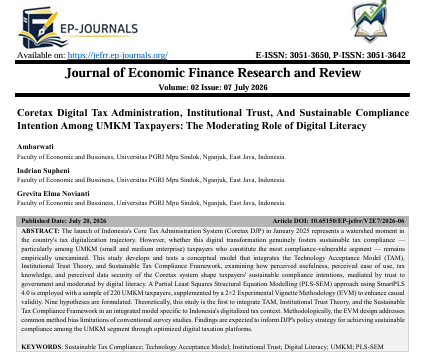
Coretax Digital Tax Administration, Institutional Trust, And Sustainable Compliance Intention Among UMKM Taxpayers: The Moderating Role of Digital Literacy
DOI:
https://doi.org/10.65150/EP-jefrr/V2E7/2026-06Keywords:
Sustainable Tax Compliance, Technology Acceptance Model, Institutional Trust, Digital Literacy, UMKM, PLS-SEMAbstract
The launch of Indonesia's Core Tax Administration System (Coretax DJP) in January 2025 represents a watershed moment in the country's tax digitalization trajectory. However, whether this digital transformation genuinely fosters sustainable tax compliance — particularly among UMKM (small and medium enterprise) taxpayers who constitute the most compliance-vulnerable segment — remains empirically unexamined. This study develops and tests a conceptual model that integrates the Technology Acceptance Model (TAM), Institutional Trust Theory, and Sustainable Tax Compliance Framework, examining how perceived usefulness, perceived ease of use, tax knowledge, and perceived data security of the Coretax system shape taxpayers' sustainable compliance intentions, mediated by trust to government and moderated by digital literacy. A Partial Least Squares Structural Equation Modelling (PLS-SEM) approach using SmartPLS 4.0 is employed with a sample of 220 UMKM taxpayers, supplemented by a 2×2 Experimental Vignette Methodology (EVM) to enhance causal validity. Nine hypotheses are formulated. Theoretically, this study is the first to integrate TAM, Institutional Trust Theory, and the Sustainable Tax Compliance Framework in an integrated model specific to Indonesia's digitalized tax context. Methodologically, the EVM design addresses common method bias limitations of conventional survey studies. Findings are expected to inform DJP's policy strategy for achieving sustainable compliance among the UMKM segment through optimized digital taxation platforms.
References
1) Aguinis, H., & Bradley, K. J. (2014). Best practice recommendations for designing and implementing experimental vignette methodology studies. Organizational Research Methods, 17(4), 351–371. https://doi.org/10.1177/1094428114547952
2) Alm, J. (2019). What motivates tax compliance? Journal of Economic Surveys, 33(2), 353–388. https://doi.org/10.1111/joes.12272
3) Bélanger, F., & Carter, L. (2020). Trust and risk in e-government adoption. Journal of Strategic Information Systems, 17(2),165–176.https://doi.org/10.1016/j.jsis.2007.12.002
4) Braithwaite, V. (2009). Defiance in Taxation and Governance: Resisting and Dismissing Authority in a Democracy.Edward Elgar Publishing.
5) Chin, W. W., Marcolin, B. L., & Newsted, P. R. (2023). A partial least squares latent variable modeling approach for measuring interaction effects. Information Systems Research, 14(2), 189–217. https://doi.org/10.1287/isre.14.2.189.16018
6) Davis, F. D. (1989). Perceived usefulness, perceived ease of use, and user acceptance of information technology. MIS Quarterly, 13(3), 319–340. https://doi.org/10.2307/249008
7) DJP. (2024). Annual Report on Tax Compliance Statistics 2024. In Ministry of Finance of the Republic of Indonesia.
8) Feld, L. P., & Frey, B. S. (2007). Tax compliance as the result of a psychological tax contract: The role of incentives and responsive regulation. Law & Policy, 29(1), 102–120. https://doi.org/10.1111/j.1467-9930.2007.00248.x
9) Hair, J. F., Risher, J. J., Sarstedt, M., & Ringle, C. M. (2019). When to use and how to report the results of PLS-SEM. European Business Review, 31(1), 2–24.
10) IKPI, I. T. C. A. (2025). Report on Coretax DJP Implementation: Complaints and Recommendations. IKPI Internal Report, January 2025.
11) Kirchler, E. (2007). The Economic Psychology of Tax Behaviour. Cambridge University Press.
https://doi.org/10.1017/CBO9780511628238
12) Ministry of Cooperatives and SMEs, Sme. (2023). Indonesian UMKM Statistics 2023. In Ministry of Cooperatives and SMEs.
13) OECD. (2020). Tax Administration 3.0: The Digital Transformation of Tax Administration. OECD Publishing.
https://doi.org/10.1787/6a5c6f6f-en
14) Pavlou, P. A. (2003). Consumer acceptance of electronic commerce: Integrating trust and risk with the technology acceptance model. International Journal of Electronic Commerce, 7(3), 101–134. https://doi.org/10.1080/10864415.2003.11044275
15) Schaupp, L. C., & Carter, L. (2010). The impact of trust, risk and optimism bias on E-file adoption. Information Systems Frontiers, 12(3), 299–309. https://doi.org/10.1007/s10796-008-9151-4
16) Supheni, I., Ambarwati, & Nugroho, A. (2022). The effect of e-filing implementation, tax knowledge, and tax officer service quality on taxpayer compliance. Journal of Accounting and Taxation, 14(2), 118–127.
17) Van Deursen, A. J. A. M., & Van Dijk, J. A. G. M. (2014). The digital divide shifts to differences in usage. New Media & Society, 16(3), 507–526. https://doi.org/10.1177/1461444813487959
18) Warkentin, M., Gefen, D., Pavlou, P. A., & Rose, G. M. (2002). Encouraging citizen adoption of e-government by building trust. Electronic Markets, 12(3), 157–162. https://doi.org/10.1080/101967802320245929
19) Zucker, L. G. (1986). Production of trust: Institutional sources of economic structure, 1840–1920. Research in Organizational Behavior, 8, 53–111.
Downloads
Published
Issue
Section
License
Copyright (c) 2026 Ambarwati, Indrian Supheni, Grevita Elma Novianti (Author)

This work is licensed under a Creative Commons Attribution 4.0 International License.