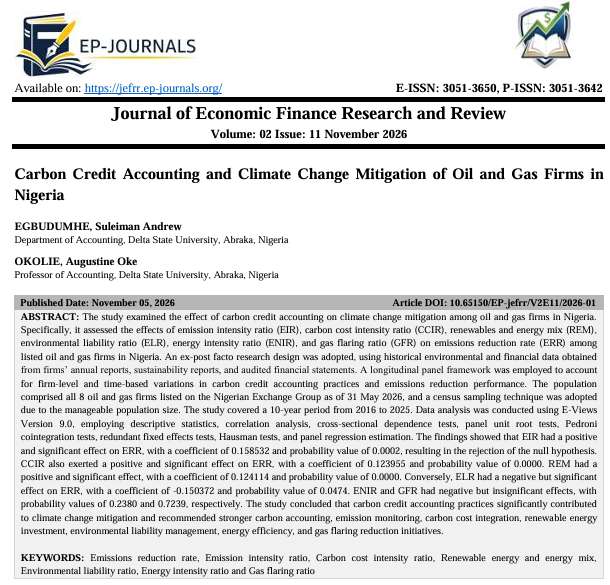
Carbon Credit Accounting and Climate Change Mitigation of Oil and Gas Firms in Nigeria
DOI:
https://doi.org/10.65150/EP-jefrr/V2E11/2026-01Keywords:
Emissions reduction rate, Emission intensity ratio, Carbon cost intensity ratio, Renewable energy and energy mix, Environmental liability ratio, Energy intensity ratio and Gas flaring ratioAbstract
The study examined the effect of carbon credit accounting on climate change mitigation among oil and gas firms in Nigeria. Specifically, it assessed the effects of emission intensity ratio (EIR), carbon cost intensity ratio (CCIR), renewables and energy mix (REM), environmental liability ratio (ELR), energy intensity ratio (ENIR), and gas flaring ratio (GFR) on emissions reduction rate (ERR) among listed oil and gas firms in Nigeria. An ex-post facto research design was adopted, using historical environmental and financial data obtained from firms’ annual reports, sustainability reports, and audited financial statements. A longitudinal panel framework was employed to account for firm-level and time-based variations in carbon credit accounting practices and emissions reduction performance. The population comprised all 8 oil and gas firms listed on the Nigerian Exchange Group as of 31 May 2026, and a census sampling technique was adopted due to the manageable population size. The study covered a 10-year period from 2016 to 2025. Data analysis was conducted using E-Views Version 9.0, employing descriptive statistics, correlation analysis, cross-sectional dependence tests, panel unit root tests, Pedroni cointegration tests, redundant fixed effects tests, Hausman tests, and panel regression estimation. The findings showed that EIR had a positive and significant effect on ERR, with a coefficient of 0.158532 and probability value of 0.0002, resulting in the rejection of the null hypothesis. CCIR also exerted a positive and significant effect on ERR, with a coefficient of 0.123955 and probability value of 0.0000. REM had a positive and significant effect, with a coefficient of 0.124114 and probability value of 0.0000. Conversely, ELR had a negative but significant effect on ERR, with a coefficient of -0.150372 and probability value of 0.0474. ENIR and GFR had negative but insignificant effects, with probability values of 0.2380 and 0.7239, respectively. The study concluded that carbon credit accounting practices significantly contributed to climate change mitigation and recommended stronger carbon accounting, emission monitoring, carbon cost integration, renewable energy investment, environmental liability management, energy efficiency, and gas flaring reduction initiatives.
References
1) Adebayo, T. A., & Ologun, S. O. (2024). Carbon emission management and environmental sustainability in emerging economies. Journal of Environmental Management and Sustainability, 12(2), 44–59.
2) Adebayo, T. O., & Nnamdi, J. U. (2023). Emissions reduction performance and environmental sustainability among industrial firms in Nigeria. Journal of Climate Governance and Sustainable Development, 8(2), 76–92.
3) Adegbite, T. O., & Nwosu, J. I. (2023). Climate change mitigation and sustainable environmental management in developing economies. Journal of Environmental Sustainability and Policy Studies, 9(2), 84–100.
4) Adekunle, M. O., & Eze, P. C. (2025). Carbon cost accounting and sustainability performance of oil and gas firms in Nigeria. International Journal of Energy Economics and Policy, 15(1), 88–102.
5) Ademola, R. S., & Salawu, A. (2025). Green accounting disclosure and performance of listed oil and gas companies in Nigeria. Acta Universitatis Bohemiae, 28(1), 72–86.
6) Adewale, T., & Adebisi, K. (2023). Renewable energy transition and carbon reduction among oil firms. Energy Policy Review, 18(4), 244–259.
7) Adeyemi, R. K., & Yusuf, S. A. (2024). Environmental transparency and carbon accounting practices in Nigeria. African Journal of Accounting and Environmental Management, 11(1), 52–68.
8) Akintoye, I., & Oladimeji, B. (2023). Carbon cost accounting and corporate environmental responsibility. International Journal of Environmental Accounting, 11(2), 94–109.
9) Bello, S., & Yusuf, M. (2024). Gas flaring management and climate change mitigation in Nigeria. Journal of Environmental Sustainability, 15(1), 77–92.
10) Chukwu, C. N., & Adeyemi, O. A. (2023). Emission intensity and environmental efficiency of oil and gas companies in Sub-Saharan Africa. Energy Policy and Environmental Review, 11(1), 27–41.
11) Dowling, J., & Pfeffer, J. (1975). Organizational legitimacy: Social values and organizational behavior. Pacific Sociological Review, 18(1), 122–136.
12) Egbunike, F. C., & Okafor, T. N. (2024). Carbon accounting practices and environmental sustainability reporting among listed firms in Nigeria. Journal of Environmental Accounting and Sustainability Management, 12(2), 87–103.
13) Emeh, Y. O., & Afolabi, K. A. (2025). Energy efficiency practices and environmental sustainability among industrial firms. International Journal of Energy and Environmental Research, 10(1), 63–78.
14) Etim, E. O., Umo, U. P., Udoh, O. A., & Edet, J. P. (2025). An exploratory research on effect of green accounting on financial performance of oil and gas companies in Nigeria. International Journal of Economics and Financial Management, 9(2), 81–95.
15) Eze, C. N., & Ibrahim, M. T. (2022). Carbon emissions accounting and climate sustainability in developing economies. Nigerian Journal of Environmental Economics, 7(1), 44–59.
16) Eze, C., Okoye, E., & Obi, K. (2024). Climate accounting and sustainability reporting among Nigerian oil firms. African Journal of Accounting and Sustainability, 11(3), 133–149.
17) Eze, P. C., & Olatunji, B. A. (2025). Climate change mitigation and environmental sustainability practices in the oil and gas industry. Journal of Energy Economics and Environmental Governance, 13(2), 118–134.
18) Ezeani, J. C., & Nwankwo, B. I. (2025). Oil exploration activities and environmental degradation in the Niger Delta region. Journal of Environmental and Resource Economics, 8(2), 91–107.
19) Freeman, R. E. (1984). Strategic management: A stakeholder approach. Pitman Publishing.
20) Garcia, P., & Martinez, H. (2023). Emission intensity management and sustainability outcomes among European oil firms. European Journal of Sustainable Energy, 17(2), 98–114.
21) Hassan, M. I., & Musa, A. A. (2024). Carbon accounting practices and environmental performance in energy-intensive industries. Global Journal of Accounting and Sustainability, 7(3), 55–70.
22) Ibrahim, H. M., & Ndukwe, A. J. (2024). Carbon accounting systems and environmental compliance in the oil and gas sector. International Journal of Green Accounting and Sustainability, 11(1), 85–101.
23) Ibrahim, L. S., & Sani, M. U. (2024). Environmental reporting and climate responsibility in the Nigerian oil and gas sector. International Journal of Environmental Accounting, 6(4), 133–149.
24) Ibrahim, M. T., & Ezeh, K. N. (2024). Environmental efficiency and emissions reduction performance in Nigeria. Journal of Green Finance and Environmental Governance, 9(3), 72–88.
25) Johnson, D., & Wang, Y. (2023). Carbon accounting systems and emission reduction in international oil companies. Journal of Global Environmental Management, 16(4), 201–219.
26) Nwachukwu, E. C., & Obi, F. N. (2025). Environmental liabilities and financial risk exposure of petroleum firms in Nigeria. Journal of Corporate Environmental Governance, 5(2), 98–114.
27) Nwafor, G. I., & Okeke, C. N. (2023). Carbon credit accounting and environmental performance measurement in Nigerian industries. International Journal of Accounting and Green Finance, 8(2), 66–82.
28) Obiora, K. N., & Garuba, M. A. (2024). Technological innovation and climate change mitigation in industrial sectors. International Journal of Energy Sustainability and Environmental Studies, 11(1), 125–141.
29) Okolie, A. O., Ewiwile, S., & Okunola, O. A. (2022). Sustainability accounting and performance of manufacturing industry in Nigeria. International Journal for Research in Business, Management and Accounting, 8(3), 1–11.
30) Okoye, P. O., & Nnamdi, C. K. (2024). Renewable energy adoption and sustainable industrial development in Africa. African Journal of Renewable Energy Studies, 11(3), 75–90.
31) Olatunji, S. A., & Ibrahim, H. Y. (2023). Energy intensity and sustainable production systems in developing economies. Journal of Energy Efficiency and Sustainability, 9(1), 48–62.
32) Onoh, E., & Ezeani, P. (2024). Carbon cost intensity and environmental sustainability among listed oil firms. International Journal of Environmental Accounting, 13(2), 88–103.
33) Onwuka, R. U., & Bello, H. A. (2024). Renewable energy adoption and carbon emissions management in industrial sectors. Journal of Energy Transition and Environmental Policy, 9(4), 130–146.
34) Salisu, A. R., & Mohammed, B. T. (2023). Renewable energy transition and carbon emission reduction strategies in emerging economies. Energy Transition and Policy Review, 4(2), 120–136.
35) Singh, R., & Patel, K. (2023). Environmental liabilities and climate performance among Asian energy firms. Asian Journal of Sustainability Accounting, 14(1), 67–82.
36) Suleiman, Y. A. (2026). Environmental accounting disclosure on financial performance: A survey of Nigerian oil and gas companies. International Journal of Scholarly Research.
37) Tonye, O., & Boubai, F. M. (2025). Performance of oil and gas sector in Nigeria: Does environmental, social, and governance reporting really matter? International Journal of Accounting Research, 10(1), 59–62.
38) Usman, A. G., & Idris, M. L. (2024). Gas flaring and environmental sustainability challenges in Nigeria’s petroleum industry. Nigerian Journal of Environmental Policy Studies, 10(2), 57–73.
39) Usman, H., & Suleiman, A. (2023). Greenhouse gas accounting and environmental sustainability among Sub-Saharan African oil firms. Journal of Sustainable Development and Energy Policy, 18(4), 214–229.
40) Yusuf, H. M., & Ezeani, C. O. (2024). Greenhouse gas emissions and climate change mitigation initiatives in Africa. African Journal of Environmental Management and Sustainability, 12(3), 77–93.
41) Yusuf, R. A., & Ahmed, S. I. (2023). Climate change challenges and carbon management practices in developing nations. Journal of Global Environmental Studies, 14(1), 19–35.
Downloads
Published
Issue
Section
License
Copyright (c) 2026 EGBUDUMHE, Suleiman Andrew, OKOLIE, Augustine Oke (Author)

This work is licensed under a Creative Commons Attribution 4.0 International License.