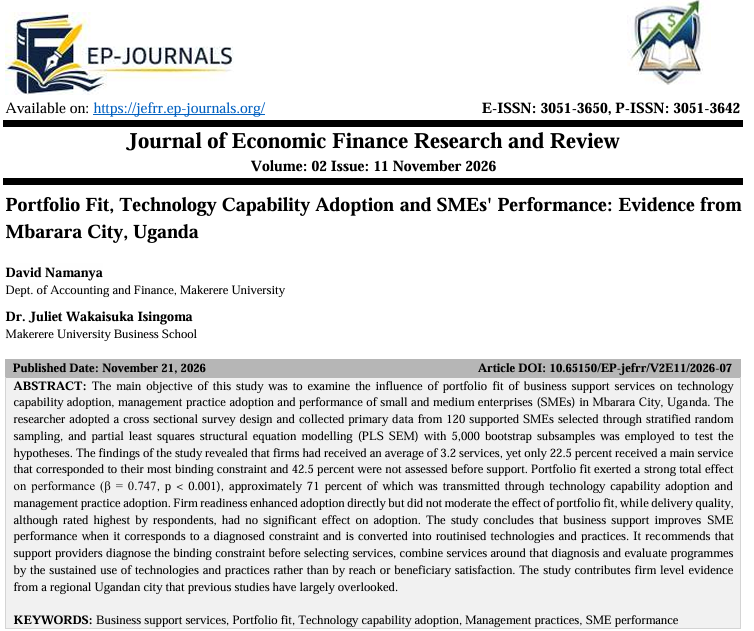
Portfolio Fit, Technology Capability Adoption and SMEs' Performance: Evidence from Mbarara City, Uganda
DOI:
https://doi.org/10.65150/EP-jefrr/V2E11/2026-07Keywords:
Business support services, Portfolio fit, Technology capability adoption, Management practices, SME performanceAbstract
The main objective of this study was to examine the influence of portfolio fit of business support services on technology capability adoption, management practice adoption and performance of small and medium enterprises (SMEs) in Mbarara City, Uganda. The researcher adopted a cross sectional survey design and collected primary data from 120 supported SMEs selected through stratified random sampling, and partial least squares structural equation modelling (PLS SEM) with 5,000 bootstrap subsamples was employed to test the hypotheses. The findings of the study revealed that firms had received an average of 3.2 services, yet only 22.5 percent received a main service that corresponded to their most binding constraint and 42.5 percent were not assessed before support. Portfolio fit exerted a strong total effect on performance (β = 0.747, p < 0.001), approximately 71 percent of which was transmitted through technology capability adoption and management practice adoption. Firm readiness enhanced adoption directly but did not moderate the effect of portfolio fit, while delivery quality, although rated highest by respondents, had no significant effect on adoption. The study concludes that business support improves SME performance when it corresponds to a diagnosed constraint and is converted into routinised technologies and practices. It recommends that support providers diagnose the binding constraint before selecting services, combine services around that diagnosis and evaluate programmes by the sustained use of technologies and practices rather than by reach or beneficiary satisfaction. The study contributes firm level evidence from a regional Ugandan city that previous studies have largely overlooked.
References
1) Bakashaba, R., Musiita, B., & Nabachwa, S. (2024a). Financial literacy, access to digital finance and performance of Ugandan SMEs in Mbarara City. Journal of Economics and Behavioral Studies, 16(1(J)), 41–51. https://doi.org/10.22610/jebs.v16i1(J).3696
2) Bakashaba, R., Musiita, B., & Nabachwa, S. (2024b). The mediating role of access to digital finance on the relationship between financial literacy and performance of Uganda SMEs in Mbarara City. Journal of Economics and Behavioral Studies, 16(1(J)), 140–151.https://doi.org/10.22610/jebs.v16i1(J).3716
3) Boateng, H., Sigdel, S. S., Ofori, K. S., Agbemabiese, G. C., & Hinson, R. E. (2023). Assessing the roles of foreign knowledge acquisition and absorptive capacity in the relationship between market orientation, innovativeness and performance. Management Research Review, 46(6), 852–869. https://doi.org/10.1108/MRR-10-2021-0726
4) Brooks, W., Donovan, K., & Johnson, T. R. (2018). Mentors or teachers? Microenterprise training in Kenya. American Economic Journal: Applied Economics, 10(4), 196–221. https://doi.org/10.1257/app.20170042
5) Bruhn, M., Karlan, D., & Schoar, A. (2018). The impact of consulting services on small and medium enterprises: Evidence from a randomized trial in Mexico. Journal of Political Economy, 126(2), 635–687. https://doi.org/10.1086/696154
6) Cohen, J. (1988). Statistical power analysis for the behavioral sciences (2nd ed.). Lawrence Erlbaum Associates.
7) Cravo, T. A., & Piza, C. (2019). The impact of business-support services on firm performance: A meta-analysis. Small Business Economics, 53(3), 753–770. https://doi.org/10.1007/s11187-018-0065-x
8) Deku, W. A., Wang, J., & Preko, A. K. (2024). Digital marketing and small and medium-sized enterprises' business performance in emerging markets. Asia Pacific Journal of Innovation and Entrepreneurship, 18(3), 251–269. https://doi.org/10.1108/APJIE-07-2022-0069
9) Eister, T., & Msimango-Galawe, J. (2024). Business development services training and entrepreneurial self-efficacy: A focus on necessity- and opportunity-driven entrepreneurs. The Southern African Journal of Entrepreneurship and Small Business Management, 16(1), a858. https://doi.org/10.4102/sajesbm.v16i1.858
10) Fietz, K., Lakemann, T., Beber, B., Priebe, J., & Lay, J. (2026). Formalizing employment in Africa's small firms: Experimental evidence from Côte d'Ivoire. The World Bank Economic Review. Advance online publication. https://doi.org/10.1093/wber/lhag003
11) Fornell, C., & Larcker, D. F. (1981). Evaluating structural equation models with unobservable variables and measurement error. Journal of Marketing Research, 18(1), 39–50. https://doi.org/10.1177/002224378101800104
12) Foster, C., Graham, M., Mann, L., Waema, T., & Friederici, N. (2018). Digital control in value chains: Challenges of connectivity for East African firms. Economic Geography, 94(1), 68–86. https://doi.org/10.1080/00130095.2017.1350104
13) Hair, J. F., Risher, J. J., Sarstedt, M., & Ringle, C. M. (2019). When to use and how to report the results of PLS-SEM. European Business Review, 31(1), 2–24. https://doi.org/10.1108/EBR-11-2018-0203
14) Hair, J. F., Sarstedt, M., Ringle, C. M., & Gudergan, S. P. (2024). Advanced issues in partial least squares structural equation modeling (2nd ed.). SAGE Publications.
15) Hassan, S. S., Meisner, K., Krause, K., Bzhalava, L., & Moog, P. (2024). Is digitalization a source of innovation? Exploring the role of digital diffusion in SME innovation performance. Small Business Economics, 62(4), 1469–1491. https://doi.org/10.1007/s11187-023-00826-7
16) Henseler, J., Ringle, C. M., & Sarstedt, M. (2015). A new criterion for assessing discriminant validity in variance-based structural equation modeling. Journal of the Academy of Marketing Science, 43(1), 115–135. https://doi.org/10.1007/s11747-014-0403-8
17) Kato, A. I., & Tsoka, G. E. (2020). Impact of venture capital financing on small- and medium-sized enterprises' performance in Uganda. The Southern African Journal of Entrepreneurship and Small Business Management, 12(1). https://doi.org/10.4102/sajesbm.v12i1.320
18) Kock, N., & Hadaya, P. (2018). Minimum sample size estimation in PLS-SEM: The inverse square root and gamma-exponential methods. Information Systems Journal, 28(1), 227–261. https://doi.org/10.1111/isj.12131
19) Konte, M., & Tetteh, G. K. (2023). Mobile money, traditional financial services and firm productivity in Africa. Small Business Economics, 60(2), 745–769. https://doi.org/10.1007/s11187-022-00613-w
20) McKenzie, D. (2021). Small business training to improve management practices in developing countries: Re-assessing the evidence for 'training doesn't work'. Oxford Review of Economic Policy, 37(2), 276–301. https://doi.org/10.1093/oxrep/grab002
21) McKenzie, D., & Woodruff, C. (2017). Business practices in small firms in developing countries. Management Science, 63(9), 2967–2981. https://doi.org/10.1287/mnsc.2016.2492
22) Medase, S. K., & Abdul-Basit, S. (2020). External knowledge modes and firm-level innovation performance: Empirical evidence from sub-Saharan Africa. Journal of Innovation & Knowledge, 5(2), 81–95. https://doi.org/10.1016/j.jik.2019.08.001
23) Mushi, H. M. (2024). Digital marketing strategies and SMEs performance in Tanzania: Insights, impact, and implications. Cogent Business & Management, 11(1), 2415533. https://doi.org/10.1080/23311975.2024.2415533
24) Podsakoff, P. M., MacKenzie, S. B., Lee, J.-Y., & Podsakoff, N. P. (2003). Common method biases in behavioral research: A critical review of the literature and recommended remedies. Journal of Applied Psychology, 88(5), 879–903. https://doi.org/10.1037/0021-9010.88.5.879
25) Rampyapedi, K. P., & Adetunji, O. (2024). Business size moderation and internal factors mediation impacts on SME business performance. The Southern African Journal of Entrepreneurship and Small Business Management, 16(1), a958. https://doi.org/10.4102/sajesbm.v16i1.958
26) Ringle, C. M., Sarstedt, M., Sinkovics, N., & Sinkovics, R. R. (2023). A perspective on using partial least squares structural equation modelling in data articles. Data in Brief, 48, 109074. https://doi.org/10.1016/j.dib.2023.109074
27) Sarstedt, M., & Liu, Y. (2024). Advanced marketing analytics using partial least squares structural equation modeling (PLS-SEM). Journal of Marketing Analytics, 12(1), 1–5. https://doi.org/10.1057/s41270-023-00279-7
28) Sarstedt, M., Hair, J. F., Cheah, J.-H., Becker, J.-M., & Ringle, C. M. (2019). How to specify, estimate, and validate higher-order constructs in PLS-SEM. Australasian Marketing Journal, 27(3), 197–211. https://doi.org/10.1016/j.ausmj.2019.05.003
29) Utonga, D., Tundui, C. S., & Mkuna, E. (2026). Harnessing performance through digital technology adoption: An empirical analysis of SMEs in the Tanzanian fruit juice processing industry. Cogent Business & Management, 13(1), 2612771. https://doi.org/10.1080/23311975.2026.2612771
30) Williams, P. A., Akon-Yamga, G., Onumah, J. A., Akuffobea-Essilfie, M., Quaye, W., & Agyemang, A. (2025). Understanding the impact of innovation and other business support interventions on SMEs' development: Lessons from sub-Saharan Africa from an evidence-based review. African Journal of Science, Technology, Innovation and Development, 17(1), 80–94. https://doi.org/10.1080/20421338.2024.2421290
31) Zahra, S. A., & George, G. (2002). Absorptive capacity: A review, reconceptualization, and extension. Academy of Management Review, 27(2), 185–203. https://doi.org/10.5465/amr.2002.6587995
32) Zhao, X., Lynch, J. G., & Chen, Q. (2010). Reconsidering Baron and Kenny: Myths and truths about mediation analysis. Journal of Consumer Research, 37(2), 197–206. https://doi.org/10.1086/651257
Downloads
Published
Issue
Section
License
Copyright (c) 2026 David Namanya, Dr. Juliet Wakaisuka Isingoma (Author)

This work is licensed under a Creative Commons Attribution 4.0 International License.