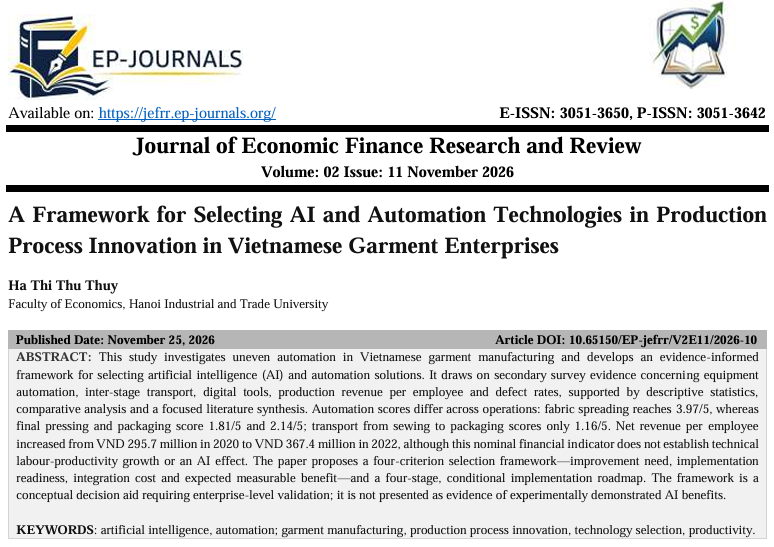
A Framework for Selecting AI and Automation Technologies in Production Process Innovation in Vietnamese Garment Enterprises
DOI:
https://doi.org/10.65150/EP-jefrr/V2E11/2026-10Keywords:
artificial intelligence, automation, garment manufacturing, production process innovation, technology selection, productivityAbstract
This study investigates uneven automation in Vietnamese garment manufacturing and develops an evidence-informed framework for selecting artificial intelligence (AI) and automation solutions. It draws on secondary survey evidence concerning equipment automation, inter-stage transport, digital tools, production revenue per employee and defect rates, supported by descriptive statistics, comparative analysis and a focused literature synthesis. Automation scores differ across operations: fabric spreading reaches 3.97/5, whereas final pressing and packaging score 1.81/5 and 2.14/5; transport from sewing to packaging scores only 1.16/5. Net revenue per employee increased from VND 295.7 million in 2020 to VND 367.4 million in 2022, although this nominal financial indicator does not establish technical labour-productivity growth or an AI effect. The paper proposes a four-criterion selection framework—improvement need, implementation readiness, integration cost and expected measurable benefit—and a four-stage, conditional implementation roadmap. The framework is a conceptual decision aid requiring enterprise-level validation; it is not presented as evidence of experimentally demonstrated AI benefits.
References
1) Monteiro, R. A., Guimarães Junior, D. S., Sobral, E. F. M., Falcão, P. H. B., Melo, F. J. C., & Bastos-Filho, C. (2024). Global trends and practices of Industry 4.0 applications in the clothing sector: A systematic literature review. Administrative Sciences, 14(10), 258. https://doi.org/10.3390/admsci14100258
2) Guo, Z. X., Wong, W. K., Leung, S. Y. S., & Li, M. (2011). Applications of artificial intelligence in the apparel industry: A review. Textile Research Journal, 81(18), 1871–1892. https://doi.org/10.1177/0040517511411968
3) Nouinou, H., Asadollahi-Yazdi, E., Baret, I., Nguyen, N. Q., Terzi, M., Ouazene, Y., Yalaoui, F., & Kelly, R. (2023). Decision-making in the context of Industry 4.0: Evidence from the textile and clothing industry. Journal of Cleaner Production, 391, 136184. https://doi.org/10.1016/j.jclepro.2023.136184
4) Islam, M., Elahi, S., Dip, T. M., Shamsuzzaman, M., Iqbal, M. A., Hossain, S., Hasan, M., Tabassum, S., Hossain, S., & Sayem, A. S. M. (2026). Digital transformation of fashion and textiles manufacturing: A systematic literature review. Textile Research Journal. https://doi.org/10.1177/00405175251375339
5) Tornatzky, L. G., & Fleischer, M. (1990). The processes of technological innovation. Lexington Books.
6) International Organization for Standardization. (2021). ISO 23247-1:2021: Automation systems and integration—Digital twin framework for manufacturing—Part 1: Overview and general principles. https://www.iso.org/standard/75066.html
7) Vietnam National Textile and Garment Group (Vinatex). (2019). Development orientations for Vietnam’s textile and garment industry in the context of the Fourth Industrial Revolution [Presentation, September 6, 2019; in Vietnamese]. https://vinatex.com.vn/wp-content/uploads/2019/11/6.-Bai-A-Hiep-Bao-cao-De-tai.pdf
8) Pham, C. V., Tu, H. C., & Vo, T. C. (2024). Implementation of the DMAIC approach for quality improvement in the garment industry: A case study. Binh Duong University Journal of Science and Technology, 7(1).
https://doi.org/10.56097/binhduonguniversityjournalofscienceandtechnology.v7i1.222
9) Grieco, A., Caricato, P., Gianfreda, D., Pesce, M., Rigon, V., Tregnaghi, L., & Voglino, A. (2017). An Industry 4.0 case study in fashion manufacturing. Procedia Manufacturing, 11, 871–877. https://doi.org/10.1016/j.promfg.2017.07.190
10) Chen, J. C., Chen, C. C., Su, L. H., Wu, H. B., & Sun, C. J. (2012). Assembly line balancing in garment industry. Expert Systems with Applications, 39(11), 10073–10081. https://doi.org/10.1016/j.eswa.2012.02.055
11) Kim, M., & Kim, S. (2023). Effects of step-by-step line balancing in apparel assembly line. Journal of Engineered Fibers and Fabrics, 18, 1–10. https://doi.org/10.1177/15589250231191196
12) He, F., Xin, B., Zhan, Z., Yang, W., & Liu, J. (2026). A review of fabric defect detection in textile manufacturing. The Journal of The Textile Institute, 117(2), 327–345. https://doi.org/10.1080/00405000.2025.2502188
13) Frank, A. G., Dalenogare, L. S., & Ayala, N. F. (2019). Industry 4.0 technologies: Implementation patterns in manufacturing companies. International Journal of Production Economics, 210, 15–26. https://doi.org/10.1016/j.ijpe.2019.01.004
Downloads
Published
Issue
Section
License
Copyright (c) 2026 Ha Thi Thu Thuy (Author)

This work is licensed under a Creative Commons Attribution 4.0 International License.