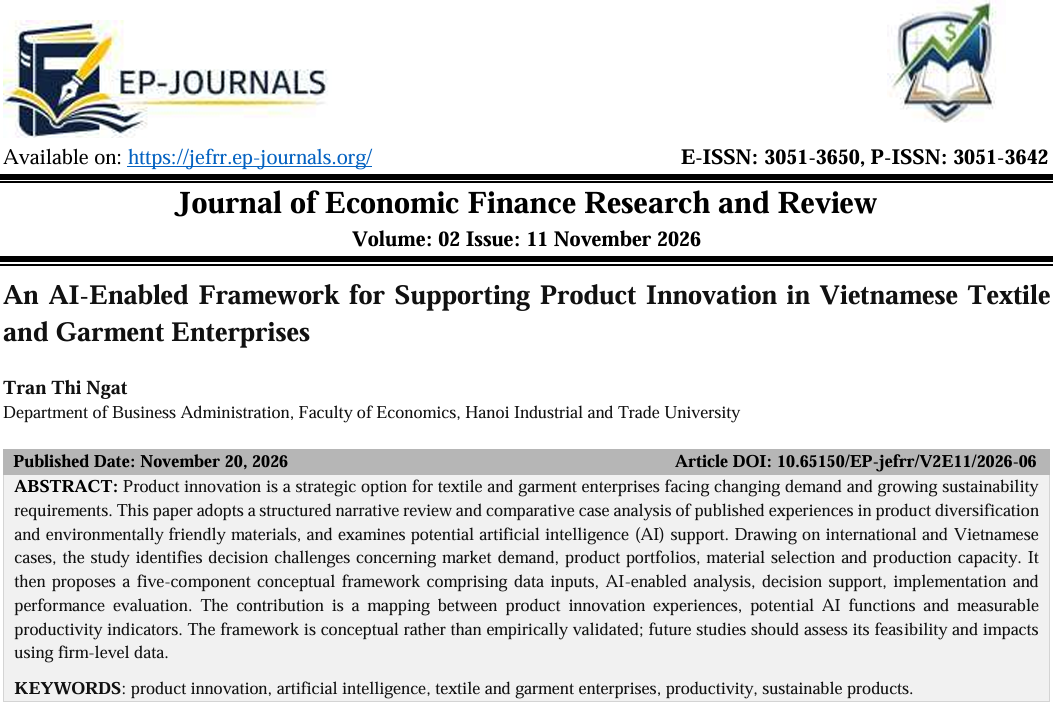
An AI-Enabled Framework for Supporting Product Innovation in Vietnamese Textile and Garment Enterprises
DOI:
https://doi.org/10.65150/EP-jefrr/V2E11/2026-06Keywords:
product innovation, artificial intelligence, textile and garment enterprises, productivity, sustainable products.Abstract
Product innovation is a strategic option for textile and garment enterprises facing changing demand and growing sustainability requirements. This paper adopts a structured narrative review and comparative case analysis of published experiences in product diversification and environmentally friendly materials, and examines potential artificial intelligence (AI) support. Drawing on international and Vietnamese cases, the study identifies decision challenges concerning market demand, product portfolios, material selection and production capacity. It then proposes a five-component conceptual framework comprising data inputs, AI-enabled analysis, decision support, implementation and performance evaluation. The contribution is a mapping between product innovation experiences, potential AI functions and measurable productivity indicators. The framework is conceptual rather than empirically validated; future studies should assess its feasibility and impacts using firm-level data.
References
1) OECD, 2009. Innovation in Firms: A Microeconomic Perspective. OECD Publishing, Paris, France.
DOI: https://doi.org/10.1787/9789264056213-en.
2) Mehrjoo M., Pasek Z.J., 2014. Impact of Product Variety on Supply Chain in Fast Fashion Apparel Industry. Procedia CIRP, 17, 296–301.
DOI: https://doi.org/10.1016/j.procir.2014.01.082.
3) Guo Z.X., Wong W.K., Leung S.Y.S., Li M., 2011. Applications of Artificial Intelligence in the Apparel Industry: A Review. Textile Research Journal, 81(18), 1871–1892. DOI: https://doi.org/10.1177/0040517511411968.
4) Huo M., Tang J., Kim C.S., 2019. Research on Application Prospect of Artificial Intelligence Technology in Clothing Industry. Proceedings of the 4th International Conference on Contemporary Education, Social Sciences and Humanities (ICCESSH 2019), Atlantis Press, 925–928. DOI: https://doi.org/10.2991/iccessh-19.2019.207.
5) Pal K., Yasar A.U.H., 2020. Internet of Things and Blockchain Technology in Apparel Manufacturing Supply Chain Data Management. Procedia Computer Science, 170, 450–457. DOI: https://doi.org/10.1016/j.procs.2020.03.088.
6) Asimova F.A., 2022. Product Diversification in Industrial Enterprises. European Scholar Journal, 3(3), 113–114.
7) Phan Hiep (2018). Viet Tien Garment and its product diversification strategy. Industry and Trade Magazine (Tap chi Cong Thuong). Accessed 12 October 2026. https://tapchicongthuong.vn/may-viet-tien-voi-chien-luoc-da-dang-hoa-san-pham-55174.htm.
8) Vartio N., 2022. The Impact of Eco-Friendly Clothing Line Extensions on the Brand Image of Fast-Fashion Companies. Bachelor's Thesis, Aalto University School of Business, Finland. https://aaltodoc.aalto.fi/handle/123456789/114246.
9) Inditex, 2016. More Sustainable Raw Materials. Inditex Annual Report 2016. Accessed 12 October 2026.
10) H&M Group, 2025. Annual and Sustainability Report 2024. H&M Group, Sweden.
https://hmgroup.com/wp-content/uploads/2025/03/HM-Group-Annual-and-sustainability-report-2024.pdf.
11) CANIFA (n.d.). About us: Business based on genuine values and green development. CANIFA. Accessed 26 October 2026. https://canifa.com/gioi-thieu.html.
12) Thao Vy (2022). BOO: A fashion brand pioneering the sustainable fashion trend. Vietnam Pictorial, Vietnam News Agency. Accessed 12 October 2026. https://vietnam.vnanet.vn/vietnamese/long-form/boo-thuong-hieu-thoi-trang-tien-phong-xu-huong-thoi-trang-ben-vung-305865.html.
13) Thanh Cong Textile Garment Investment Trading Joint Stock Company (2025). Report on the Company's Environmental and Social Impact 2024. Thanh Cong Group. https://www.thanhcong.com.vn/wp-content/uploads/2025/04/tcm_design_2024-cbtt-8.4.2025.pdf.
14) Thanh Cong Group (n.d.). ECO WOOD. Thanh Cong Group. Accessed 12 October 2026. https://www.thanhcong.com.vn/vi/san-pham/eco-wood/
Downloads
Published
Issue
Section
License
Copyright (c) 2026 Tran Thi Ngat (Author)

This work is licensed under a Creative Commons Attribution 4.0 International License.