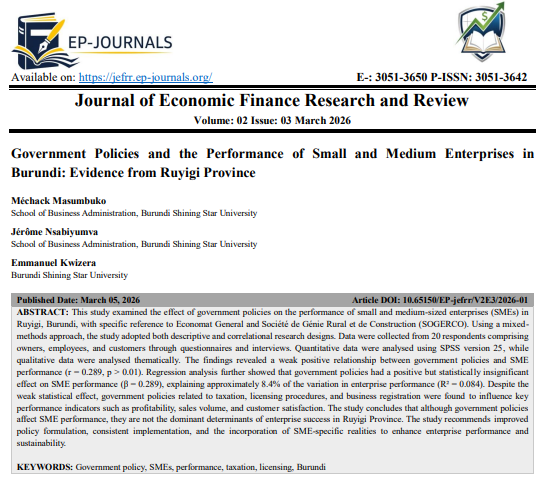
Government Policies and the Performance of Small and Medium Enterprises in Burundi: Evidence from Ruyigi Province
DOI:
https://doi.org/10.65150/EP-jefrr/V2E3/2026-01Keywords:
Government policy, SMEs, performance, taxation, licensing, BurundiAbstract
This study examined the effect of government policies on the performance of small and medium-sized enterprises (SMEs) in Ruyigi, Burundi, with specific reference to Economat General and Société de Génie Rural et de Construction (SOGERCO). Using a mixed-methods approach, the study adopted both descriptive and correlational research designs. Data were collected from 20 respondents comprising owners, employees, and customers through questionnaires and interviews. Quantitative data were analysed using SPSS version 25, while qualitative data were analysed thematically. The findings revealed a weak positive relationship between government policies and SME performance (r = 0.289, p > 0.01). Regression analysis further showed that government policies had a positive but statistically insignificant effect on SME performance (β = 0.289), explaining approximately 8.4% of the variation in enterprise performance (R² = 0.084). Despite the weak statistical effect, government policies related to taxation, licensing procedures, and business registration were found to influence key performance indicators such as profitability, sales volume, and customer satisfaction. The study concludes that although government policies affect SME performance, they are not the dominant determinants of enterprise success in Ruyigi Province. The study recommends improved policy formulation, consistent implementation, and the incorporation of SME-specific realities to enhance enterprise performance and sustainability.
References
1) Altenburg, T., & Eckhardt, U. (2006). Productivity enhancement and equitable development: Challenges for SME development. United Nations Industrial Development Organization Working Paper.
2) Anthony, K., & Harry, E. (2015). Government regulation and small and medium enterprises performance in developing economies. International Journal of Business and Management, 10(5), 12–22.
3) Barney, J. (1991). Firm resources and sustained competitive advantage. Journal of Management, 17(1), 99–120.
4) Beck, T., Demirgüç-Kunt, A., & Maksimovic, V. (2005). Financial and legal constraints to firm growth: Does firm size matter? Journal of Finance, 60(1), 137–177.
5) Chong, H. G. (2008). Measuring performance of small‐and‐medium sized enterprises: The grounded theory approach. Journal of Business and Public Affairs, 2(1), 1–10.
6) Dandago, K. I., & Usman, A. G. (2011). Government policies and SMEs development in Nigeria. Journal of Management Research, 3(2), 1–18.
7) Davidsson, P. (2004). Researching entrepreneurship. New York: Springer.
8) Eniola, A. A., & Ektebang, H. (2014). SME firms’ performance in Nigeria: Competitive advantage and its impact. International Journal of Research Studies in Management, 3(2), 75–86.
9) Hudson, M., Smart, A., & Bourne, M. (2001). Theory and practice in SME performance measurement systems. International Journal of Operations & Production Management, 21(8), 1096–1115.
10) International Finance Corporation (IFC). (2010). Scaling-up SME access to financial services in the developing world. Washington, DC: World Bank Group.
11) Kothari, C. R. (2004). Research methodology: Methods and techniques (2nd ed.). New Delhi: New Age International.
12) Lumpkin, G. T., & Dess, G. G. (1996). Clarifying the entrepreneurial orientation construct and linking it to performance. Academy of Management Review, 21(1), 135–172.
13) Mugenda, O. M., & Mugenda, A. G. (1999). Research methods: Quantitative and qualitative approaches. Nairobi: Acts Press.
14) Naudé, W., Szirmai, A., & Goedhuys, M. (2011). Innovation and entrepreneurship in developing countries. World Development, 39(4), 567–577.
15) OECD. (2004). Promoting entrepreneurship and innovative SMEs in a global economy. Paris: OECD Publishing.
16) OECD. (2012). SME and entrepreneurship outlook. Paris: OECD Publishing.
17) Okpara, J. O. (2011). Factors constraining the growth and survival of SMEs in Nigeria. Management Research Review, 34(2), 156–171.
18) Sathe, V. (2006). Corporate entrepreneurship: Top managers and new business creation. Cambridge: Cambridge University Press.
19) Wiklund, J., & Shepherd, D. (2005). Entrepreneurial orientation and small business performance: A configurational approach. Journal of Business Venturing, 20(1), 71–91.
20) Zahra, S. A. (1993). Environment, corporate entrepreneurship, and financial performance. Journal of Business Venturing, 8(4), 319–340.
Downloads
Published
Issue
Section
License
Copyright (c) 2026 Méchack Masumbuko, Jérôme Nsabiyumva, Emmanuel Kwizera (Author)

This work is licensed under a Creative Commons Attribution 4.0 International License.