Hidden Vulnerability Under Global Shocks: A Dynamic Resilience Index for Import-Dependent Food Systems—Evidence from Jordan
DOI:
https://doi.org/10.65150/EP-jefrr/V2E7/2026-03Keywords:
Dynamic resilience index, Food system resilience, Global shocks, Import dependence, VolatilityAbstract
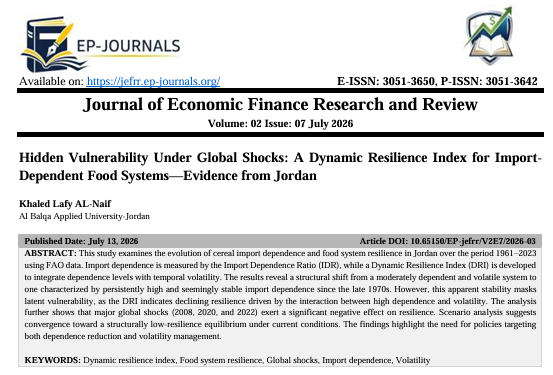
This study examines the evolution of cereal import dependence and food system resilience in Jordan over the period 1961–2023 using FAO data. Import dependence is measured by the Import Dependence Ratio (IDR), while a Dynamic Resilience Index (DRI) is developed to integrate dependence levels with temporal volatility. The results reveal a structural shift from a moderately dependent and volatile system to one characterized by persistently high and seemingly stable import dependence since the late 1970s. However, this apparent stability masks latent vulnerability, as the DRI indicates declining resilience driven by the interaction between high dependence and volatility. The analysis further shows that major global shocks (2008, 2020, and 2022) exert a significant negative effect on resilience. Scenario analysis suggests convergence toward a structurally low-resilience equilibrium under current conditions. The findings highlight the need for policies targeting both dependence reduction and volatility management.
References
1) Anderson, K., & Nelgen, S. (2012). Trade barrier volatility and agricultural price stabilization. World Dev., 40(1), 36–48.
https://doi.org/10.1016/j.worlddev.2011.05.018
2) Béné, C., Headey, D., Haddad, L., & von Grebmer, K. (2016). Is resilience a useful concept in the context of food security and nutrition programmes? Some conceptual and practical considerations. Food Sec., 8, 123–138. https://doi.org/10.1007/s12571-015-0526-x
3) Chaturvedi, S. (2024). Agricultural exports and trade policy responses. Econ. Polit. Wkly., 59(46).
4) Clapp, J. (2017). Food self-sufficiency: Making sense of it, and when it makes sense. Food Policy, 66, 88–96.
https://doi.org/10.1016/j.foodpol.2016.12.001
5) Das, M., & Bhandari, G. (2025). Unlocking dairy export potential: An elasticity-based study of India’s trade with Asia. Econ. Aff., 70(2), 283–293. https://doi.org/10.46852/0424-2513.2.2025.12
6) Fanzo, J., Haddad, L., McLaren, R., Marshall, Q., Davis, C., Herforth, A., Jones, A., Beal, T., Tschirley, D., Bellows, A., Miachon, L., Gu, Y., Bloem, M., & Kapuria, A. (2020). The Food Systems Dashboard is a new tool to inform better food policy. Nature Food, 1(5), 243–246. https://doi.org/10.1038/s43016-020-0077-y
7) FAO, IFAD, UNICEF, WFP, & WHO. (2025). The state of food security and nutrition in the world 2025: Addressing high food price inflation for food security and nutrition. FAO. https://doi.org/10.4060/cd6008en
8) FAO. (2023). FAOSTAT: Food balance sheets. https://www.fao.org/faostat/en/#data/FBS
9) FAO. (2021). The state of food security and nutrition in the world. https://www.fao.org/interactive/state-of-food-security-nutrition/2021/en/10) FAO. (2018). Sustainable food systems.
12) FAO. (2006). The state of food insecurity in the world 2006. https://www.fao.org/4/a0750e/a0750e01.pdf
13) Ghoddusi, H. (2016). Integration of physical and futures prices in the US natural gas market. Energy Econ., 56, 229–238.
https://doi.org/10.1016/j.eneco.2016.03.011
14) Gilbert, C. L., & Morgan, C. W. (2010). Food price volatility. Philos. Trans. R. Soc. B, 365(1554), 3023–3034.
https://doi.org/10.1098/rstb.2010.0139
15) Horák, J. (2026). Price volatility and prediction of rapeseed as a market commodity. Res. World Agric. Econ., 7(1), 685–701.
https://doi.org/10.36956/rwae.v7i1.2439
16) Headey, D., & Fan, S. (2008). Anatomy of a crisis: The causes and consequences of surging food prices. Agric. Econ., 39(s1), 375–391.https://doi.org/10.1111/j.1574-0862.2008.00345.x
17) KC, U., Friedman, R., Lim-Camacho, L., & Crimp, S. (2025). Measuring resilience in national food systems using food systems resilience score. Data & Policy, 7, e54. https://doi.org/10.1017/dap.2025.10021
18) Kumar, K. N., Naidu, G. M., & Shafiwu, A. B. (2024). Exploring the drivers of Indian agricultural exports: A dynamic panel data approach. Cogent Econ. Finance, 12(1). https://doi.org/10.1080/23322039.2024.2344733
19) Laborde, D., Martin, W., Swinnen, J., & Vos, R. (2020). COVID-19 risks to global food security. Science, 369(6503), 500–502. https://doi.org/10.1126/science.abc4765
20) Nazlioglu, S., & Soytas, U. (2011). World oil prices and agricultural commodity prices: Evidence from an emerging market. Energy Econ., 33(3), 488–496. https://doi.org/10.1016/j.eneco.2010.11.012
21) Patare, S., Pokharkar, V., & Hile, R. (2024). Seasonality and volatility in arrivals and prices of turmeric in major markets of Marathwada region. Int. J. Agric. Ext. Soc. Dev., 7(2), 183–185. https://doi.org/10.33545/26180723.2024.v7.i2c.324
22) Puma, M. J., Bose, S., Chon, S. Y., & Cook, B. I. (2015). Assessing the evolving fragility of the global food system. Environ. Res. Lett., 10(2), 024007. https://doi.org/10.1088/1748-9326/10/2/024007
23) Tendall, D. M., Joerin, J., Kopainsky, B., Edwards, P., Shreck, A., Le, Q. B., Kruetli, P., Grant, M., & Six, J. (2015). Food system resilience: Defining the concept. Glob. Food Secur., 6, 17–23. https://doi.org/10.1016/j.gfs.2015.08.001
24) Timmer, P. (2010). Reflections on food crises past. Food Policy, 35(1), 1–11. https://doi.org/10.1016/j.foodpol.2009.09.002
25) World Bank. (2022). Food security update. https://www.worldbank.org/en/topic/agriculture/brief/food-security-update
Downloads
Published
Issue
Section
License
Copyright (c) 2026 Khaled Lafy AL Naif (Author)

This work is licensed under a Creative Commons Attribution 4.0 International License.