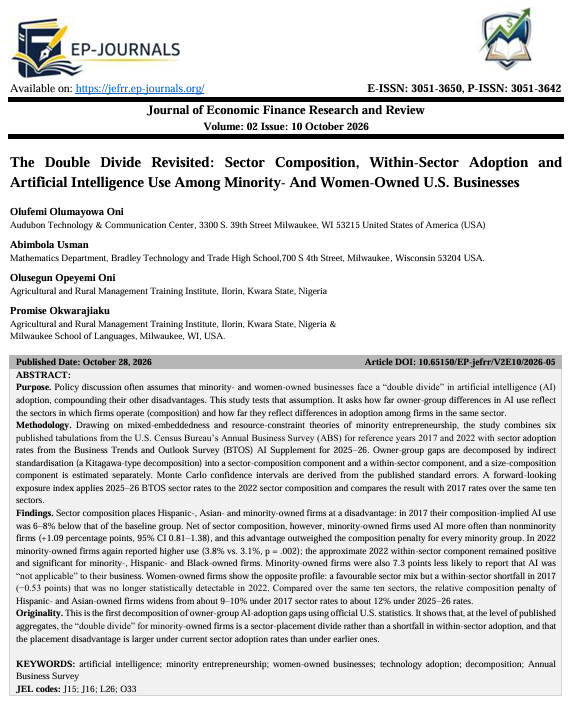
The Double Divide Revisited: Sector Composition, Within-Sector Adoption and Artificial Intelligence Use Among Minority- And Women-Owned U.S. Businesses
DOI:
https://doi.org/10.65150/EP-jefrr/V2E10/2026-05Keywords:
artificial intelligence, minority entrepreneurship, women-owned businesses;, technology adoption, decomposition;, Annual Business SurveyAbstract
Purpose. Policy discussion often assumes that minority- and women-owned businesses face a “double divide” in artificial intelligence (AI) adoption, compounding their other disadvantages. This study tests that assumption. It asks how far owner-group differences in AI use reflect the sectors in which firms operate (composition) and how far they reflect differences in adoption among firms in the same sector.
Methodology. Drawing on mixed-embeddedness and resource-constraint theories of minority entrepreneurship, the study combines six published tabulations from the U.S. Census Bureau’s Annual Business Survey (ABS) for reference years 2017 and 2022 with sector adoption rates from the Business Trends and Outlook Survey (BTOS) AI Supplement for 2025–26. Owner-group gaps are decomposed by indirect standardisation (a Kitagawa-type decomposition) into a sector-composition component and a within-sector component, and a size-composition component is estimated separately. Monte Carlo confidence intervals are derived from the published standard errors. A forward-looking exposure index applies 2025–26 BTOS sector rates to the 2022 sector composition and compares the result with 2017 rates over the same ten sectors.
Findings. Sector composition places Hispanic-, Asian- and minority-owned firms at a disadvantage: in 2017 their composition-implied AI use was 6–8% below that of the baseline group. Net of sector composition, however, minority-owned firms used AI more often than nonminority firms (+1.09 percentage points, 95% CI 0.81–1.38), and this advantage outweighed the composition penalty for every minority group. In 2022 minority-owned firms again reported higher use (3.8% vs. 3.1%, p = .002); the approximate 2022 within-sector component remained positive and significant for minority-, Hispanic- and Black-owned firms. Minority-owned firms were also 7.3 points less likely to report that AI was “not applicable” to their business. Women-owned firms show the opposite profile: a favourable sector mix but a within-sector shortfall in 2017 (−0.53 points) that was no longer statistically detectable in 2022. Compared over the same ten sectors, the relative composition penalty of Hispanic- and Asian-owned firms widens from about 9–10% under 2017 sector rates to about 12% under 2025–26 rates.
Originality. This is the first decomposition of owner-group AI-adoption gaps using official U.S. statistics. It shows that, at the level of published aggregates, the “double divide” for minority-owned firms is a sector-placement divide rather than a shortfall in within-sector adoption, and that the placement disadvantage is larger under current sector adoption rates than under earlier ones.
References
1) Acemoglu, D., Anderson, G. W., Beede, D. N., Buffington, C., Childress, E. E., Dinlersoz, E., Foster, L. S., Goldschlag, N., Haltiwanger, J. C., Kroff, Z., Restrepo, P., & Zolas, N. (2022). Automation and the workforce: A firm-level view from the 2019 Annual Business Survey (NBER Working Paper No. 30659). National Bureau of Economic Research. https://doi.org/10.3386/w30659
2) Aldrich, H. E., & Waldinger, R. (1990). Ethnicity and entrepreneurship. Annual Review of Sociology, 16, 111–135. https://doi.org/10.1146/annurev.so.16.080190.000551
3) Blanchflower, D. G., Levine, P. B., & Zimmerman, D. J. (2003). Discrimination in the small-business credit market. Review of Economics and Statistics, 85(4), 930–943. https://doi.org/10.1162/003465303772815835
4) Bonney, K., Breaux, C., Buffington, C., Dinlersoz, E., Foster, L., Goldschlag, N., Haltiwanger, J., Kroff, Z., & Savage, K. (2024). Tracking firm use of AI in real time: A snapshot from the Business Trends and Outlook Survey (NBER Working Paper No. 32319). National Bureau of Economic Research. https://doi.org/10.3386/w32319
5) Das Gupta, P. (1993). Standardization and decomposition of rates: A user’s manual (Current Population Reports, Series P23-186). U.S. Bureau of the Census. https://www.census.gov/library/publications/1993/demo/p23-186.html
6) Fairlie, R. W. (2004). Race and the digital divide. Contributions in Economic Analysis & Policy, 3(1), 1–38. https://doi.org/10.2202/1538-0645.1263
7) Fairlie, R. W., & Robb, A. M. (2008). Race and entrepreneurial success: Black-, Asian-, and White-owned businesses in the United States. MIT Press.
8) Fairlie, R., Robb, A., & Robinson, D. T. (2022). Black and white: Access to capital among minority-owned start-ups. Management Science, 68(4), 2377–2400. https://doi.org/10.1287/mnsc.2021.3998
9) Jennings, J. E., & Brush, C. G. (2013). Research on women entrepreneurs: Challenges to (and from) the broader entrepreneurship literature? Academy of Management Annals, 7(1), 663–715. https://doi.org/10.5465/19416520.2013.782190
10) Kitagawa, E. M. (1955). Components of a difference between two rates. Journal of the American Statistical Association, 50(272), 1168–1194. https://doi.org/10.1080/01621459.1955.10501299
11) Kloosterman, R., & Rath, J. (2001). Immigrant entrepreneurs in advanced economies: Mixed embeddedness further explored. Journal of Ethnic and Migration Studies, 27(2), 189–201. https://doi.org/10.1080/13691830020041561
12) McElheran, K., Li, J. F., Brynjolfsson, E., Kroff, Z., Dinlersoz, E., Foster, L., & Zolas, N. (2024). AI adoption in America: Who, what, and where. Journal of Economics & Management Strategy, 33(2), 375–415. https://doi.org/10.1111/jems.12576
13) Oaxaca, R. (1973). Male-female wage differentials in urban labor markets. International Economic Review, 14(3), 693–709. https://doi.org/10.2307/2525981
14) Robb, A. M., & Watson, J. (2012). Gender differences in firm performance: Evidence from new ventures in the United States. Journal of Business Venturing, 27(5), 544–558. https://doi.org/10.1016/j.jbusvent.2011.10.002
15) Rogers, E. M. (2003). Diffusion of innovations (5th ed.). Free Press.
16) Smith, L. (2026). The Main Street AI paradox. Association for Enterprise Opportunity. https://research.aeoworks.org/publications/ai-main-street-paradox/
17) U.S. Census Bureau. (n.d.-a). Annual Business Survey: Extent of technology use of employer firms by 2-digit NAICS for the United States and states: 2018 (Table AB1800TCB01A) [Data set]. Retrieved October 7, 2026, from https://data.census.gov/table/ABSTCB2018.AB1800TCB01A
18) U.S. Census Bureau. (n.d.-b). Annual Business Survey: Extent of technology use of employer firms by sex, ethnicity, race, veteran status, and employment size for the United States: 2018 (Table AB1800TCB01B) [Data set]. Retrieved October 7, 2026, from https://data.census.gov/table/ABSTCB2018.AB1800TCB01B
19) U.S. Census Bureau. (n.d.-c). Annual Business Survey: Statistics for employer firms by industry, sex, ethnicity, race, and veteran status for the U.S., states, metro areas, counties, and places: 2017 (Table AB1700CSA01) [Data set]. Retrieved October 7, 2026, from https://data.census.gov/table/ABSCS2017.AB1700CSA01
20) U.S. Census Bureau. (n.d.-d). Annual Business Survey: Statistics for employer firms by industry, sex, ethnicity, race, and veteran status for the U.S., states, metro areas, counties, and places: 2022 (Table AB2200CSA01) [Data set]. Retrieved October 7, 2026, from https://data.census.gov/table/ABSCS2022.AB2200CSA01
21) U.S. Census Bureau. (n.d.-e). Annual Business Survey: Technology, financing, and climate impact characteristics of businesses: 2022 (Table AB2200MCB01) [Data set]. Retrieved October 7, 2026, from https://data.census.gov/table/ABSMCB2022.AB2200MCB01
22) U.S. Census Bureau. (n.d.-f). Annual Business Survey: Years in business statistics for employer firms by sector, sex, ethnicity, race, and veteran status for the U.S., states, metro areas, and counties: 2022 (Table AB2200CSA02) [Data set]. Retrieved October 7, 2026, from https://data.census.gov/table/ABSCS2022.AB2200CSA02
23) U.S. Census Bureau. (2026). Business Trends and Outlook Survey (BTOS), Artificial Intelligence Supplement, collected November 17, 2025–February 8, 2026 [Data files]. https://www.census.gov/hfp/btos/data
24) U.S. Government Accountability Office. (2026). Minority Business Development Agency: Information on performance assessment and compliance monitoring (GAO-26-107718). https://www.gao.gov/products/gao-26-107718
25) U.S. Senate Committee on Commerce, Science, and Transportation. (2026, February 17). Cantwell, Moran reintroduce bill to help small business leverage AI tools [Press release]. https://www.commerce.senate.gov/2026/2/cantwell-moran-reintroduce-bill-to-help-small-business-leverage-ai-tools
26) Wheat, C., Mac, C., & Passalacqua, A. (2026). The AI adoption gap: Gender and generation among small business owners. JPMorganChase Institute. https://www.jpmorganchase.com/institute/all-topics/business-growth-and-entrepreneurship/ai-adoption-gap-gender-generation-among-small-business-owners
27) Zolas, N., Kroff, Z., Brynjolfsson, E., McElheran, K., Beede, D. N., Buffington, C., Goldschlag, N., Foster, L., & Dinlersoz, E. (2020). Advanced technologies adoption and use by U.S. firms: Evidence from the Annual Business Survey (NBER Working Paper No. 28290). National Bureau of Economic Research. https://doi.org/10.3386/w28290
Downloads
Published
Issue
Section
License
Copyright (c) 2026 Olufemi Olumayowa Oni, Abimbola Usman, Olusegun Opeyemi Oni, Promise Okwarajiaku (Author)

This work is licensed under a Creative Commons Attribution 4.0 International License.