Impact of Employees’ Training and Development and Competitive Reward Systems on the Organizational Performance in Virtual Legal Assistance Agency
DOI:
https://doi.org/10.65150/EP-jefrr/V2E7/2026-10Keywords:
training and development, competitive reward systems, organizational Performance, virtual legal assistanceAbstract
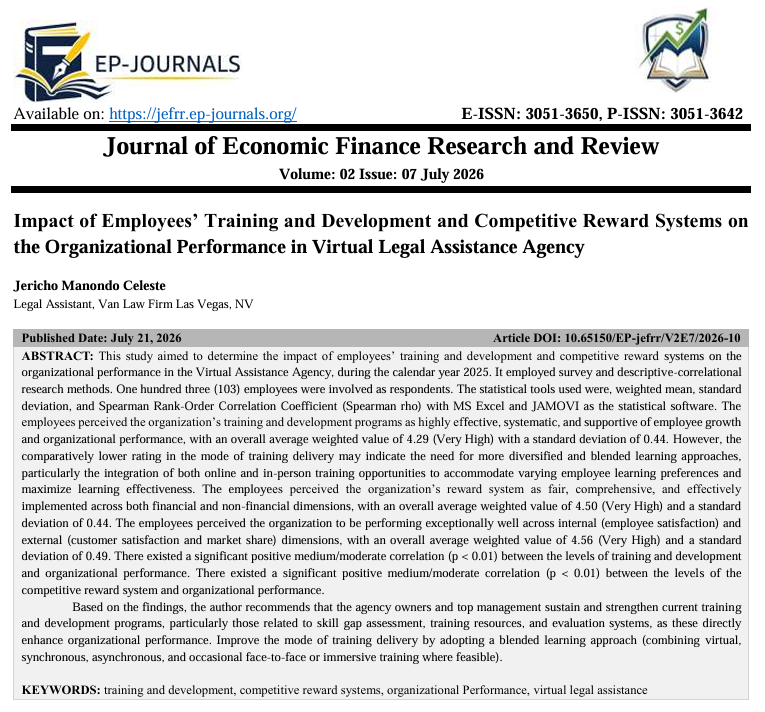
This study aimed to determine the impact of employees’ training and development and competitive reward systems on the organizational performance in the Virtual Assistance Agency, during the calendar year 2025. It employed survey and descriptive-correlational research methods. One hundred three (103) employees were involved as respondents. The statistical tools used were, weighted mean, standard deviation, and Spearman Rank-Order Correlation Coefficient (Spearman rho) with MS Excel and JAMOVI as the statistical software. The employees perceived the organization’s training and development programs as highly effective, systematic, and supportive of employee growth and organizational performance, with an overall average weighted value of 4.29 (Very High) with a standard deviation of 0.44. However, the comparatively lower rating in the mode of training delivery may indicate the need for more diversified and blended learning approaches, particularly the integration of both online and in-person training opportunities to accommodate varying employee learning preferences and maximize learning effectiveness. The employees perceived the organization’s reward system as fair, comprehensive, and effectively implemented across both financial and non-financial dimensions, with an overall average weighted value of 4.50 (Very High) and a standard deviation of 0.44. The employees perceived the organization to be performing exceptionally well across internal (employee satisfaction) and external (customer satisfaction and market share) dimensions, with an overall average weighted value of 4.56 (Very High) and a standard deviation of 0.49. There existed a significant positive medium/moderate correlation (p < 0.01) between the levels of training and development and organizational performance. There existed a significant positive medium/moderate correlation (p < 0.01) between the levels of the competitive reward system and organizational performance.
Based on the findings, the author recommends that the agency owners and top management sustain and strengthen current training and development programs, particularly those related to skill gap assessment, training resources, and evaluation systems, as these directly enhance organizational performance. Improve the mode of training delivery by adopting a blended learning approach (combining virtual, synchronous, asynchronous, and occasional face-to-face or immersive training where feasible).
References
1) Abdullah, N. (2024). Online training in the workforce: A systematic review of effectiveness, challenges, and opportunities. [Journal details require verification].
2) Al Karim, R. (2019). Impact of different training and development programs on employee performance in Bangladesh perspective. International Journal of Entrepreneurial Research, 2(1), 8–14.
3) Alkandi, I. G., Khan, M. A., Fallatah, M., Alabdulhadi, A., Alanizan, S., & Alharbi, J. (2023). The impact of incentive and reward systems on employee performance in the Saudi primary, secondary, and industrial sectors: The mediating influence of employee job satisfaction. Sustainability, 15(4), Article 3415. https://doi.org/10.3390/su15043415
4) Almatrooshi, B., Singh, S. K., & Farouk, S. (2016). Determinants of organizational performance: A proposed framework. International Journal of Productivity and Performance Management, 65(6), 844–859. https://doi.org/10.1108/IJPPM-02-2016-0038
5) Alqudah, I. H. A., Carballo-Penela, A., & Ruzo-Sanmartín, E. (2024). Digital training infrastructure, continuous learning, and employee performance in digitally enabled workplaces.
6) Althammer, S. E., Reis, D., van der Beek, S., Beck, L., & Michel, A. (2023). Comparing web-based and blended training for coping with the challenges of flexible work designs: Randomized controlled trial. Journal of Medical Internet Research, 25, Article e42510. https://doi.org/10.2196/42510
7) Anwar, G., & Abdullah, N. N. (2021). The impact of human resource management practice on organizational performance. International Journal of Engineering, Business and Management, 5(1), 35–47. https://doi.org/10.22161/ijebm.5.1.4
8) Bae, K. B., & Kang, S. (2025). Employee satisfaction and firm performance: Evidence from employee reviews and company-level outcomes. [Journal and DOI require verification].
9) Bhat, A. (2019). Correlational research: Definition, types, and examples. QuestionPro.
10) Blume, B. D., Ford, J. K., Surface, E. A., & Olenick, J. (2024). A dynamic model of training transfer. Human Resource Management Review, 34(1), Article 100975. https://doi.org/10.1016/j.hrmr.2023.100975
11) Edeling, A., & Himme, A. (2018). When does market share matter? New empirical generalizations from a meta-analysis of the market share–performance relationship. Journal of Marketing, 82(3), 1–24. https://doi.org/10.1509/jm.16.0250
12) Estebal, J. M., et al. (2024). Organizational commitment and employee performance under work-from-home arrangements in a Philippine business-process-outsourcing company.
13) Faisal-E-Alam, M., et al. (2025). Training evaluation and its influence on employee and organizational performance. [Complete publication details require verification].
14) Fareri, S., Apreda, R., Mulas, V., & Alonso, R. (2023). The worker profiler: Assessing the digital skill gaps for enhancing energy efficiency in manufacturing. Technological Forecasting and Social Change, 192, Article 122844. https://doi.org/10.1016/j.techfore.2023.122844
15) Figueiredo, E., Margaça, C., Sánchez García, J. C., & Ribeiro, C. (2025). The contribution of reward systems in the work context: A systematic review of the literature and directions for future research. Journal of the Knowledge Economy. Advance online publication. https://doi.org/10.1007/s13132-024-02492-w
16) Fowler, F. J., Jr. (2014). Survey research methods (5th ed.). SAGE Publications.
17) Gazi, M. A. I., Yusof, M. F., Islam, M. A., Amin, M. B., & Senathirajah, A. R. B. S. (2024). Analyzing the impact of employee job satisfaction on their job behavior in the industrial setting: An analysis from the perspective of job performance. Journal of Open Innovation: Technology, Market, and Complexity, 10(4), Article 100427. https://doi.org/10.1016/j.joitmc.2024.100427
18) Giday, D. G., & Elantheraiyan, P. (2023). A study on the effect of training on employee performance in the case of the Tigray Regional Education Bureau. International Journal of Research in Business and Social Science, 12(2), 138–147. https://doi.org/10.20525/ijrbs.v12i2.2395
19) Gumasing, M. J. J., et al. (2025). Macroergonomic factors affecting the motivation and performance of virtual assistants in the National Capital Region, Philippines.
20) Hansaram, R. M., et al. (2023). Training and development, compensation and benefits, and organizational performance in Malaysian insurance companies.
21) Hansen, C., Usanova, K., et al. (2025). A meta-analysis on the effects of high-performance work practices in small- and medium-sized enterprises: An exploration of organizational- and individual-level outcomes. Journal of Business Venturing Insights, 24, Article e00553.
22) Hosen, S., Hamzah, S. R., Ismail, I. A., Noormi Alias, S., Abd Aziz, M. F., & Rahman, M. M. (2024). Training and development, career development, and work performance: The moderating role of organizational commitment. Heliyon, 10(1), Article e23918. https://doi.org/10.1016/j.heliyon.2023.e23918
23) Huynh, T. T. S., et al. (2024). Organizational learning, intellectual capital, entrepreneurial innovation, and organizational performance: Evidence from Vietnamese firms. [Complete journal and DOI require verification].
24) Kareem, M. A., & Hussein, I. J. (2019). The impact of human resource development on employee performance and organizational effectiveness. Management Dynamics in the Knowledge Economy, 7(3), 307–322. https://doi.org/10.25019/MDKE/7.3.02
25) Lee, H., et al. (2025). Perceived pay level and employee turnover intention. [Complete author names and publication details require verification].
26) LinkedIn Learning. (2024). 2024 workplace learning report: The rise of career champions. LinkedIn Corporation.
27) Mabaso, C. M., & Dlamini, B. I. (2017). Impact of compensation and benefits on job satisfaction. Research Journal of Business Management, 11(2), 80–90. https://doi.org/10.3923/rjbm.2017.80.90
28) Meng, L., et al. (2024). Achievement recognition, career adaptability, and employee task performance. [Complete author list, journal title, volume, and DOI require verification].
29) Mueni, A. S. (2025). Training and development scale [Unpublished research instrument or thesis].
30) Paul, R., et al. (2024). A quantitative protocol for evaluating training effectiveness based on Kirkpatrick’s four-level model.
31) Phan Thi Hang, N., et al. (2024). The influence of service quality on customer satisfaction and loyalty in Vietnamese commercial banking.
32) Ranta, M., & Ylinen, M. (2024). Employee benefits and company performance: Evidence from a high-dimensional machine learning model. Management Accounting Research, 62, Article 100864. https://doi.org/10.1016/j.mar.2023.100864
33) Reizer, B. (2025). The relationship between bonuses and firm performance. Finance Research Letters, 86, 108514. https://doi.org/10.1016/j.frl.2025.108514
34) Rikala, P., Braun, G., Järvinen, M., Stahre, J., & Hämäläinen, R. (2024). Understanding and measuring skill gaps in Industry 4.0: A review. Technological Forecasting and Social Change, 201, Article 123206.
35) Salas, E., Tannenbaum, S. I., Kraiger, K., & Smith-Jentsch, K. A. (2024). The science of training and development in organizations: What matters in practice.
36) Shtembari, E., Kufo, A., & Haxhinasto, D. (2022). Employee compensation and benefits pre- and post-COVID-19. Administrative Sciences, 12(3), Article 106. https://doi.org/10.3390/admsci12030106
37) Sklenarz, F. A., et al. (2024). Digital transformation and the market share–profitability relationship.
38) Suchánek, P., et al. (2024). Customer experience, consumer psychology, customer satisfaction, and organizational performance. [Complete publication details require verification].
39) Tausif, M. (2020). Relationship between intrinsic rewards and job satisfaction: A comparative study of public and private organization. International Journal of Research in Commerce, IT & Management, 10, 19–25.
40) Veto, M. B., et al. (2025). Job satisfaction and productivity among virtual assistants in Bukidnon,Philippines. [Complete publication details require verification].
41) World Bank. (2025). [Report on human capital, employee well-being, service quality, and organizational performance in digital industries].
42) World Economic Forum. (2025). The future of jobs report 2025. World Economic Forum.
43) Yang, C., et al. (2022). Employee recognition, pride, task performance, and organizational citizenship behavior. [Complete publication details require verification].
44) Yang, Y. (2026). Employee compensation and total factor productivity: The roles of employee morale and labor turnover. [Complete journal and publication details require verification].
45) Zhao, X., et al. (2025). Compensation, employee recognition, and performance in remote and technology-driven workplaces.
Downloads
Published
Issue
Section
License
Copyright (c) 2026 Jericho Manondo Celeste (Author)

This work is licensed under a Creative Commons Attribution 4.0 International License.