Beyond Access: Digital Literacy and the Limits of MSME Support for Women’s Entrepreneurship in Nigeria
DOI:
https://doi.org/10.65150/EP-jefrr/V2E4/2026-04Keywords:
MSME Support Mechanisms, Digital Literacy, Women Entrepreneurship, Business Performance, Personal Empowerment, PLS-SEM, NigeriaAbstract
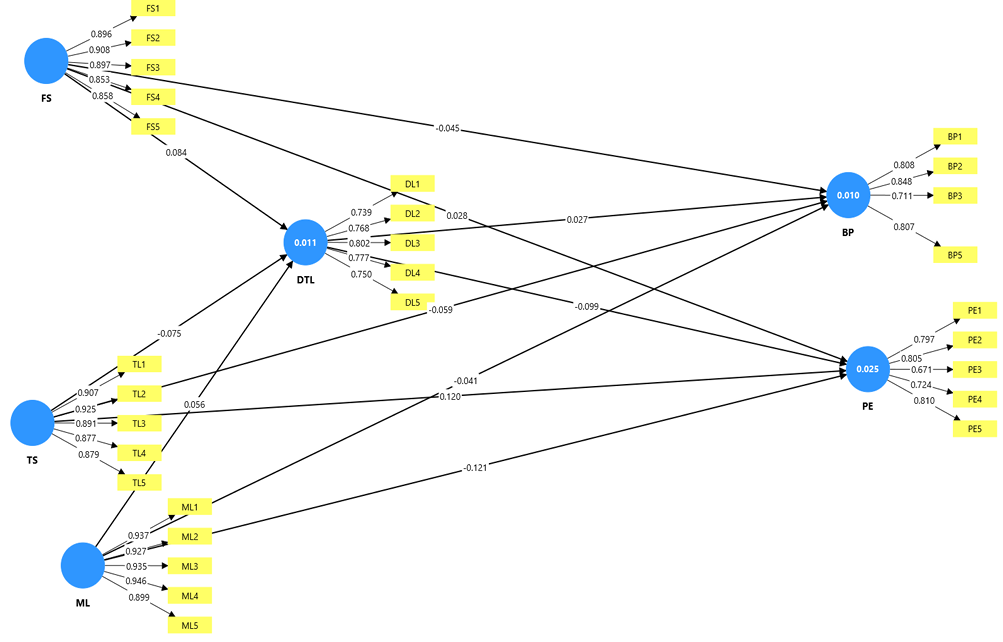
This study examines the persistent disconnect between MSME support interventions and entrepreneurial outcomes among women in Nigeria, where increased access to finance, training, and market linkages has not translated into improved firm performance. Drawing on capability-based and contingency perspectives, the study investigates whether digital literacy mediates the relationship between MSME support mechanisms and women’s entrepreneurial development. Using survey data from 600 women-owned MSMEs and Partial Least Squares Structural Equation Modelling (PLS-SEM), the findings reveal that MSME support mechanisms have no significant effect on business performance (β = −0.020, p = 0.748) and do not significantly influence digital literacy (β = −0.070, p = 0.492). Additionally, digital literacy does not significantly affect business performance (β = 0.024, p = 0.571) and does not mediate the relationship between MSME support and entrepreneurial outcomes. However, digital literacy exerts a significant negative effect on personal empowerment (β = −0.096, p = 0.004), while MSME support shows no significant influence on empowerment outcomes. The study concludes that MSME support mechanisms and digital literacy are insufficient to drive entrepreneurial outcomes in structurally constrained environments such as Nigeria and comparable developing economies. It highlights the need for integrated, ecosystem-based interventions that align entrepreneurial capabilities with enabling institutional and infrastructural conditions.
References
1) Acs, Z. J., Estrin, S., Mickiewicz, T., & Szerb, L. (2018). Entrepreneurship, institutional economics, and economic growth: An ecosystem perspective. Small Business Economics, 51(2), 501–514. https://doi.org/10.1007/s11187-018-0013-9
2) Acs, Z. J., Stam, E., Audretsch, D. B., & O’Connor, A. (2017). The lineages of the entrepreneurial ecosystem approach. Small Business Economics, 49(1), 1–10. https://doi.org/10.1007/s11187-017-9864-8
3) Aker, J. C., & Mbiti, I. M. (2010). Mobile phones and economic development in Africa. Journal of Economic Perspectives, 24(3), 207–232. https://doi.org/10.1257/jep.24.3.207
4) Aldrich, H. E., & Zimmer, C. (1986). Entrepreneurship through social networks. In D. L. Sexton & R. W. Smilor (Eds.), The art and science of entrepreneurship (pp. 3–23). Ballinger. https://doi.org/10.2139/ssrn.1497761
5) Amine, L. S., & Staub, K. M. (2009). Women entrepreneurs in sub-Saharan Africa: An institutional theory analysis. Entrepreneurship & Regional Development, 21(2), 183–211. https://doi.org/10.1080/08985620802182156
6) Aremu, M. A., & Adeyemi, S. L. (2011). Small and medium scale enterprises as a survival strategy for employment generation in Nigeria. Journal of Sustainable Development, 4(1), 200–206. https://doi.org/10.5539/jsd.v4n1p200
7) Aterido, R., Hallward-Driemeier, M., & Pagés, C. (2013). Big constraints to small firms’ growth? Economic Development and Cultural Change, 61(3), 609–647. https://doi.org/10.1086/669170
8) Audretsch, D. B., & Belitski, M. (2021). Knowledge complexity and firm performance. Journal of Business Research, 123, 40–50. https://doi.org/10.1016/j.jbusres.2020.09.047
9) Autio, E., Nambisan, S., Thomas, L. D. W., & Wright, M. (2018). Digital affordances and entrepreneurial ecosystems. Strategic Entrepreneurship Journal, 12(1), 72–95. https://doi.org/10.1002/sej.1266
10) Autio, E., Nambisan, S., Thomas, L. D. W., & Wright, M. (2018). Digital affordances, spatial affordances, and the genesis of entrepreneurial ecosystems. Strategic Entrepreneurship Journal, 12(1), 72–95. https://doi.org/10.1002/sej.1266
11) Barney, J. (1991). Firm resources and sustained competitive advantage. Journal of Management, 17(1), 99–120.
https://doi.org/10.1177/014920639101700108
12) Barney, J. (1991). Firm resources and sustained competitive advantage. Journal of Management, 17(1), 99–120.
https://doi.org/10.1177/014920639101700108
13) Beck, T., & Cull, R. (2014). SME finance in Africa. Journal of African Economies, 23(5), 583–613. https://doi.org/10.1093/jae/eju016
14) Beck, T., & Cull, R. (2014). SME finance in Africa. Journal of African Economies, 23(5), 583–613. https://doi.org/10.1093/jae/eju016
15) Beck, T., & Demirgüç-Kunt, A. (2006). SMEs: Access to finance as a growth constraint. Journal of Banking & Finance, 30(11), 2931–2943. https://doi.org/10.1016/j.jbankfin.2006.05.014
16) Beck, T., Demirgüç-Kunt, A., & Maksimovic, V. (2005). Financial and legal constraints to firm growth. Journal of Finance, 60(1), 137–177. https://doi.org/10.1111/j.1540-6261.2005.00727.x
17) Becker, G. S. (1964). Human capital: A theoretical and empirical analysis. University of Chicago Press.
18) Bouwman, H., Nikou, S., Molina-Castillo, F. J., & de Reuver, M. (2019). The impact of digitalization on business models. Technological Forecasting and Social Change, 149, 119747. https://doi.org/10.1016/j.techfore.2019.119747
19) Duflo, E. (2012). Women empowerment and economic development. Journal of Economic Literature, 50(4), 1051–1079.
https://doi.org/10.1257/jel.50.4.1051
20) Duflo, E. (2012). Women empowerment and economic development. Journal of Economic Literature, 50(4), 1051–1079.
https://doi.org/10.1257/jel.50.4.1051
21) Fairlie, R. W., & Robb, A. M. (2009). Gender differences in business performance. Small Business Economics, 33(4), 375–395.
https://doi.org/10.1007/s11187-009-9207-5
22) Fowowe, B. (2017). Access to finance and firm performance. Review of Development Finance, 7(1), 6–17.
https://doi.org/10.1016/j.rdf.2017.01.001
23) Fowowe, B. (2017). Access to finance and firm performance. Review of Development Finance, 7(1), 6–17.
https://doi.org/10.1016/j.rdf.2017.01.001
24) Goldstein, M., Gonzalez Martinez, P., & Papineni, S. (2019). Gender and firm performance differences. World Bank Research Observer, 34(2), 229–266. https://doi.org/10.1093/wbro/lky014
25) Hinson, R. E., Boateng, H., Renner, A., & Kosiba, J. P. (2019). SME digitization outcomes. Technological Forecasting and Social Change, 146, 761–770. https://doi.org/10.1016/j.techfore.2018.12.005
26) Kabeer, N. (1999). Resources, agency, achievements. Development and Change, 30(3), 435–464.https://doi.org/10.1111/1467-7660.00125
27) Kabeer, N. (1999). Resources, agency, and achievements. Development and Change, 30(3), 435–464. https://doi.org/10.1111/1467-7660.00125
28) Klapper, L. F., & Parker, S. C. (2011). Gender and firm creation. World Bank Research Observer, 26(2), 237–257.
https://doi.org/10.1093/wbro/lkp032
29) Kraus, S., Palmer, C., Kailer, N., Kallinger, F. L., & Spitzer, J. (2021). Digital entrepreneurship. International Journal of Entrepreneurial Behavior & Research, 27(2), 353–375. https://doi.org/10.1108/IJEBR-06-2019-0425
30) McKenzie, D., & Woodruff, C. (2014). Business training and entrepreneurship. World Bank Research Observer, 29(1), 48–82.
https://doi.org/10.1093/wbro/lkt007
31) Nambisan, S. (2017). Digital entrepreneurship. Entrepreneurship Theory and Practice, 41(6), 1029–1055.
https://doi.org/10.1111/etap.12254
32) Nambisan, S., Wright, M., & Feldman, M. (2019). Digital transformation of entrepreneurship. Research Policy, 48(8), 103773.
https://doi.org/10.1016/j.respol.2019.03.018
33) Nambisan, S., Wright, M., & Feldman, M. (2019). The digital transformation of innovation and entrepreneurship. Research Policy, 48(8), 103773. https://doi.org/10.1016/j.respol.2019.03.018
34) Ngoasong, M. Z. (2015). SME learning capabilities. International Journal of Entrepreneurial Behavior & Research, 21(4), 554–573.
https://doi.org/10.1108/IJEBR-01-2014-0003
35) Omiunu, O. G. (2019). E-literacy and women-owned SMEs in Nigeria. Journal of Global Entrepreneurship Research, 9(1).
https://doi.org/10.1186/s40497-019-0149-3
36) Priem, R. L., & Butler, J. E. (2001). Is the resource-based “view” a useful perspective? Academy of Management Review, 26(1), 22–40.
https://doi.org/10.5465/amr.2001.4011928
37) Sajuyigbe, A. S., Obi, N. J., Oladapo, J. T., Adegun, E. A., Adedoyin, A. R., & Dunsin, A. T. (2025). Digital literacy and financial inclusion among SMEs in Nigeria. Southeast Asian Business Review, 3(1), 34–52. https://doi.org/10.20473/sabr.v3i1.67731
38) Schultz, T. W. (1961). Investment in human capital. American Economic Review, 51(1), 1–17.
39) Sussan, F., & Acs, Z. J. (2017). Digital entrepreneurial ecosystem. Small Business Economics, 49(1), 55–73.https://doi.org/10.1007/s11187-017-9867-5
40) Teece, D. J. (2018). Business models and dynamic capabilities. Long Range Planning, 51(1), 40–49.https://doi.org/10.1016/j.lrp.2017.06.007
41) Teece, D. J. (2018). Business models and dynamic capabilities. Long Range Planning, 51(1), 40–49.https://doi.org/10.1016/j.lrp.2017.06.007
42) Teece, D. J., Pisano, G., & Shuen, A. (1997). Dynamic capabilities and strategic management. Strategic Management Journal, 18(7), 509–533. https://doi.org/10.1002/(SICI)1097-0266(199708)18:7<509::AID-SMJ882>3.0.CO;2-Z
43) Teece, D. J., Pisano, G., & Shuen, A. (1997). Dynamic capabilities and strategic management. Strategic Management Journal, 18(7), 509–533. https://doi.org/10.1002/(SICI)1097-0266(199708)18:7<509::AID-SMJ882>3.0.CO;2-Z
44) van Deursen, A. J. A. M., & van Dijk, J. A. G. M. (2014). Digital divide and usage differences. New Media & Society, 16(3), 507–526. https://doi.org/10.1177/1461444813487959
45) Welter, F. (2011). Contextualizing entrepreneurship. Entrepreneurship Theory and Practice,35(1),165–184.
https://doi.org/10.1111/j.1540-6520.2010.00427.x
46) Welter, F. (2011). Contextualizing entrepreneurship. Entrepreneurship Theory and Practice, 35(1), 165–184.
Downloads
Published
Issue
Section
License
Copyright (c) 2026 Akeem AKINKUOLIE, Dotun Olaleye FALOYE (Author)

This work is licensed under a Creative Commons Attribution 4.0 International License.