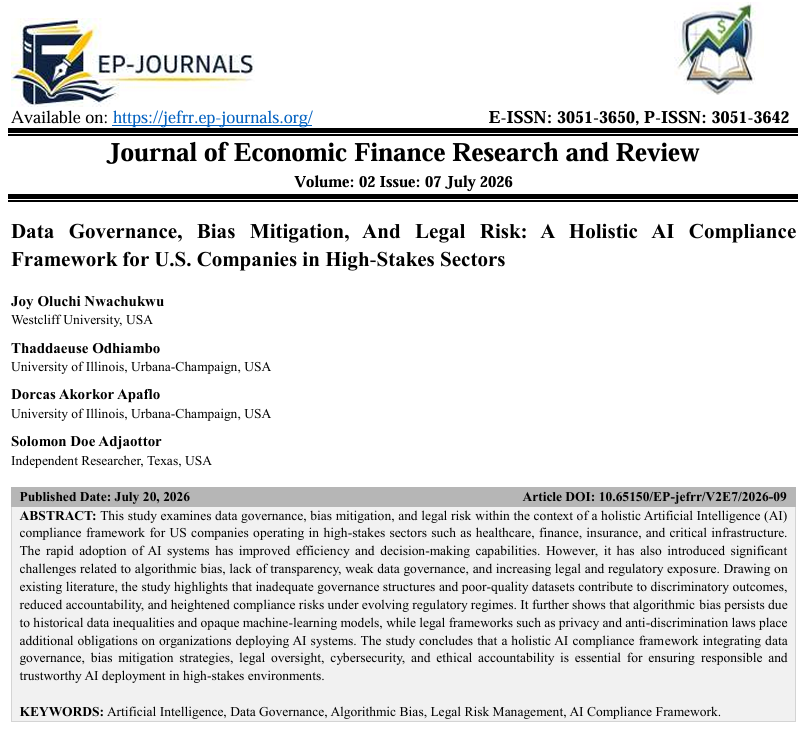
Data Governance, Bias Mitigation, And Legal Risk: A Holistic AI Compliance Framework for U.S. Companies in High Stakes Sectors
DOI:
https://doi.org/10.65150/EP-jefrr/V2E7/2026-09Keywords:
Artificial Intelligence, Data Governance, Algorithmic Bias, Legal Risk Management, AI Compliance Framework.Abstract
This study examines data governance, bias mitigation, and legal risk within the context of a holistic Artificial Intelligence (AI) compliance framework for US companies operating in high-stakes sectors such as healthcare, finance, insurance, and critical infrastructure. The rapid adoption of AI systems has improved efficiency and decision-making capabilities. However, it has also introduced significant challenges related to algorithmic bias, lack of transparency, weak data governance, and increasing legal and regulatory exposure. Drawing on existing literature, the study highlights that inadequate governance structures and poor-quality datasets contribute to discriminatory outcomes, reduced accountability, and heightened compliance risks under evolving regulatory regimes. It further shows that algorithmic bias persists due to historical data inequalities and opaque machine-learning models, while legal frameworks such as privacy and anti-discrimination laws place additional obligations on organizations deploying AI systems. The study concludes that a holistic AI compliance framework integrating data governance, bias mitigation strategies, legal oversight, cybersecurity, and ethical accountability is essential for ensuring responsible and trustworthy AI deployment in high-stakes environments.
References
1) Adekunle, B. I., Chukwuma-Eke, E. C., Balogun, E. D., & Ogunsola, K. O. (2023). Integrating AI-driven risk assessment frameworks in financial operations: A model for enhanced corporate governance. International Journal of Scientific Research in Computer Science, Engineering and Information Technology, 9(6), 445-464.
2) Adelusi, B. S., Uzoka, A. C., Hassan, Y. G., & Ojika, F. U. (2023). Reviewing Data Governance Strategies for Privacy and Compliance in AI-Powered Business Analytics Ecosystems. Journal Not Specified.
3) Agboola, O. K. (2025). Auditing bias in AI and machine learning-based credit algorithms: A data science perspective on fairness and ethics in FinTech. International Journal of Technology, Management and Humanities, 11(02), 1-11.
4) Akinsola, K. (2025). Legal compliance in corporate governance frameworks: best practices for ensuring transparency, accountability, and risk mitigation. Accountability, and Risk Mitigation (January 31, 2025).
5) Alkan, E., & Ibazizene, K. (2025). Study of FATES Properties in the MLOps field (Doctoral dissertation, IRIT: Institut de Recherche Informatique de Toulouse; UT2J: Université Toulouse 2 Jean Jaurès).
6) Brakye, K., & Yeboah, M. M. (2026). Technology-driven risk governance in U.S. financial reporting: The role of cybersecurity disclosure and regulatory technology in strengthening capital market transparency. Sarcouncil Journal of Engineering and Computer Sciences, 5(4). https://doi.org/10.5281/zenodo.19654718.
7) Brkan, M., & Bonnet, G. (2020). Legal and technical feasibility of the GDPR’s quest for explanation of algorithmic decisions: of black boxes, white boxes and fata morganas. European Journal of Risk Regulation, 11(1), 18-50.
8) Cramer, H., Garcia-Gathright, J., Springer, A., & Reddy, S. (2018). Assessing and addressing algorithmic bias in practice. Interactions, 25(6), 58-63.
9) Finch, W. W., & Butt, M. (2025). Gaps in AI-Compliant Complementary Governance Frameworks’ Suitability (for Low-Capacity Actors), and Structural Asymmetries (in the Compliance Ecosystem)—A Systematic Review. Journal of Cybersecurity and Privacy, 5(4), 101.
10) Hamon, R., Junklewitz, H., Sanchez, I., Malgieri, G., & De Hert, P. (2022). Bridging the gap between AI and explainability in the GDPR: towards trustworthiness-by-design in automated decision-making. IEEE Computational Intelligence Magazine, 17(1), 72-85.
11) Herzog, L. (2021). Algorithmic bias and access to opportunities (pp. 413-432). Oxford: Oxford Academic.
12) Ibrahim, A., Thiruvady, D., Schneider, J. G., & Abdelrazek, M. (2020). The challenges of leveraging threat intelligence to stop data breaches. Frontiers in Computer Science, 2, 36.
13) Ijaiya, H., & Odumuwagun, O. O. (2024). Advancing artificial intelligence and safeguarding data privacy: a comparative study of EU and US regulatory frameworks amid emerging cyber threats. International Journal of Research Publication and Reviews, 5(12), 3357-3375.
14) Ilcic, A., Fuentes, M., & Lawler, D. (2025). Artificial intelligence, complexity, and systemic resilience in global governance. Frontiers in Artificial Intelligence, 8, 1562095.
15) Jahan, I., & Nashid, S. (2025). Strategic Digital Transformation: Reviewing AI-Driven Frameworks for Risk Management, Regulatory Compliance, and Sustainability. Pacific Journal of Business Innovation and Strategy, 2(4), 210-220.
16) Khan, F. (2025). DATA JUSTICE AND ALGORITHMIC BIAS: UNDERSTANDING THE SOCIAL, ETHICAL, AND LEGAL IMPLICATIONS OF ALGORITHMIC DECISION-MAKING AND ITS IMPACT ON MARGINALIZED COMMUNITIES. Frontiers in Multidisciplinary Studies, 2(01), 54-65.
17) Krause, D. (2024). Addressing the challenges of auditing and testing for AI Bias: a comparative analysis of regulatory frameworks. Available at SSRN 5050631.
18) Leon, M. (2026). Lifecycle‐Based Governance to Build Reliable Ethical AI Systems. Systems Research and Behavioral Science.
19) Lev-Aretz, Y., & Nielsen, A. (2024). Privacy as a Matter of Public Health. Colum. Sci. & Tech. L. Rev., 26, 107.
20) Lewis, J. (2024). AI and bias: Addressing discrimination in machine learning algorithms abstract. AlgoVista: Journal of AI and Computer Science, 1(1), 592647.
21) Mapungwana, P. (2025). Addressing the Ethical and Data Privacy Concerns Related to AI in Occupational Health and Safety: Ethical Issues in OHS. In Cases on AI Innovations in Occupational Health and Safety (pp. 1-22). IGI Global Scientific Publishing.
22) Mensah, G. B. (2023). Artificial intelligence and ethics: a comprehensive review of bias mitigation, transparency, and accountability in AI Systems. Preprint, November, 10(1), 1.
23) Minkkinen, M., & Mäntymäki, M. (2023). Discerning between the “easy” and “hard” problems of AI governance. IEEE Transactions on Technology and Society, 4(2), 188-194.
24) Mohammed, S. S. (2025). Navigating Algorithmic Accountability and Ethical Governance in Autonomous Data Analytics Systems: Toward Transparent, Bias-Resistant, and Human-Centric AI Frameworks for Critical Decision-Making. Bias-Resistant, and Human-Centric AI Frameworks for Critical Decision-Making.
25) Mukherjee, B. N. (2025). Navigating AI Governance: National and International Legal and Regulatory Frameworks. In Navigating the Intersection of AI Policy, Technology, and Governance (pp. 201-224). IGI Global Scientific Publishing.
26) Nartey, O. L., Aryeetey, S., Apaflo, D. A., & Yeboah, M. M. (2026). AI and blockchain in financial auditing: A systematic review of fraud detection techniques and their impact on investor confidence in U.S. market. EPRA International Journal of Research and Development (IJRD), 11(3). https://doi.org/10.36713/epra2016
27) Nwinyi, I. P., Amoakoh, C. K., Twum, P. G., & Yeboah, M. M. (2026). Small business financial compliance analytics: Reducing regulatory burden while maintaining oversight through data-driven solutions. International Journal for Multidisciplinary Research, 8(1).
28) Oberhauser, H. J. (2025). Bias in Artificial Intelligence: Exploring its role in institutional discrimination and strategies for mitigation (Master's thesis, Universidade NOVA de Lisboa (Portugal)).
29) Okon, R., Zouo, S. J. C., & Sobowale, A. (2024). Operational oversight in high-stakes turnarounds: Key insights for c-suite leaders.
30) Oko-Odion, C. (2025). Ai-driven risk assessment models for financial markets: Enhancing predictive accuracy and fraud detection. International Journal of Computer Applications Technology and Research, 14(04), 80-96.
31) Oluka, A. (2026). Potential liability risk with artificial intelligence errors in financial reporting. In Driving excellence through AI-powered performance management (pp. 201-228). IGI Global Scientific Publishing.
32) Park, S. (2023). Bridging the global divide in AI regulation: a proposal for a contextual, coherent, and commensurable framework. Wash. Int'l LJ, 33, 216.
33) Qudus, L. (2025). Leveraging artificial intelligence to enhance process control and improve efficiency in manufacturing industries. International Journal of Computer Applications Technology and Research, 14(02), 18-38.
34) Radanliev, P. (2025). AI ethics: Integrating transparency, fairness, and privacy in AI development. Applied Artificial Intelligence, 39(1), 2463722.
35) Rajgopal, P. R., & Yadav, S. D. (2025). The role of data governance in enabling secure AI adoption. International Journal of Sustainability and Innovation in Engineering, 3(1).
36) Savolainen, L., & Ruckenstein, M. (2024). Dimensions of autonomy in human–algorithm relations. New Media & Society, 26(6), 3472-3490.
37) Selbst, A. D., & Barocas, S. (2022). Unfair artificial intelligence: how FTC intervention can overcome the limitations of discrimination law. U. Pa. L. Rev., 171, 1023.
38) Sharma, A. K., & Sharma, R. (2025). Data governance in the age of artificial intelligence: Challenges, best practices and regulatory compliance. Applied Marketing Analytics, 10(4), 390-403.
39) Siddique, S. M., Tipton, K., Leas, B., Jepson, C., Aysola, J., Cohen, J. B., ... & Mull, N. K. (2024). The impact of health care algorithms on racial and ethnic disparities: a systematic review. Annals of Internal Medicine, 177(4), 484-496.
40) Valsala Saratchandran, D. (2025). Addressing Compliance, Bias, and Transparency in AI Systems. In The Impact of Artificial Intelligence on Finance: Transforming Financial Technologies (pp. 299-321). Cham: Springer Nature Switzerland.
41) Westover, J. H. (2026). Artificial Intelligence Risk Management: A Comprehensive Framework for Organizational Implementation.
42) Zhaltyrbayeva, R., Jangabulova, A., Suleimenova, S., Saimova, S., & Tlembayeva, Z. (2025). Legal challenges of regulating artificial intelligence in law enforcement, taking into account the interdisciplinary approach to socio-legal transformations. Social and Legal Studios, 2(8), 118-130.
Downloads
Published
Issue
Section
License
Copyright (c) 2026 Joy Oluchi Nwachukwu , Thaddaeuse Odhiambo , Dorcas Akorkor Apaflo , Solomon Doe Adjaottor (Author)

This work is licensed under a Creative Commons Attribution 4.0 International License.