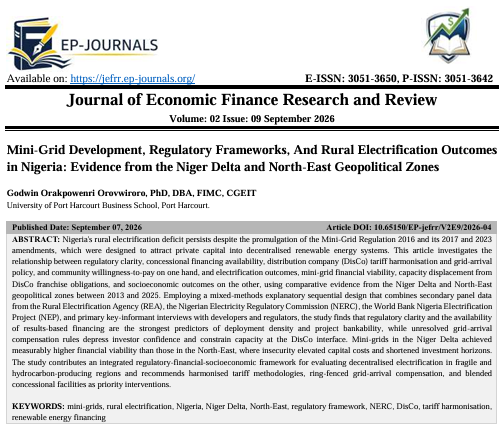
Mini-Grid Development, Regulatory Frameworks, And Rural Electrification Outcomes in Nigeria: Evidence from the Niger Delta and North-East Geopolitical Zones
DOI:
https://doi.org/10.65150/EP-jefrr/V2E9/2026-04Keywords:
mini-grids, rural electrification, Nigeria, Niger Delta, North-East, regulatory framework, NERC, DisCo, tariff harmonisation, renewable energy financingAbstract
Nigeria's rural electrification deficit persists despite the promulgation of the Mini-Grid Regulation 2016 and its 2017 and 2023 amendments, which were designed to attract private capital into decentralised renewable energy systems. This article investigates the relationship between regulatory clarity, concessional financing availability, distribution company (DisCo) tariff harmonisation and grid-arrival policy, and community willingness-to-pay on one hand, and electrification outcomes, mini-grid financial viability, capacity displacement from DisCo franchise obligations, and socioeconomic outcomes on the other, using comparative evidence from the Niger Delta and North-East geopolitical zones between 2013 and 2025. Employing a mixed-methods explanatory sequential design that combines secondary panel data from the Rural Electrification Agency (REA), the Nigerian Electricity Regulatory Commission (NERC), the World Bank Nigeria Electrification Project (NEP), and primary key-informant interviews with developers and regulators, the study finds that regulatory clarity and the availability of results-based financing are the strongest predictors of deployment density and project bankability, while unresolved grid-arrival compensation rules depress investor confidence and constrain capacity at the DisCo interface. Mini-grids in the Niger Delta achieved measurably higher financial viability than those in the North-East, where insecurity elevated capital costs and shortened investment horizons. The study contributes an integrated regulatory-financial-socioeconomic framework for evaluating decentralised electrification in fragile and hydrocarbon-producing regions and recommends harmonised tariff methodologies, ring-fenced grid-arrival compensation, and blended concessional facilities as priority interventions.
References
1) Africa Minigrids Programme. (2023). Nigeria country diagnostic: De-risking mini-grid investment in fragile states. United Nations Development Programme.
2) Ahlborg, H., & Hammar, L. (2014). Drivers and barriers to rural electrification in Tanzania and Mozambique: Grid extension, off-grid, and renewable energy sources. Renewable Energy, 61, 117–124.
3) Akinbami, O. M., Oke, S. R., & Bodunrin, M. O. (2021). The state of renewable energy development in Nigeria: Policy and technical issues. AIMS Energy, 9(6), 1185–1214.
4) Akpan, U. S., Isihak, S. R., & Udoakah, Y. N. (2013). Electricity access in Nigeria: Viability of off-grid photovoltaic system. Niger Delta University Press.
5) Blimpo, M. P., & Cosgrove-Davies, M. (2019). Electricity access in sub-Saharan Africa: Uptake, reliability, and complementary factors for economic impact. World Bank.
6) Federal Republic of Nigeria. (2023). Electricity Act, 2023. Federal Ministry of Justice.
7) GIZ. (2021). Nigeria Energy Support Programme: Mini-grids in conflict-affected North-East Nigeria. Deutsche Gesellschaft für Internationale Zusammenarbeit.
8) International Energy Agency. (2023). Africa Energy Outlook 2023. IEA Publications.
9) National Bureau of Statistics. (2023). Nigeria multidimensional poverty index and energy access survey. NBS.
10) Nigerian Electricity Regulatory Commission. (2016). Mini-Grid Regulation, 2016. NERC.
11) Nigerian Electricity Regulatory Commission. (2023). Mini-Grid Regulation (Amendment), 2023. NERC.
12) North, D. C. (1990). Institutions, institutional change and economic performance. Cambridge University Press.
13) Ohiare, S. (2015). Expanding electricity access to all in Nigeria: A spatial planning and cost analysis. Energy, Sustainability and Society, 5(8), 1–18.
14) Orovwiroro, G. O. (2024). Corporate governance, liquidity, and recapitalisation in Nigeria's electricity distribution sector. Winman Research Series.
15) Oseni, M. O. (2012). Improving households' access to electricity and energy consumption pattern in Nigeria: Renewable energy alternative. Renewable and Sustainable Energy Reviews, 16(6), 3967–3974.
16) Oyedepo, S. O. (2014). Towards achieving energy for sustainable development in Nigeria. Renewable and Sustainable Energy Reviews, 34, 255–272.
17) Oyewo, B., & Akintola, F. (2024). State electricity regulatory commissions and the post-devolution mini-grid landscape in Nigeria. Journal of African Energy Policy, 12(1), 44–63.
18) Rural Electrification Agency. (2022). Nigeria mini grid status report 2022. REA.
19) Rural Electrification Agency. (2024). Nigeria mini grid status report 2024. REA.
20) Tenenbaum, B., Greacen, C., Siyambalapitiya, T., & Knuckles, J. (2014). From the bottom up: How small power producers and mini-grids can deliver electrification and renewable energy in Africa. World Bank.
21) UNDP. (2013). De-risking renewable energy investment: A framework to support policymakers. United Nations Development Programme.
22) UNDP. (2022). Africa Minigrids Programme annual progress report. United Nations Development Programme.
23) UNHCR. (2022). Energy access in displacement settings: North-East Nigeria. United Nations High Commissioner for Refugees.
24) Ugwoke, B., Adeyemi, O., & Bello, S. (2020). Mini-grid regulation and the grid-arrival dilemma in Nigeria: A policy review. Energy Policy Research Group Working Paper Series.
25) Waissbein, O., Glemarec, Y., Bayraktar, H., & Schmidt, T. S. (2013). Derisking renewable energy investment. United Nations Development Programme.
26) World Bank. (2021). Nigeria Electrification Project: Implementation status and results report. World Bank.
27) World Bank. (2022). Nigeria power sector recovery performance assessment. World Bank.
28) World Bank. (2023). Tracking SDG 7: The energy progress report. World Bank.
Downloads
Published
Issue
Section
License
Copyright (c) 2026 Godwin Orakpowenri Orovwiroro, PhD, DBA, FIMC, CGEIT (Author)

This work is licensed under a Creative Commons Attribution 4.0 International License.