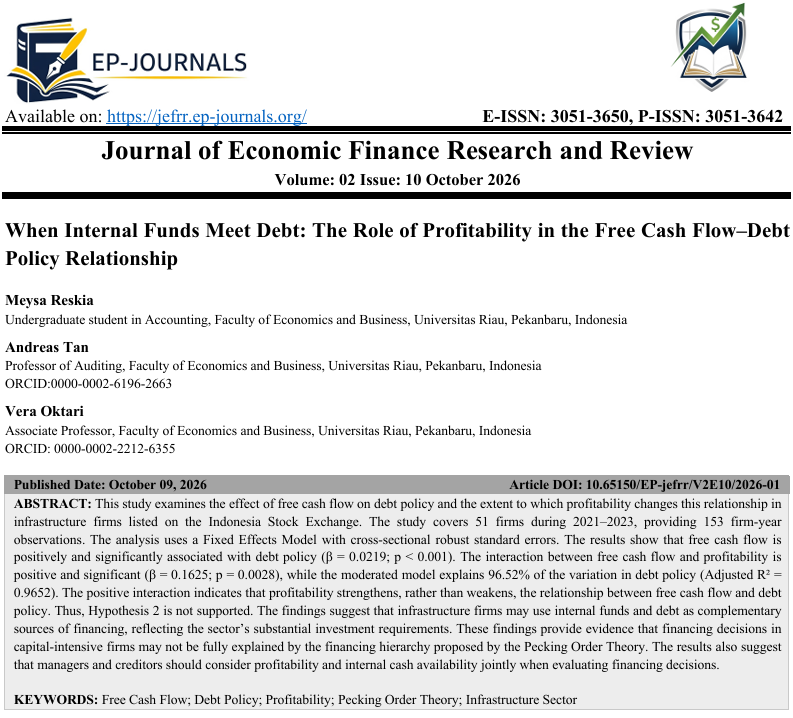
When Internal Funds Meet Debt: The Role of Profitability in the Free Cash Flow–Debt Policy Relationship
DOI:
https://doi.org/10.65150/EP-jefrr/V2E10/2026-01Keywords:
Free Cash Flow, Debt Policy, Profitability, Pecking Order Theory, Infrastructure SectorAbstract
This study examines the effect of free cash flow on debt policy and the extent to which profitability changes this relationship in infrastructure firms listed on the Indonesia Stock Exchange. The study covers 51 firms during 2021–2023, providing 153 firm-year observations. The analysis uses a Fixed Effects Model with cross-sectional robust standard errors. The results show that free cash flow is positively and significantly associated with debt policy (β = 0.0219; p < 0.001). The interaction between free cash flow and profitability is positive and significant (β = 0.1625; p = 0.0028), while the moderated model explains 96.52% of the variation in debt policy (Adjusted R² = 0.9652). The positive interaction indicates that profitability strengthens, rather than weakens, the relationship between free cash flow and debt policy. Thus, Hypothesis 2 is not supported. The findings suggest that infrastructure firms may use internal funds and debt as complementary sources of financing, reflecting the sector’s substantial investment requirements. These findings provide evidence that financing decisions in capital-intensive firms may not be fully explained by the financing hierarchy proposed by the Pecking Order Theory. The results also suggest that managers and creditors should consider profitability and internal cash availability jointly when evaluating financing decisions.
References
1) Acaravci, S. K. (2015). The determinants of capital structure: Evidence from the Turkish manufacturing sector. International Journal of Economics and Financial Issues, 5(1), 158–171.
2) Aivazian, V. A., Ge, Y., & Qiu, J. (2005). The impact of leverage on firm investment: Canadian evidence. Journal of Corporate Finance, 11(1–2), 277–291. https://doi.org/10.1016/S0929-1199(03)00062-2
3) Alipour, M., Mohammadi, M. F. S., & Derakhshan, H. (2015). Determinants of capital structure: An empirical study of firms in Iran. International Journal of Law and Management, 57(1), 53–83. https://doi.org/10.1108/IJLMA-01-2013-0004
4) Dang, V. A., Kim, M., & Shin, Y. (2012). Asymmetric capital structure adjustments: New evidence from dynamic panel threshold models. Journal of Empirical Finance, 19(4), 465–482. https://doi.org/10.1016/j.jempfin.2012.04.004
5) Danis, A., Rettl, D. A., & Whited, T. M. (2014). Refinancing, profitability, and capital structure. Journal of Financial Economics, 114(3), 424–443. https://doi.org/10.1016/j.jfineco. 2014.07 .010
6) De Jong, A., Kabir, R., & Nguyen, T. T. (2008). Capital structure around the world: The roles of firm- and country-specific determinants. Journal of Banking & Finance, 32(9), 1954–1969. https://doi.org/10.1016/j.jbankfin.2007.12.034
7) Ermalini, A., & Badera, I. D. N. (2025). Free cash flow, leverage, and firm value: The moderating role of managerial ownership. Dinasti International Journal of Economics, Finance & Accounting, 6(3), 2434–2445. https://doi.org/10.38035/dijefa.v6i3.4795
8) Frank, M. Z., & Goyal, V. K. (2003). Testing the pecking order theory of capital structure. Journal of Financial Economics, 67(2), 217–248. https://doi.org/10.1016/S0304-405X(02)00252-0
9) Frank, M. Z., & Goyal, V. K. (2009). Capital structure decisions: Which factors are reliably important? Financial Management, 38(1), 1–37. https://doi.org/10.1111/j.1755-053X.2009.01026.x
10) Hamouda, R. Z. B., Hamzaoui, N., & Jilani, F. (2023). Capital structure determinants: New evidence from MENA region countries. International Journal of Economics and Financial Issues, 13(1), 144–163. https://doi.org/10.32479/ijefi.13695
11) Huang, R., & Ritter, J. R. (2009). Testing theories of capital structure and estimating the speed of adjustment. Journal of Financial and Quantitative Analysis, 44(2), 237–271. https://doi.org/10.1017/S0022109009090152
12) Jaiswal, S., & Elmarzouky, M. (2025). Capital structure and firm performance: Evidence from FTSE All-Share firms during COVID-19. Journal of Risk and Financial Management, 18(11), 648. https://doi.org/10.3390/jrfm18110648
13) Jensen, M. C. (1986). Agency costs of free cash flow, corporate finance, and takeovers. American Economic Review, 76(2), 323–329.
14) Lang, L., Ofek, E., & Stulz, R. M. (1996). Leverage, investment, and firm growth. Journal of Financial Economics, 40(1), 3–29. https://doi.org/10.1016/0304-405X(95)00842-3
15) Lemma, T. T., & Negash, M. (2011). Institutional, macroeconomic and firm-specific determinants of capital structure: The African evidence. Management Research Review, 36(11), 1081–1122. https://doi:10.1108/MRR-09-2012-0201
16) Myers, S. C., & Majluf, N. S. (1984). Corporate financing and investment decisions when firms have information that investors do not have. Journal of Financial Economics, 13(2), 187–221. https://doi.org/10.1016/0304-405X(84)90023-0
17) Nguyen, T. H., Nguyen, H. T., & Nguyen, D. T. (2017). Determinants of capital structure in emerging markets: Evidence from Vietnam. Research in International Business and Finance, 40, 105–113. https://doi.org/10.1016/j.ribaf.2016.12.001
18) Rajan, R. G., & Zingales, L. (1995). What do we know about capital structure? Some evidence from international data. Journal of Finance, 50(5), 1421–1460. https://doi.org/10.1111/ j.1540-6261.1995.tb05184.x
19) Shyam-Sunder, L., & Myers, S. C. (1999). Testing static tradeoff against pecking order models of capital structure. Journal of Financial Economics, 51(2), 219–244. https://doi.org/ 10.1016/S0304-405X(98)00051-8
20) Stulz, R. M. (1990). Managerial discretion and optimal financing policies. Journal of Financial Economics, 26(1), 3–27. https://doi.org/10.1016/0304-405X(90)90011-N
21) Vo, X. V., & Ellis, C. (2017). An empirical investigation of capital structure and firm value in Vietnam. Finance Research Letters, 22, 90–94. https://doi.org/10.1016/j.frl.2016.10.014
Downloads
Published
Issue
Section
License
Copyright (c) 2026 Meysa Reskia, Andreas Tan, Vera Oktari (Author)

This work is licensed under a Creative Commons Attribution 4.0 International License.