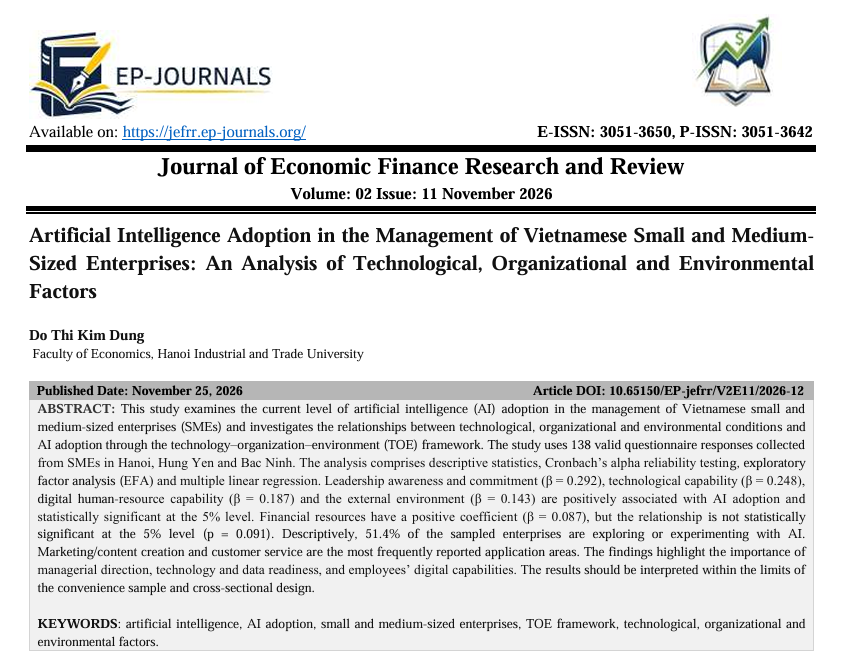
Artificial Intelligence Adoption in the Management of Vietnamese Small and Medium-Sized Enterprises: An Analysis of Technological, Organizational and Environmental Factors
DOI:
https://doi.org/10.65150/EP-jefrr/V2E11/2026-12Keywords:
artificial intelligence, AI adoption, small and medium-sized enterprises, TOE framework, technological, organizational and environmental factors.Abstract
This study examines the current level of artificial intelligence (AI) adoption in the management of Vietnamese small and medium-sized enterprises (SMEs) and investigates the relationships between technological, organizational and environmental conditions and AI adoption through the technology–organization–environment (TOE) framework. The study uses 138 valid questionnaire responses collected from SMEs in Hanoi, Hung Yen and Bac Ninh. The analysis comprises descriptive statistics, Cronbach’s alpha reliability testing, exploratory factor analysis (EFA) and multiple linear regression. Leadership awareness and commitment (β = 0.292), technological capability (β = 0.248), digital human-resource capability (β = 0.187) and the external environment (β = 0.143) are positively associated with AI adoption and statistically significant at the 5% level. Financial resources have a positive coefficient (β = 0.087), but the relationship is not statistically significant at the 5% level (p = 0.091). Descriptively, 51.4% of the sampled enterprises are exploring or experimenting with AI. Marketing/content creation and customer service are the most frequently reported application areas. The findings highlight the importance of managerial direction, technology and data readiness, and employees’ digital capabilities. The results should be interpreted within the limits of the convenience sample and cross-sectional design.
References
1) Russell, S., & Norvig, P. (2021). Artificial intelligence: A modern approach (4th ed.). Pearson.
2) Kaplan, A., & Haenlein, M. (2019). Siri, Siri, in my hand: Who’s the fairest in the land? On the interpretations, illustrations, and implications of artificial intelligence. Business Horizons, 62(1), 15–25. https://doi.org/10.1016/j.bushor.2018.08.004
3) Tornatzky, L. G., & Fleischer, M. (1990). The processes of technological innovation. Lexington Books.
4) Davis, F. D. (1989). Perceived usefulness, perceived ease of use, and user acceptance of information technology. MIS Quarterly, 13(3), 319–340. https://doi.org/10.2307/249008
5) Vial, G. (2019). Understanding digital transformation: A review and a research agenda. The Journal of Strategic Information Systems, 28(2), 118–144. https://doi.org/10.1016/j.jsis.2019.01.003
6) Hoang, H. (2024). Navigating the digital landscape: An exploration of the relationship between technology-organization-environment factors and digital transformation adoption in SMEs. SAGE Open, 14(4). https://doi.org/10.1177/21582440241276198
7) Nguyen Van Phuoc. (2022). The critical factors impacting artificial intelligence applications adoption in Vietnam: A structural equation modeling analysis. Economies, 10(6), 129. https://doi.org/10.3390/economies10060129
8) Tran Duc Tung. (2026). Impact of technological, organizational, and environmental factors on AI adoption level: An empirical study of small and medium-sized enterprises in Ho Chi Minh City. Tạp chí Công Thương – Các kết quả nghiên cứu khoa học và ứng dụng công nghệ, (16), 1–6. https://doi.org/10.62831/nckh.2026.408.v1
9) Davenport, T. H., & Ronanki, R. (2018). Artificial intelligence for the real world. Harvard Business Review, 96(1), 108–116.
https://hbr.org/2018/01/artificial-intelligence-for-the-real-world
10) Jöhnk, J., Weißert, M., & Wyrtki, K. (2021). Ready or not, AI comes: An interview study of organizational AI readiness factors. Business & Information Systems Engineering, 63, 5–20. https://doi.org/10.1007/s12599-020-00676-7
11) Badghish, S., & Soomro, Y. A. (2024). Artificial intelligence adoption by SMEs to achieve sustainable business performance: Application of technology–organization–environment framework. Sustainability, 16(5), 1864. https://doi.org/10.3390/su16051864
12) Fernandez de Arroyabe, J. C. F. A., Fernandez de Arroyabe, I., & Fernandez de Arroyabe, J. C. (2024). Analyzing AI adoption in European SMEs: A study of digital capabilities, innovation, and external environment. Technology in Society, 79, 102733.
https://doi.org/10.1016/j.techsoc.2024.102733
13) Ul Haq, F., & Suki, N. M. (2025). AI-driven innovation in emerging markets: Extending the technology acceptance model-technology-organization-environment framework in small- and medium-sized enterprises. Data Science and Management, 8(4), 485–499.
Downloads
Published
Issue
Section
License
Copyright (c) 2026 Do Thi Kim Dung (Author)

This work is licensed under a Creative Commons Attribution 4.0 International License.